Travel Guide · Festivals & Events · Updated November 2026
Magh Mela 2027 in Prayagraj: Dates, Snan Days, Kalpavas and Travel Guide
By Gurudutt, Experience My India·16 November 2026
Quick Answer
Quick Enquiry
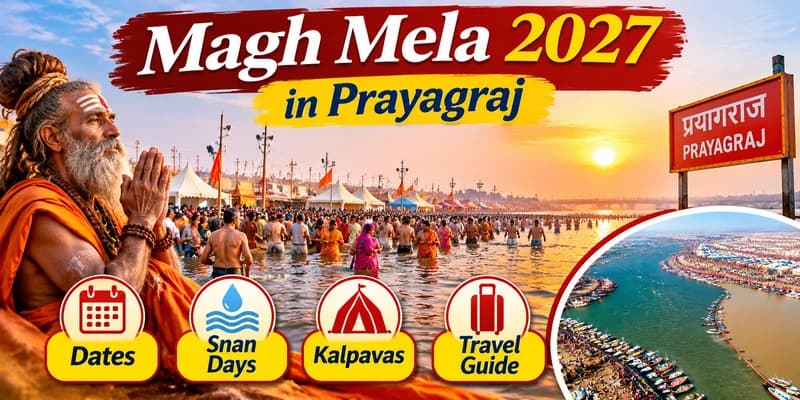
The Magh Mela is one of the great annual pilgrimages of our land, every winter, lakhs of devotees gather on the sands of the Triveni Sangam in Prayagraj to bathe in the holy confluence and live the simple, ascetic life of Kalpavas. It is quieter than the great Kumbh, but no less sacred and for many devotees it is a yearly vow. If you are planning to go in 2027, two things matter most: pick your snan day (Mauni Amavasya on 6 February is the biggest and most crowded) and pack for real cold and fog, the January and February mornings at the Sangam are bitter. And since the final snan falls on Mahashivratri on 6 March, close to the Braj Holi season, many devotees combine the two. We help pilgrims plan both. Har Har Gange and Radhe Radhe. See our Mathura Vrindavan tour Packages or message WhatsApp +91 7302265809.
What is the Magh Mela?
The Magh Mela is an annual Hindu religious gathering held during the holy month of Magh (January to February) at the Triveni Sangam in Prayagraj, the sacred meeting point of the Ganga, the Yamuna and the mythical, unseen Saraswati river. It is one of the most revered annual pilgrimages in India.
Location: the Triveni Sangam, Prayagraj (formerly Allahabad), Uttar Pradesh.
Duration: approximately 51 days of ritual baths, spiritual gatherings and religious discourses.
The heart of it: taking a holy bath (snan) in the confluence on the auspicious days, believed, by tradition, to cleanse sins and bestow great spiritual merit. These are cherished devotional beliefs.
For devotees, the Magh Mela is a yearly opportunity to bathe at the holiest of confluences, hear discourses from saints, and, for the most devout, to undertake the month-long austerity of Kalpavas. It draws lakhs of pilgrims, sadhus and seekers each winter to the vast tent city that rises on the riverbanks.
Magh Mela 2027 snan (holy bath) dates
The snan dates are the heart of the Magh Mela, the auspicious days on which a dip in the Sangam is considered most sacred. Here are the key snan dates for 2027. Festival tithis follow the Hindu lunar calendar, so treat these as the expected dates per the panchang and reconfirm with official sources close to the time.
Makar Sankranti, Friday 15 January 2027, the first snan, opening the mela.
Paush Purnima, Friday 22 January 2027, the formal start of Kalpavas.
Mauni Amavasya, Saturday 6 February 2027, the largest and most crowded main bathing day, the single most important snan of the mela.
Basant Panchami, Thursday 11 February 2027, an auspicious spring snan.
Maghi Purnima, Saturday 20 February 2027, a major full-moon snan.
Mahashivratri, Saturday 6 March 2027, the final snan and the closing day of the mela.
If you are going for a specific snan, plan around its date and expect the heaviest crowds on Mauni Amavasya (6 February). For a calmer experience, the non-peak days between the main snans are quieter while still deeply sacred. Arrive a day early for the big snan days, as the crowds and traffic are immense.
The Kalpavas tradition
One of the most distinctive features of the Magh Mela is Kalpavas. During the mela, devotees known as Kalpavasis take a vow to live for a full month on the sandy banks of the Sangam, in a vast temporary tent city, practising a life of asceticism, simplicity and devotion.
A Kalpavasi typically lives simply in a tent, eats a restricted sattvic diet (often one meal a day), rises before dawn, takes multiple daily dips in the holy confluence, spends the day in prayer, meditation, scriptural study and listening to discourses and observes discipline and detachment from worldly comforts for the month. Kalpavas traditionally begins around Paush Purnima (22 January in 2027) and continues through the month of Magh. It is considered a profound spiritual discipline, a month set apart from ordinary life for austerity and devotion at the holiest of confluences. These are cherished devotional traditions. Many families return year after year to undertake Kalpavas and the tent city, with its ordered rows of camps, kitchens and discourse pavilions, becomes a temporary spiritual township on the riverbank.
SECTION E · How the Magh Mela differs from the Kumbh Mela
A common question is how the Magh Mela relates to the famous Kumbh Mela and the distinction is simple but important.
Frequency. The Kumbh Mela at Prayagraj is held every 12 years (with the Ardh or half, Kumbh every 6 years and the great Maha Kumbh at a longer cycle). The Magh Mela, by contrast, happens every single year, in the years between the Kumbhs.
Scale. The Kumbh is the larger, more spectacular event, drawing tens of millions. The Magh Mela, while still massive, is more intimate in scale, a yearly, more local tradition rather than the once-in-over-a-decade spectacle of the Kumbh.
Continuity. The Magh Mela is, in a sense, the annual continuation of the same sacred tradition at the same spot. It follows the same core of snan, Kalpavas and discourse, on the same Triveni Sangam sands, every year.
So you can think of the Magh Mela as the annual, more intimate version of the great pilgrimage, a chance to experience the sacred bathing tradition of Prayagraj every year, without waiting for the Kumbh cycle. For many devotees, this annual accessibility is precisely its appeal.
How to reach Prayagraj for the Magh Mela
Prayagraj is well connected by air, rail and road, which makes the Magh Mela accessible from across India.
By air. Prayagraj Airport connects to major Indian cities; Varanasi Airport is about 120 km away and is an alternative.
By rail. Prayagraj Junction and the surrounding railway stations offer extensive connectivity across the country and special trains often run for the mela season. The railways are the most popular way for pilgrims to reach the mela.
By road. State RTC buses, private cabs and well-connected highways link Prayagraj to Lucknow, Varanasi, Kanpur and Delhi.
During the major snan days, expect heavy congestion, route diversions and vehicle restrictions around the mela area, so plan your arrival and departure with plenty of extra time and follow the official traffic and parking guidance. Arriving a day before a big snan is wise.
Where to stay at the Magh Mela
Accommodation for the Magh Mela falls into two main types.
Tented camps in the mela. Private tented camps and cottages are set up across the mela sectors on the riverbank for the winter season, from simple tents to comfortable, well-appointed cottages with heating. Staying in the mela puts you close to the Sangam and in the heart of the atmosphere.
Prayagraj city hotels. The city has a range of hotels, from budget to comfortable, a warmer and more conventional option, from which you travel to the Sangam for your snan.
Whichever you choose, book well in advance, especially for the major snan days (above all Mauni Amavasya on 6 February), when both the camps and the city hotels fill up and prices rise sharply. For the big snan days, the earlier you book, the better your choice and rate.
Weather and what to pack
This is one of the most important practical points: the Magh Mela falls in the depth of the North Indian winter and the Sangam, on open sand by the river, is genuinely cold.
The weather. January and February nights and early mornings in Prayagraj are very cold and prone to dense fog, especially at dawn by the river, which is exactly when the snans happen. Days are cooler and can be hazy.
What to pack: heavy woollens, thermal innerwear, a windproof jacket, warm socks and a cap and gloves, comfortable walking shoes (there is a lot of walking on sand) and modest, warm, traditional clothing. Bring a change of dry, warm clothes for after your snan, as you will be wet and the air is freezing. Add a torch, a power bank, any personal medicines and small cash.
For the snan itself: a quick-dry towel, a mat and warm clothing to change into immediately after the dip are essential, the water and air are bitterly cold at dawn.
Underestimating the cold is the most common mistake visitors make. Pack as you would for a cold-weather trip and the mela is comfortable; pack too light and the pre-dawn snan is a shock.
Nearby attractions in Prayagraj
If you have time around your snan, Prayagraj has several revered and historic sites worth visiting:
Shri Bade Hanuman Ji Mandir, the famous temple of the reclining Hanuman, near the Sangam.
Allahabad Fort and Akshayavat, the historic Mughal-era fort and the sacred immortal banyan tree.
Alop Shankari Devi Shakti Peeth, a revered Shakti Peeth temple.
Anand Bhawan, the historic Nehru family mansion, now a museum.
Azad Park (Chandra Shekhar Azad Park / Company Garden), the large historic park.
These let you round out a Magh Mela trip with the wider heritage and devotion of Prayagraj. A local guide can help you fit them around your snan and the mela schedule.
Planning your Magh Mela trip
To plan well: choose your snan date (and decide whether you want the intensity of Mauni Amavasya or a calmer day), book your stay, tent camp or city hotel, well in advance, arrange your travel with extra time for the snan-day congestion and pack properly for the cold and fog. Arrive a day early for a major snan. If you wish to undertake Kalpavas, plan for the full month and the austere routine.
A note for devotees combining pilgrimages: the Magh Mela’s final snan falls on Mahashivratri (6 March 2027), close to the Braj Holi season in Mathura and Vrindavan. Many pilgrims combine a late Magh Mela snan with the famous Braj Holi; see our mathura vrindavan holi guide and a ready-made mathura vrindavan tour plan for the Braj leg. As a travel host based in Braj, we can help arrange the Braj part of such a combined pilgrimage and connect it with your Prayagraj trip.
Let a Brajwasi plan your visit
The Magh Mela is a profound, atmospheric pilgrimage, but the cold, the crowds and the logistics of the big snan days reward careful planning. As a travel host, we can help you plan your Magh Mela trip: advise on which snan day suits you, arrange your stay (a tented camp in the mela or a Prayagraj hotel) and your travel around the snan-day congestion and guide you on packing for the cold. And because the final snan on Mahashivratri sits right next to the Braj Holi season, we are especially glad to help pilgrims combine the Magh Mela with a Braj pilgrimage in Mathura, Vrindavan and Barsana, the land of Lord Krishna, where we are based. A shared Mathura and Vrindavan darshan in Braj starts from around 1,499 rupees per person; see our mathura vrindavan tour. Message us on WhatsApp at +91-7302265809 and we will help plan your Magh Mela and Braj journey. Har Har Gange and Radhe Radhe.
Related guides
Book Your Mathura - Vrindavan Trip Today
📞 +91-7302265809
💬 WhatsApp: +91-7302265809
We Reply in 30 Minutes
Packages start from ₹1,999/ person | Rated 4.5★ / 204+ Reviews
Explore all: Mathura Vrindavan Tour Packages
Jai Shri Krishna
Meet Gurudutt — Your Mathura Vrindavan Guide
Not just a tour operator — Gurudutt was born and raised in Braj Bhoomi. He has spent over a decade personally guiding pilgrims through the sacred lanes of Mathura & Vrindavan.
Founder – Experience My India
Gurudutt
Founder · Experience My India