Travel Guide · Festivals & Events · Updated November 2026
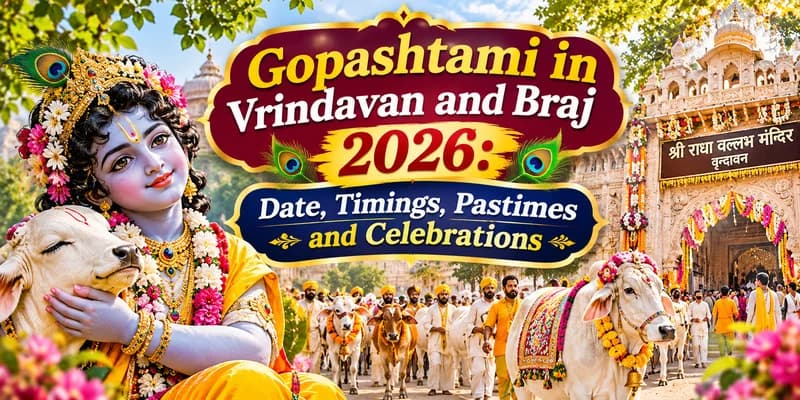
Gopashtami in Vrindavan and Braj 2026: Date, Timings, Pastimes and Celebrations
By Gurudutt, Experience My India·12 November 2026
Quick Answer
Quick Enquiry
Gopashtami is one of the most tender festivals of Braj, the day we honour Gau Mata and the cowherd life of our Krishna. For us Brajwasis the cow is not livestock, she is mother and serving her is serving the Lord. On Gopashtami morning the gaushalas are washed and the cows are bathed, their horns painted, garlands and bells put on and we feed them jaggery and fresh grass before walking around them in parikrama. In the temples you will see the deities dressed as little cowherds with a lathi (herding stick), our Radha Raman is dressed as the young Gopa with his flute. If you want to experience it, come to a Braj gaushala in the early morning, there is nothing like it. We can take you to the right place at the right time. Radhe Radhe. See our Mathura Vrindavan tour Packages or message WhatsApp +91 7302265809.
What is Gopashtami?
Gopashtami is a beloved Braj festival that celebrates the day Lord Krishna first took the cows out to graze and became a Gopa (cowherd), and, with it, the deep and loving bond between Krishna, the cowherd community and Gau Mata, the cow. It falls on Kartik Shukla Ashtami, the eighth day of the bright fortnight of the sacred month of Kartik; for the wider month, see our kartik guide.
In the land of Braj, where Krishna spent his childhood among the cowherds and the cows, Gopashtami is especially meaningful. It is both a remembrance of a sweet pastime of the Lord and a day of active, loving service to the cow, who is honoured in Braj as a divine mother. The festival is observed across Vrindavan, Mathura, Govardhan, Nandgaon, Barsana and the gaushalas of the whole region, with temple celebrations and cow worship (Gau Puja) at its heart.
Timings and tithi for 2026
The Ashtami tithi timing governs the morning puja and the Gau Puja across the temples and gaushalas. Festival timings follow the Hindu lunar calendar, so treat these as the expected panchang timings and reconfirm locally.
Gopashtami date: Tuesday, 17 November 2026 (Kartik Shukla Ashtami).
Ashtami tithi begins: 4:19 AM on Tuesday, 17 November 2026.
Ashtami tithi ends: 6:04 AM on Wednesday, 18 November 2026.
Primary observance: the festival is observed throughout the day on Tuesday, 17 November, with the morning puja hours being the most auspicious for Gau Puja and temple darshan.
Because the most sacred observances, cleaning and bathing the cows, the Gau Puja and the special temple darshans, happen in the morning, an early start is the key to experiencing Gopashtami fully. Treat all timings as general and confirm locally, especially at individual temples and gaushalas, which may set their own schedules for the day.
History and the pastimes behind Gopashtami
Gopashtami draws on two cherished pastimes described in scriptures such as the Srimad Bhagavatam. These are recounted here as treasured devotional tradition.
1. The graduation to Gopa. In his early childhood, Krishna was permitted only to tend the young calves near the house (as a Vatsapa, a keeper of calves), because Nanda Maharaja considered him too young for more. On this lunar day, having entered the pauganda stage (traditionally the age of six to ten), Krishna, together with Balarama, was formally entrusted for the very first time with the great responsibility of taking the full-grown cows out to graze in the pastures of Vrindavan. From this day on, he was lovingly known as a Gopa, a cowherd and the festival takes its name from this, Gopa plus Ashtami.
2. The submission of Indra. Gopashtami is also remembered as the final day of the Govardhan Lila. After Krishna lifted Govardhan Hill on his little finger and held it aloft for seven days and nights to shelter the people and cattle of Braj from Indra’s torrential storm, it was on this eighth day (Ashtami) that Indra conceded defeat, halted the rains and humbly apologised, acknowledging Krishna as Govinda. For the lifting of the hill, see our govardhan hill significance guide and for the festival of the lifting itself, our govardhan puja guide.
Together, these pastimes give Gopashtami its two layers of meaning: Krishna stepping into his loving role as protector of the cows and the triumph of devotion to Govardhan and Govinda over pride.
Significance in Braj culture
For Braj, Gopashtami is far more than a date on the calendar. It marks Krishna’s transition into active service and responsibility, the little boy becoming the cowherd who protects and loves the cows. And in Braj, the care of cows (Gau Seva) is understood not as a chore but as an act of intimate, loving service to the Divine, because the cow, Gau Mata, is revered as a sacred mother and is dear to Krishna himself. On Gopashtami, this devotion is expressed in its fullest, tenderest form.
There is also a beautiful, more esoteric layer unique to the Braj tradition, involving Srimati Radharani. Because only the young cowherd boys were allowed to take the cows out to graze, Radharani and her gopi companions, by tradition, dressed themselves as cowherd boys (in Subala-vesha, the guise of Krishna’s friend Subala) so that they could slip into the pastures and join Krishna in his cow-herding pastimes. This sweet pastime is cherished especially in Barsana, the land of Radharani; see our shri radha rani temple barsana guide and our maan mandir barsana guide. It adds a note of playful, loving devotion to the festival that is distinctly of Braj.
Key locations and celebrations in Vrindavan and Braj
If you want to experience Gopashtami on the ground, the celebration is concentrated around the major temples and the gaushalas (cow sanctuaries) of the region.
The gaushalas (cow sanctuaries). The heart of Gopashtami is at the gaushalas, where the cows are honoured. Prime destinations include the Surabhi Gaushala at the Vrindavan Chandrodaya Mandir, the ISKCON Vrindavan gaushala (see our iskcon vrindavan guide) and the historic cow sanctuaries of Nandgaon, Barsana and Govardhan, where the bond between Braj and its cows runs deepest.
Radha Raman temple and the major shrines. In the main temples of Vrindavan, the deities are often beautifully dressed in special cowherd attire for the day, carrying a herding stick (lathi). Notably, the deity of Radha Raman is dressed in a dhoti and holds a flute, reflecting the youthful Gopa form of Krishna; see our radha raman guide. Other great temples, such as banke bihari and prem mandir, are also wonderful for darshan around the festival.
Across Braj. Barsana, Nandgaon and Govardhan all hold cherished Gopashtami celebrations. See our places to visit in barsana guide and our places to visit in govardhan guide and for a Barsana and Govardhan day, our govardhan barsana tour.
For the wider temple circuit of the town, see our places to visit in vrindavan guide. Visiting a gaushala in the early morning, when the cows are bathed and worshipped, is the most authentic way to experience the day.
The rituals of Gopashtami
The rituals of Gopashtami are tender and hands-on, centred on honouring the cow. On the morning of the festival:
The gaushalas are cleaned. Devotees wake early and clean the cow shelters, preparing them for the day’s worship.
The cows are bathed and decorated. The cows are bathed, their horns painted and they are adorned with colourful cloths, flower garlands and brass bells, dressed up as the honoured mothers they are.
Gau Puja is performed. The cows are worshipped with the traditional articles of puja and tilak is applied, as Gau Mata is venerated.
The cows are fed and circumambulated. People feed the cows special fodder, fresh green grass and jaggery (sometimes as laddus) and then perform parikrama (circumambulation) around them, offering their respect and love.
Alongside the gaushala worship, devotees take darshan of the temple deities in their special cowherd shringar, sing the glories of Krishna the Gopa and share in the devotional atmosphere. It is a gentle, joyful festival and taking part in even a little of the Gau Seva, feeding a cow some jaggery with your own hand, is a touching experience of Braj devotion.
How to experience Gopashtami and plan your visit
The best way to experience Gopashtami is to be at a Braj gaushala or temple early on the morning of 17 November 2026. For getting to the region, see our how to reach vrindavan guide. Gopashtami falls within the glorious month of Kartik, so it pairs naturally with the wider Kartik pilgrimage and it comes just after Govardhan Puja, so a Govardhan visit fits beautifully alongside it.
To fit Gopashtami into a fuller Braj trip, a ready-made mathura vrindavan tour plan helps you plan your days, taking in the Vrindavan temples, the gaushalas and a Govardhan and Barsana leg. Because the key observances are in the morning and the festival draws crowds, plan an early start and allow time at the gaushalas. A local host can get you to the right gaushala and temples at the right hours, which makes all the difference on a busy festival day.
Let a Brajwasi plan your visit
Gopashtami is one of the sweetest, most authentic festivals to experience in Braj, but the best of it, the early-morning Gau Seva and the special temple shringar, is easy to miss without local knowledge of where to be and when. As Brajwasis running Experience My India, we can take you to the right gaushala for the morning worship (the sanctuaries at Vrindavan, Nandgaon, Barsana and Govardhan), time your darshan at Radha Raman and the other temples for the cowherd shringar, arrange your transport and an early start and build Gopashtami into a complete Kartik-season Braj pilgrimage, with Govardhan and Barsana alongside. A shared Mathura and Vrindavan darshan starts from around 1,499 rupees per person; see our mathura vrindavan tour or our Govardhan and Barsana tour for the wider Braj day. Message us on WhatsApp at +91-7302265809 and we will plan your Gopashtami in Braj. Radhe Radhe.
Related guides
Book Your Mathura - Vrindavan Trip Today
📞 +91-7302265809
💬 WhatsApp: +91-7302265809
We Reply in 30 Minutes
Packages start from ₹1,999/ person | Rated 4.5★ / 204+ Reviews
Explore all: Mathura Vrindavan Tour Packages
Jai Shri Krishna
Meet Gurudutt — Your Mathura Vrindavan Guide
Not just a tour operator — Gurudutt was born and raised in Braj Bhoomi. He has spent over a decade personally guiding pilgrims through the sacred lanes of Mathura & Vrindavan.
Founder – Experience My India
Gurudutt
Founder · Experience My India