Travel Guide · Travel Guides · Updated July 2026
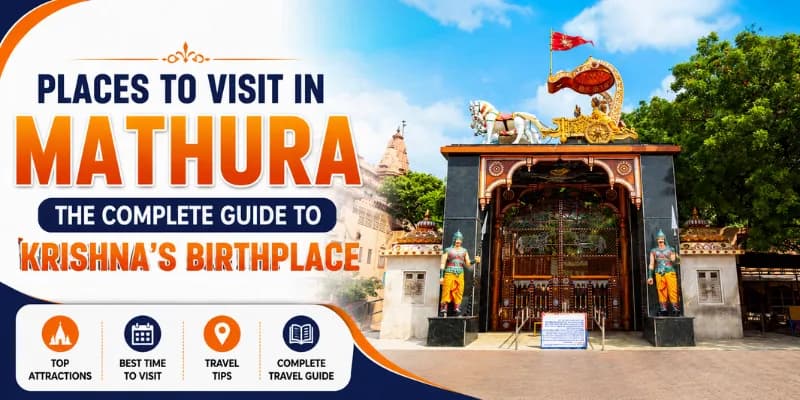
Places to Visit in Mathura: The Complete Guide to Krishna's Birthplace
By Gurudutt, Experience My India·27 July 2026
Quick Answer
Quick Enquiry
Key facts at a glance
The birthplace | Shri Krishna Janmabhoomi, the sacred prison cell where Krishna was born |
Great temples | Dwarkadhish Temple and the Gita Mandir |
The river | Vishram Ghat, the main ghat, with its evening Yamuna aarti |
History | Kans Qila fort, Sati Burj and the Government Museum's ancient sculpture |
Sacred water | Potara Kund, where Krishna's baby clothes were washed by tradition |
Nearby Braj | Vrindavan, Gokul, Govardhan, Barsana and Nandgaon, all close by |
Mathura, the birthplace of Krishna
Mathura is one of the seven holiest cities of India and, for millions, the most sacred of all, for it is the birthplace of Lord Krishna. Older than almost any living city, it sits on the west bank of the Yamuna, a dense weave of ancient temples, riverside ghats, ruined forts and narrow lanes fragrant with peda and incense. Where Vrindavan is the town of Krishna's childhood play, Mathura is the town of his birth and his return and its atmosphere is distinct.
This is the complete guide to the places worth visiting in the city, from the great temples and the ghats to the historic forts, the famous museum and the sacred kunds, followed by the Braj sites a short trip away and everything practical you need to plan the visit. Where a place has its own detailed guide, this page links you to it, so treat this as your map to the whole city.
From the ground (Gurudutt): Mathura rewards an early start above all else. The temples close for a long midday break, the lanes are cool and quiet before mid morning and the light on the Yamuna at dawn is the finest you will see all day. Plan the temples for the morning, the historic sites and museum for the midday closure and the ghats for the evening aarti. See our Mathura vrindavan tour or message WhatsApp +91 7302265809.
Mathura places at a glance: timings, location and entry
Here are the main places with their location and darshan hours in one place, so you can build the day around them. The temples run a summer and a winter schedule, with a long midday closure and the times below are the current darshan hours for each; only on major festivals such as Janmashtami and Holi do these change.
Place | Location | Timings | Entry |
Krishna Janmabhoomi | Janmbhoomi, near Deeg Gate, about 3 km from Mathura Junction | Summer 5:00 am to 12:00 pm and 4:00 pm to 9:30 pm; winter 5:30 am to 12:00 pm and 3:00 pm to 8:30 pm | Free; phones and bags deposited outside |
Dwarkadhish Temple | Pathak Gali, near Vishram Ghat, old city | Summer 6:30 am to 10:30 am and 4:00 pm to 7:00 pm; winter 6:30 am to 10:30 am and 3:30 pm to 6:00 pm | Free |
Vishram Ghat (Yamuna aarti) | City centre, on the Yamuna | Ghat open all day; evening Yamuna aarti about 7:00 pm in summer and 6:45 pm in winter, lasting around 25 minutes, plus an early morning aarti | Free |
Government (Mathura) Museum | Dampier Nagar | 10:30 am to 4:30 pm; closed on Mondays and public holidays | Small ticket, plus a camera fee |
Gita Mandir (Birla Mandir) | Mathura Vrindavan Road | About 5:30 am to 12:00 pm and 3:00 pm to 8:30 pm; aarti around 7:00 am and 7:00 pm | Free |
Potara Kund | Beside the Janmabhoomi | Daylight hours | Free |
Kans Qila | Riverside, old city | Daylight hours (open site) | Free |
Sati Burj | Near Vishram Ghat | Daylight hours | Free |
Rangeshwar Mahadev | Old city | Morning to noon and evening, with a midday break | Free |
Jai Gurudev Mandir | On the highway near Mathura | Daytime, roughly 6:00 am to 8:00 pm | Free |
On festival days: The one exception to the hours above is the major festivals, above all Janmashtami and Holi, when darshan schedules extend and change with special rituals and vast crowds. On any ordinary day, the timings in the table are the ones to plan around.
Shri Krishna Janmabhoomi
The Shri Krishna Janmabhoomi, the Janmasthan, is the heart of Mathura and the single most important place to visit: the sacred site revered as the very spot where Krishna was born, in a prison cell, to Devaki and Vasudeva. The complex holds the Keshavdev temple and the small, deeply atmospheric cell that marks the birthplace itself, where devotees gather in quiet reverence.
Two practical things to know. Security is very tight here: mobile phones, cameras, bags and electronics are generally not permitted inside, so carry as little as possible and be ready to leave items in the lockers or with your vehicle. And the complex sits beside a mosque, with a long standing dispute concerning the site that remains before the courts; we note this simply as fact, take no side and observe that pilgrims take darshan here peacefully as they always have. Our guide to the shri krishna janmabhoomi temple covers the visit in full detail.
Said with care: The birth of Krishna at this spot is the cherished faith of millions, which we share with reverence. The site's dispute is a live legal matter on which we express no opinion. Visitors of every background are asked simply to be respectful; the practical advice above, especially on security, matters more to your day than any of the wider debate.
Dwarkadhish Temple
The Dwarkadhish Temple is Mathura's principal living temple and its devotional centre of gravity, a short walk from Vishram Ghat in the old city. Built in the early nineteenth century and belonging to the Pushtimarg tradition, it is known for its richly painted and carved interior, its beautifully dressed deity and its intense, joyous celebrations, above all at Holi and Janmashtami.
It is busy, colourful and full of feeling, quite different from the quiet of the birthplace and it anchors the old city cluster of ghat, temple and market that you can happily spend a morning in. Photography inside is restricted and the midday closure applies. Our full dwarkadhish temple mathura guide covers its timings, history and how to visit.
Vishram Ghat and the Yamuna aarti
Vishram Ghat is the main and most sacred of Mathura's riverside ghats, the place where, by tradition, Krishna rested after slaying the tyrant Kansa. It is the centre of the ghat scene, ringed by small temples and marble steps and the point from which the chain of some two dozen ghats runs along the Yamuna. A boat ride from here at dawn or dusk is one of Mathura's quiet pleasures.
The great draw is the evening aarti, which begins around 7:00 pm in summer and about 6:45 pm in winter and runs for roughly twenty five minutes, when lamps are offered to the Yamuna and countless small diyas are floated onto the dark water, a scene of real beauty and devotion. Arrive fifteen to twenty minutes early for a good place. Photography of the aarti is generally fine from a respectful distance. Our vishram ghat mathura guide covers the boat rides and the surrounding temples.
From the ground (Gurudutt): Take the boat first, then settle on the steps for the aarti. A short row upriver at golden hour shows you the whole sweep of ghats and temples from the water and returns you in time to find a spot for the lamps. Agree the boat fare before you step in; it is negotiated, not fixed.
Kans Qila, Sati Burj and the historic sites
Mathura is not only temples; it carries deep layers of history and a few sites reward the traveller who cares for the past.
Kans Qila, the ruined riverside fort associated in tradition with Kansa, Krishna's tyrant uncle. Now largely dilapidated, it is notable as a fusion of Hindu and Islamic building styles and a Jaipur era observatory is said to have once stood here. It is atmospheric rather than grand, best for history lovers.
Sati Burj, a tall sixteenth century tower near Vishram Ghat, raised in memory of a queen, a striking piece of old Mathura standing among the lanes.
Jama Masjid, a seventeenth century mosque in the old city, a notable piece of the town's Mughal era heritage.
Rangbhoomi, held in tradition to be the arena where Krishna confronted Kansa, now marked within the city's fabric.
These sites are woven through the old city rather than gathered in one place, so they suit a wander on foot or a short rickshaw circuit between the temples and the ghat, ideally during the midday temple closure when there is little else open.
The Government Museum and the Mathura school of art
The Government Museum of Mathura, often simply the Mathura Museum, is one of the most important archaeological museums in India and an unmissable stop for anyone with the least interest in art or history. It houses a superb collection of ancient sculpture, above all the red sandstone masterpieces of the Mathura school of art, which flourished around the Kushan and Gupta eras and shaped Indian sculpture for centuries.
Here you can see some of the earliest images in the whole Indian tradition, carved in the distinctive spotted red sandstone quarried nearby. It is a calm, air conditioned refuge in the heat and a reminder that Mathura was a great city of art and learning long before the temples you see today. It keeps its own hours and its usual weekly closing day, so confirm before you go. Photography rules vary, so ask at the entrance.
Gita Mandir, Potara Kund and more temples
Several more temples and sacred spots round out a Mathura visit, each with its own character.
The Gita Mandir, also called the Birla Mandir, on the Mathura Vrindavan road, built by the Birla family and known for the verses of the Bhagavad Gita inscribed on its walls and the Gita Stambh pillar. Calm, spacious and easy to visit. See our birla mandir mathura guide.
Potara Kund, a large red sandstone stepped tank beside the Janmabhoomi, where by tradition the infant Krishna's clothes were washed. A serene, historic spot.
Rangeshwar Mahadev, one of the temples traditionally regarded as guarding the four directions of Mathura, dedicated to Shiva, a reminder that Mathura honours more than Krishna alone.
Jai Gurudev Mandir, the striking modern Naam Yog Sadhna Mandir on the highway, an architectural landmark drawing large crowds at its festivals.
Mathura has, of course, countless smaller shrines beyond these; for the wider circuit taking in both towns, our mathura vrindavan local sightseeing guide sets out how the sightseeing joins up.
Nearby Braj: day trips from Mathura
Mathura is the gateway to the whole of Braj and half the joy of visiting is the sacred country around it, all within an easy day's reach.
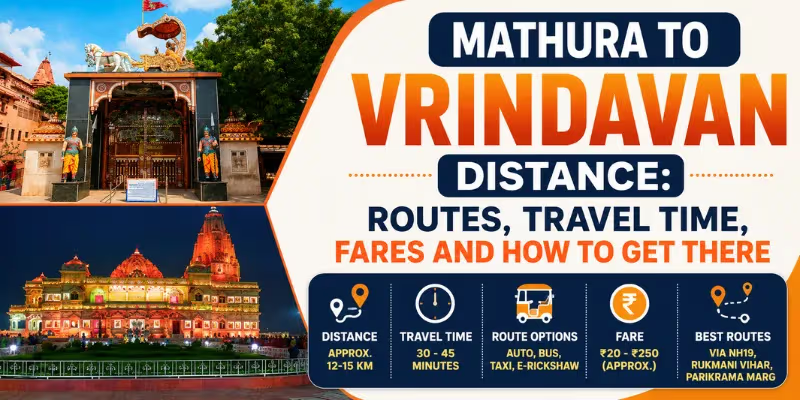
Vrindavan, only about 13 to 15 km away, the town of Krishna's childhood and of Banke Bihari, Prem Mandir and ISKCON, effectively the twin of Mathura and visited together.
Gokul and Mahavan, across the Yamuna, the sites of Krishna's infancy and the beloved leelas of his earliest years.
Baldeo, home of the Dauji temple of Balarama, Krishna's elder brother, east of the river.
Govardhan, the sacred hill Krishna lifted, with its parikrama, Kusum Sarovar and the revered Radha Kund nearby. See our govardhan parikrama guide.
Barsana and Nandgaon, the villages of Radha and of Krishna, home of the famous Lathmar Holi, covered in our gokul barsana nandgaon day trip guide.
Because these sites lie in different directions from Mathura, a little sequencing saves a great deal of driving, which is exactly what a planned circuit gives you.
How to reach Mathura and get around
Mathura is superbly connected, which is part of why it has drawn pilgrims for millennia.
By train: Mathura Junction is a major railhead on the busy Delhi corridor, with fast connections from Delhi, Agra and across India. It is the region's rail gateway.
By road: the Yamuna Expressway links Mathura to Delhi and Noida and the national highways connect it to Agra, about 57 km away and beyond. Delhi is roughly 160 km.
By air: the nearest airports are Agra, around 60 km and Delhi, roughly 140 to 160 km, each followed by a road transfer.
Within the city, auto rickshaws, e-rickshaws and cycle rickshaws handle short hops between the temples, ghats and sites, with fares negotiated rather than metered, so agree the price first. The old city around the Janmabhoomi, Dwarkadhish and Vishram Ghat is best explored on foot. For arriving in the wider region, see our how to reach vrindavan guide and for the temple hours across the day keep our mathura vrindavan temple timings page handy.
Best time, food, itineraries and planning
The best time to visit Mathura is October to March, when the weather is pleasant for walking the old city and the ghats. Holi and Janmashtami are magnificent here and utterly crowded; the summer months are harsh. Mathura's food is a pilgrimage in itself: the world famous Mathura peda above all, plus kachori sabzi and jalebi for breakfast, chaat and cooling lassi, all pure vegetarian and the old markets of Chhata Bazaar and Tilak Dwar are the place for peda, brass idols and prayer beads.
For a half day, do the Janmabhoomi, Dwarkadhish and Vishram Ghat aarti. For a full day, add the museum, Gita Mandir, Kans Qila and Potara Kund. For two days, fold in Vrindavan and a Braj village or Govardhan. However long you have, plan around the midday temple closure and the aarti and keep it unhurried.
We arrange Mathura visits and full Braj circuits, timed around the darshan hours, the aarti and the crowds, with the old city, the ghats and the nearby Braj sites sequenced so you are never doubling back. A shared day tour starts from around ₹1,499 per person and an overnight mathura and vrindavan tour takes in both towns unhurried, with darshan free throughout. Message me on WhatsApp at +91-7302265809 with your dates and group and I will build the visit around what matters most to you.
Related guides
Meet Gurudutt — Your Mathura Vrindavan Guide
Not just a tour operator — Gurudutt was born and raised in Braj Bhoomi. He has spent over a decade personally guiding pilgrims through the sacred lanes of Mathura & Vrindavan.
Founder – Experience My India
Gurudutt
Founder · Experience My India