Travel Guide · Temple Guides · Updated July 2026
Dwarkadhish Temple, Mathura: Timings, Darshan, Holi and a Complete Visitor's Guide
By Gurudutt, Experience My India·23 July 2026
Quick Answer
Quick Enquiry
Key facts at a glance
What | A principal living temple of Mathura, near Vishram Ghat |
Built | In 1814 by Seth Gokuldas Parikh, treasurer of Gwalior |
Tradition | Pushtimarg, the sampradaya of Vallabhacharya |
Deity | Krishna as Dwarkadhish, the King of Dwarka, a black stone idol |
Famous for | Its vibrant Holi and elaborate daily darshan sessions |
Entry | Free. Midday closure. Photography not allowed inside |
What is Dwarkadhish Temple and why it matters
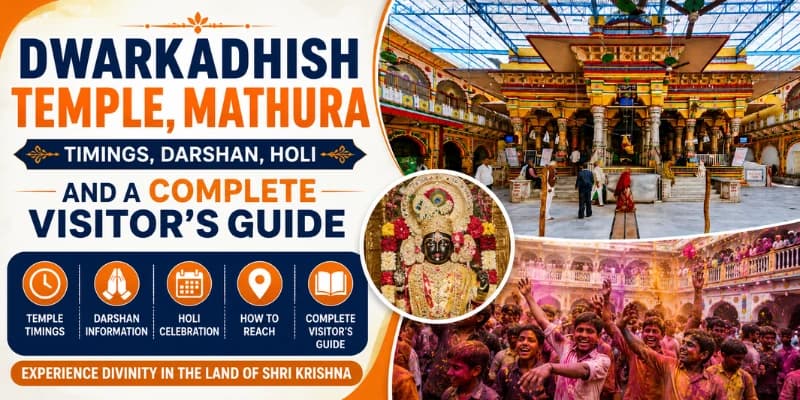
Dwarkadhish Temple is one of the principal living temples of Mathura, set in the old cultural heart of the city near Vishram Ghat and the Yamuna. Here Krishna is worshipped not as the child of Braj but as Dwarkadhish, the majestic King of Dwarka, through the elaborate daily rituals of the Pushtimarg tradition. For many pilgrims it is the devotional centre of a Mathura visit.
It sits within the sacred Mathura circuit alongside Vishram Ghat and Krishna Janmabhoomi, so the three are naturally visited together. Our how to plan a mathura vrindavan trip guide shows how to sequence them; this page is the full visitor's guide to Dwarkadhish itself.
From the ground (Gurudutt): Dwarkadhish rewards an early morning visit more than almost any temple in Mathura. Come for a morning darshan session before the crowds and the lanes around it are calm; come at a festival and you enter a different, thrilling, overwhelming world. Know which you want before you go. See our mathura vrindavan tour or message WhatsApp +91 7302265809.
The story: Seth Gokuldas Parikh and the Pushtimarg tradition
Dwarkadhish is not an ancient ruin but a relatively recent temple with a very human story. It was built in 1814 by Seth Gokuldas Parikh, a hugely wealthy treasurer of the Gwalior state and a devoted follower of Krishna, who wished to build his Lord a home to match the palaces of the kings he served. He raised it near the Yamuna in the heart of Mathura.
The temple follows the Pushtimarg tradition, the sampradaya established by Mahaprabhu Vallabhacharya and is maintained by his followers. Its worship follows the elaborate Pushtimarg pattern of daily darshan sessions. We describe the tradition as it is practised here, without adjudicating the finer points that different sampradayas hold in their own ways.
On the details: We share the temple's history from widely reported accounts. The essentials, the 1814 founding by Seth Gokuldas Parikh and the Pushtimarg tradition, are well established and consistent across sources.
Dwarkadhish timings and the darshan sessions
Worship at Dwarkadhish follows the Pushtimarg rhythm of several darshan sessions through the day, each revealing the deity in a different phase of its divine daily routine, from the morning waking through to the night rest. The temple opens for morning darshan, closes for a midday break and reopens for evening darshan.
Morning darshan sessions, beginning with the waking of the deity.
A midday closure, the Pushtimarg afternoon rest, as at Braj temples generally.
Evening darshan sessions, through to the night rest of the deity.
The Raj Bhog darshan is among the most cherished, the deity in full shringar.
Because the sessions shift between the summer and winter schedules, we do not print fixed clock times here, which would soon be wrong. Confirm the day's darshan sessions locally, or see our mathura vrindavan temple timings page for how Mathura timings move through the seasons. An early morning session is the calmest and most peaceful.
From the ground (Gurudutt): The Pushtimarg darshans open and close in jhankis, glimpses, rather than staying open continuously. Time your arrival for the start of a session rather than turning up between them, or you may find the curtains drawn. A local who knows the day's rhythm saves you a wasted wait.
The architecture, paintings and the deity
The temple is an architectural treasure, blending Rajasthani and Mughal styles, with intricately carved pillars and domes and, most beautifully, vibrant ceiling and wall paintings narrating episodes from Krishna's life. It was built to royal standards and it shows. The presiding deity, Dwarkadhish, is a striking black stone form, adorned with a golden crown and elaborate daily shringar.
Take a little time to look up and around at the paintings and carvings rather than only ahead at the sanctum. The artistry is a large part of what makes Dwarkadhish special, a devotee's fortune poured into beauty for his Lord. Photography is not permitted inside, so it is a place to see with your own eyes and remember.
Holi at Dwarkadhish: vibrant and honestly intense
Dwarkadhish is globally famous for its Holi and I want to describe it honestly. During Holi the temple erupts in colour: priests stand on the balconies and shower the crowds below with tesu, natural flower based colours and the courtyard becomes a sea of joyful, drenched devotion. Flower based colours are distributed as prasad. It is magnificent and it is unforgettable.
It is also genuinely intense. The crowds are enormous, the city's population swells and the courtyard is a crush. It is not for the faint hearted, for small children, or for frail elders. If you come, wear clothes you will discard, protect your eyes, keep valuables away and be ready for the crowd. Or watch the spectacle from a calmer edge rather than the centre.
Honest Holi note: The Dwarkadhish Holi is a wonder, but it is overwhelming and packed. Go prepared and clear eyed, keep children and elders out of the crush and for exact festival dates, which shift each year, check our festival calendar and confirm locally.
Jhulan, Janmashtami and other festivals
Beyond Holi, Dwarkadhish celebrates the full Pushtimarg festival calendar with great splendour. In the monsoon month of Shravan, the Jhulan or Hindola festival places the deity on beautifully decorated swings, sometimes of silver, gold or flowers. Janmashtami, Krishna's birth, brings special darshans and enormous crowds and Diwali and Annakut are marked with rich celebration.
These festivals are the temple at its most beautiful and its most crowded. If you wish to time your visit to one, plan well ahead and expect the numbers. For the dates, which follow the lunar calendar, see our braj festival calendar and confirm locally before you travel.
Entry, photography and the temple rules
To be clear and honest about the practicalities: entry to Dwarkadhish is free, with no ticket. There is, however, one rule visitors often trip over: photography is not permitted inside the temple, to preserve its sanctity and security. Respect it and enjoy the darshan and the paintings with your own eyes.
Entry is free. There is no ticket for darshan.
Photography is not allowed inside the temple. Do not attempt it.
Dress modestly and remove footwear, as at any temple.
Time your visit for the start of a darshan session, not between them.
For the wider dress and etiquette customs across Braj temples, our vrindavan temple dress code and etiquette guide covers what to wear and how to conduct yourself, which applies at Dwarkadhish as much as anywhere.
How to reach Dwarkadhish Temple
Dwarkadhish sits in the old cultural heart of Mathura, near Vishram Ghat, a short distance from Mathura Junction. As with old temple quarters everywhere in Braj, vehicles cannot reach the temple directly through the tight lanes, so you alight nearby and walk or take an auto or e-rickshaw the last stretch through the busy bazaar.
It pairs naturally with the nearby vishram ghat mathura on the Yamuna, a short walk away and with Krishna Janmabhoomi, the three forming the core Mathura circuit. Reach Mathura first, then these sit close together in the old city.
Fitting Dwarkadhish into a Mathura visit
Dwarkadhish is the devotional anchor of a Mathura morning. Pair it with an early Yamuna aarti or a dip at Vishram Ghat next door and with Krishna Janmabhoomi close by and you have the sacred heart of Mathura in one calm early circuit before the midday closures. Keep festival visits for when you specifically want the spectacle and the crowd.
We sequence Dwarkadhish, Vishram Ghat and Janmabhoomi into our Mathura mornings, timed for the darshan sessions so you are not left waiting between jhankis. A shared tour starts from around ₹1,499 per person and a fuller mathura and vrindavan tour across two days covers both towns. Darshan is free throughout. Message me on WhatsApp at +91-7302265809 and I will plan your Mathura circuit around the darshan times.
Related guides
Meet Gurudutt — Your Mathura Vrindavan Guide
Not just a tour operator — Gurudutt was born and raised in Braj Bhoomi. He has spent over a decade personally guiding pilgrims through the sacred lanes of Mathura & Vrindavan.
Founder – Experience My India
Gurudutt
Founder · Experience My India