Travel Guide · Travel Guides · Updated July 2026
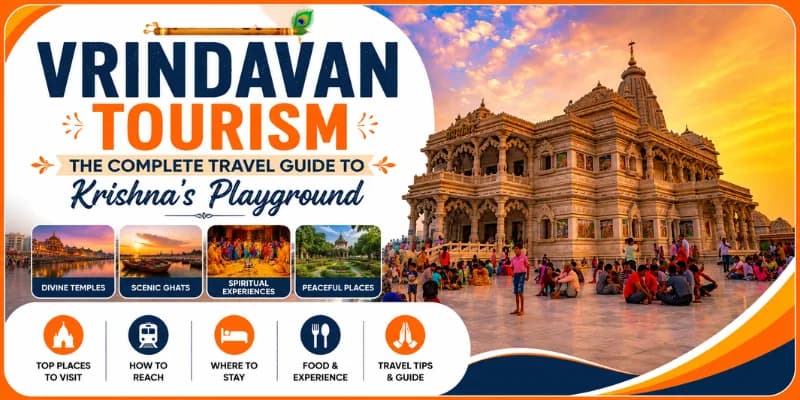
Vrindavan Tourism: The Complete Travel Guide to Krishna's Playground
By Gurudutt, Experience My India·31 July 2026
Quick Answer
Quick Enquiry
Key facts at a glance
What it is | The town of Krishna's childhood, a city of temples |
Where | On the Yamuna in Uttar Pradesh, 13 km from Mathura |
Famous for | Its thousands of temples, Banke Bihari, Holi and the raas leela |
Best time | October to March; Holi, Janmashtami and Radhashtami for festivals |
Time needed | A day for Vrindavan, two with Mathura |
Usually paired with | Mathura, 13 km away and often Agra |
Vrindavan tourism: an overview
Vrindavan is the town where Krishna spent his childhood and youth and for the devotees of Krishna and Radha there is no more beloved place on earth. It stands on the Yamuna in the Braj region of Uttar Pradesh, only about 13 km from Mathura, the birthplace of Krishna and it is a city of temples, thousands of them, from ancient shrines in narrow lanes to vast modern marble complexes, all echoing with the names of Radha and Krishna. It is here, the tradition says, that Krishna played his flute, danced the raas with the gopis and lived the sweet pastimes that Braj remembers in every stone.
This guide is a complete overview of Vrindavan tourism: why to visit, the top temples and attractions, the festivals and experiences, the best time to go, how to reach, where to stay, the food, itineraries and honest travel tips. It is the gateway; for the town's history and identity see our vrindavan up guide and for its most beloved temple our banke bihari temple guide. Vrindavan is almost always visited together with Mathura, 13 km away, so plan for the twin cities as a pair.
From the ground (Gurudutt): The single thing that most shapes a good Vrindavan visit is that this is above all a place of devotion and its old heart is a maze of narrow lanes, not a city of broad avenues and set-piece sights. The most beloved temples, like Banke Bihari, are reached on foot through crowded alleys; the deities are the point, not the architecture; and the calendar turns on festivals and the daily rhythm of darshan. Come with that devotional spirit, be ready to walk and to wait in crowds, plan around the midday temple closure and Vrindavan opens its heart to you. See our Mathura Vrindavan tour or message WhatsApp +91 7302265809.
Vrindavan tourism at a glance
Here are the essentials of Vrindavan tourism in one place.
Detail | Information |
What it is | The town of Krishna's childhood, a city of temples |
State and region | Uttar Pradesh, the Braj region, on the Yamuna |
Famous for | Its thousands of temples, Banke Bihari, Holi, the raas leela |
Top sights | Banke Bihari, ISKCON, Prem Mandir, the Goswami temples, the ghats |
Best time | October to March; festivals in spring and monsoon |
From Mathura / Delhi | About 13 km / 150 km |
Time needed | A day for Vrindavan, two or more with Mathura and Braj |
Usually paired with | Mathura, 13 km away and often Agra |
In one line: Vrindavan tourism centres on Banke Bihari, ISKCON and Prem Mandir, the old Goswami temples, the Yamuna ghats and the great festivals, in the town of Krishna's childhood on the Yamuna, best visited October to March and paired with Mathura nearby.
Why visit Vrindavan?
People come to Vrindavan above all because it is the land of Krishna's childhood leelas, the sweetest and most intimate chapter of his story, where he is loved not as a distant god but as the beloved cowherd boy of Braj. For the devout, to take darshan of Banke Bihari, to walk the parikrama, to sit by the Yamuna, is among the tenderest of all pilgrimages. Vrindavan is called a city of temples, said to hold thousands of them and its atmosphere of unbroken devotion, of kirtan and the constant call of Radhe Radhe, is unlike anywhere else.
But Vrindavan offers more than its old temples: the great modern marble temples of ISKCON and Prem Mandir draw visitors from around the world, the mysterious grove of Nidhivan intrigues, the Yamuna ghats and their aarti are beautiful and the festivals, above all the Braj Holi, are extraordinary. Vrindavan is also known as a refuge for widows, who come to live out their days in devotion, a poignant part of its character. So it draws devotees, seekers and travellers of every kind, especially combined with Mathura, the wider Braj and the Taj Mahal at Agra nearby.
The top temples and attractions
Vrindavan's attractions are, above all, its temples, of which these are the essentials.
The Banke Bihari temple, the most beloved temple of Vrindavan, home to the enchanting deity of Banke Bihari, in the heart of the old town; see our banke bihari temple guide.
The great modern temples: ISKCON's Krishna-Balaram Mandir and Prem Mandir, the magnificent marble temple famous for its evening light show, with the towering Chandrodaya Mandir rising nearby.
The ancient Goswami temples: Radha Raman, Radha Damodar, Radha Vallabh, Govind Dev, Madan Mohan and others, the historic heart of Vrindavan's devotion.
Nidhivan, the mysterious sacred grove where, the tradition says, Krishna dances the raas with Radha and the gopis each night.
The Yamuna ghats, chief among them Keshi Ghat, for the beautiful evening Yamuna aarti; see our keshi ghat yamuna aarti guide.
Beyond these, the Rangaji temple, the Shahji temple, the Seva Kunj and the wider Braj extend the sightseeing. The old temples lie in the maze of the old town, reached on foot, while the big modern temples stand on the outskirts, reached by road. The vrindavan parikrama rings the town, taking in many sacred sites in one circuit.
Festivals and experiences
Vrindavan's festivals are among the great experiences of Indian tourism. Holi, in the land of Krishna, is world-famous and extraordinary, celebrated for many days with unmatched colour and joy, including the flower Holi at Banke Bihari and the widow's Holi that has become renowned. Janmashtami, Krishna's birth and Radhashtami, the birthday of Radha, fill the temples with fervour and the sacred month of Kartik and the daily Yamuna aartis complete the calendar. These are magnificent but bring enormous crowds, so plan around them.
Beyond the festivals, the signature experiences are the darshan of Banke Bihari and the other deities, the evening Yamuna aarti at Keshi Ghat, walking the parikrama of the holy town, the light and fountain show at Prem Mandir and simply absorbing the atmosphere of unbroken devotion in the lanes. For the festival dates, which follow the lunar calendar and shift each year, see our braj festival calendar guide.
The best time to visit Vrindavan
The best time for Vrindavan tourism is the cool, pleasant winter months of roughly October to March, when the weather is comfortable for temples, ghats and walking the lanes and the parikrama, avoiding the fierce summer heat of April to June and the humid monsoon. The deep-winter mornings of December and January can be chilly, so pack a layer, but the days are lovely.
The great exceptions are the festivals: Holi in March, Janmashtami in August and Radhashtami around August or September are spiritually spectacular and unforgettable, but bring enormous crowds, much higher prices and heavy pressure on transport and accommodation, so come then only if you want the festival fervour and are ready for the intensity and book far ahead. For a calmer, easier visit, choose an ordinary week in the cool season. Our best time to visit vrindavan mathura guide covers the seasons and festivals in full.
How to reach Vrindavan
Vrindavan is very well connected, which makes its tourism easily accessible.
By road: about 150 km from Delhi via the Yamuna Expressway, roughly 3 to 4 hours and only about 13 km from Mathura, half an hour or so; well served by buses and taxis.
By train: the nearest major railway station is Mathura Junction, about 13 to 15 km away, superbly connected across India; Vrindavan also has its own smaller station.
By air: the nearest airports are Agra, about 70 km, with limited flights and Delhi, about 150 km, the main international gateway; a new regional airport is also developing.
Most visitors arrive by train at Mathura Junction and continue the short way to Vrindavan or by road via the Yamuna Expressway, often on a trip that also takes in Mathura and Agra. Our how to reach vrindavan guide covers all the routes into Vrindavan and the twin cities from Delhi, Agra and beyond in full detail.
Getting around and where to stay
Getting around Vrindavan has one important quirk: the old town is a maze of very narrow lanes where vehicles cannot go, so the old temples like Banke Bihari are reached on foot or by cycle-rickshaw. E-rickshaws and autos serve the wider town and the big outskirts temples like ISKCON and Prem Mandir. Reach the edge of the old town by auto, then walk its lanes. For combining Vrindavan with Mathura and Braj, a hired car for the day or a planned tour is the most comfortable way. Our vrindavan guide for foreigners guide covers navigating the town, which helps every visitor.
For where to stay, Vrindavan offers a wide range, from the many ashrams and dharamshalas that give it its devotional character, to guesthouses and comfortable hotels and a few upscale options near the big temples on the outskirts. Many pilgrims love to stay in an ashram for the atmosphere. Staying near the old town suits temple-focused visitors, while the outskirts suit those wanting more comfort. Book well ahead for festivals and weekends, when rooms fill fast and prices rise sharply.
Food and shopping
Vrindavan, as one of the holiest towns of Hinduism, is strictly vegetarian and much of it avoids even onion and garlic, serving the pure, satvik food offered first to the deities. The Braj sweets, above all the peda and the milk sweets, are famous, along with kachori, the Braj thali and the prasad of the temples. Eating the simple, sacred food of Vrindavan is part of the pilgrimage. Our famous food in vrindavan and mathura guide covers the cuisine of the twin cities in full.
For shopping, the bazaars of the old town, around Banke Bihari and Loi Bazaar, offer devotional items, deity dresses and images, prayer beads, brassware, books and the famous pedas to take home, along with the colours of Holi in season. Bargaining is expected. Shopping in the atmospheric old-town lanes, amid the temples and the crowds, is part of the Vrindavan experience, though be firm with pushy sellers and mind commission touts around some shops.
Suggested itineraries
How long to give Vrindavan depends on how much of Braj you want to see.
One day in Vrindavan: Banke Bihari and the old-town temples in the morning, ISKCON and Prem Mandir in the afternoon and evening and the Yamuna aarti at Keshi Ghat, working around the midday temple closure.
Two days, Vrindavan and Mathura: add a day for Mathura's Krishna Janmabhoomi, Dwarkadhish and Vishram Ghat, the classic twin-city visit.
Three to four days, the wider Braj: add Govardhan and its parikrama, Barsana and Nandgaon and Gokul, the towns of Krishna's life.
With Agra: add the Taj Mahal and Agra, about 70 km away, for a Braj-and-Taj or Golden Triangle trip.
So Vrindavan tourism can be a single day, a two-day twin-city pilgrimage or the heart of a rich multi-day journey through Braj and beyond. Most visitors give the twin cities two days and add Agra. We can plan a trip of any length and interest for you, handling the routing, timing and darshan.
Honest travel tips for Vrindavan
A few honest tips make Vrindavan tourism far smoother and more rewarding.
Mind the monkeys: Vrindavan is famous for bold monkeys that snatch glasses, phones and prasad, especially near the temples and ghats, so hold your belongings tight and be wary; a local can often retrieve a snatched item for a small treat.
Navigate by landmarks and on foot: the old-town temples are reached through narrow lanes where map apps struggle and vehicles cannot go, so walk the final stretch and ask locals.
Darshan is free: at Banke Bihari and every temple, darshan is free, so beware anyone selling paid VIP darshan or queue jumps, which are scams; genuine seva is different and is arranged only through hereditary temple families.
Plan around the midday temple closure, dress modestly and be honest about the Yamuna, whose water quality is poor, so revere the river and the ghats without treating the water as clean for bathing.
Be politely firm with touts and pandas pressing for large donations, agree fares in advance, expect crowds especially at festivals and keep belongings secure.
With a little planning and the right, devotional spirit, Vrindavan is among the most moving of all destinations. We arrange complete Vrindavan and Mathura tourism, with the transport, the routing, the timing around the temple closures, comfortable stays and a knowledgeable local guide handled, so you simply experience the holy town in comfort. A shared Vrindavan day tour starts from around ₹1,499 per person, with darshan free throughout and our one-day vrindavan tour package and two-day mathura vrindavan tour cover the twin cities in full. Message me on WhatsApp at +91-7302265809 with your dates to plan your Vrindavan visit.
Related guides
Meet Gurudutt — Your Mathura Vrindavan Guide
Not just a tour operator — Gurudutt was born and raised in Braj Bhoomi. He has spent over a decade personally guiding pilgrims through the sacred lanes of Mathura & Vrindavan.
Founder – Experience My India
Gurudutt
Founder · Experience My India