Travel Guide · Travel Guides · Updated July 2026
Varaha Ghat, Vrindavan: The Ghat of Krishna's Boar Form and Its Rare Deity
By Gurudutt, Experience My India·31 July 2026
Quick Answer
Quick Enquiry
Key facts at a glance
What it is | A sacred ghat on the Yamuna in Vrindavan |
Named after | Varaha, the boar incarnation of Vishnu |
The tradition | Where Krishna revealed his Varaha form to the gopis |
The temple | Holds a rare deity of Lord Varaha |
Where | The southwestern bank of the Yamuna, near Keshi Ghat |
On the route of | The Vrindavan parikrama marg |
Varaha Ghat, Vrindavan: an overview
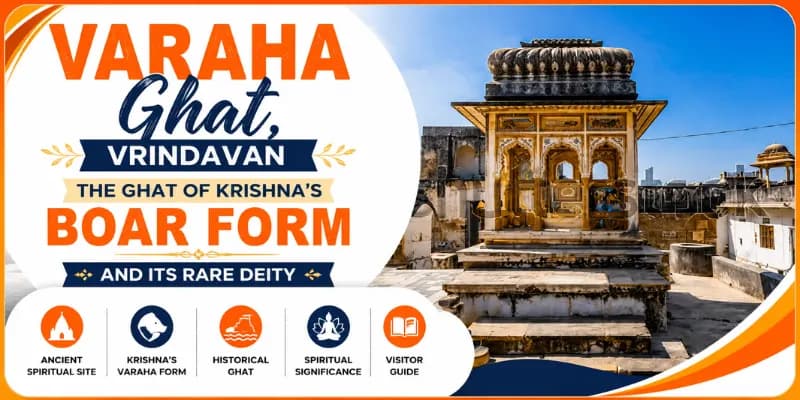
Of all the ghats that line the Yamuna in Vrindavan, Varaha Ghat is one I always send thoughtful pilgrims to, precisely because it is quiet. It sits on the southwestern bank of the river, in the older riverside part of the town, near the far more famous Keshi Ghat and most of the crowds pass it by. Yet it carries one of the loveliest of the Braj traditions, for it is here, the elders of Braj say, that Krishna revealed his form as Varaha, the boar incarnation of Vishnu, to the gopis.
Named for that boar avatar, the ghat is watched over by a small temple that holds a rare deity of Lord Varaha and it lies on the Vrindavan parikrama marg, so pilgrims walking the sacred circuit of the town pass its steps. This guide covers who Varaha is, the story of the ghat, the rare deity, the ghat as it is today, its significance and how to reach it. For the neighbouring ghat and its famous aarti, see our keshi ghat yamuna aarti guide and for the circuit our vrindavan parikrama.
From the ground (Gurudutt): Come to Varaha Ghat for its quiet more than for any spectacle. It is not a grand or busy place and that is its gift: on an ordinary evening you may have the marble steps almost to yourself, the Yamuna moving slowly past and the rare Varaha deity to take darshan of in peace. Pair it with Keshi Ghat a short walk away, sit a while and let the story of Krishna showing his boar form to the gopis settle in your mind. That unhurried, contemplative spirit is how this ghat is best received. See our Mathura Vrindavan tour or message WhatsApp +91 7302265809.
Varaha Ghat at a glance
Here are the essentials of Varaha Ghat in one place.
Detail | Information |
What it is | A sacred ghat on the Yamuna in Vrindavan |
Named after | Varaha, the boar incarnation of Vishnu |
The tradition | Where Krishna revealed his Varaha form to the gopis |
The temple | A small temple with a rare deity of Lord Varaha |
Location | Southwestern bank of the Yamuna, near Keshi Ghat |
On the route of | The Vrindavan parikrama marg |
Best for | A quiet, contemplative darshan and the evening Yamuna aarti |
Entry | Free |
In one line: Varaha Ghat, on the southwestern bank of the Yamuna in Vrindavan near Keshi Ghat, is where by tradition Krishna revealed his Varaha boar form to the gopis; a small temple there holds a rare Varaha deity and it lies on the parikrama marg.
Who is Varaha, the boar incarnation?
To understand the ghat, it helps to know who Varaha is. In the tradition, Varaha is the third of the ten principal incarnations, the Dashavatara, of Vishnu, who took the form of a mighty boar. By the puranic story, the demon Hiranyaksha had dragged the Earth, the goddess Bhudevi, down into the depths of the cosmic ocean and Vishnu descended as the great boar Varaha, dived into those waters, slew the demon and lifted the Earth back to safety on his tusks. So Varaha is the lord who rescues and upholds the Earth herself, an image of divine protection and the restoration of balance.
This is the great deity the ghat honours and it is why devotees, especially Vaishnavas, hold Varaha in such reverence: he is the protector who lifts the world from darkness. We tell this story as it is cherished in the tradition, as belief and devotion rather than as documented history. Holding this picture of Varaha, the boar who saves the Earth, gives the ghat and its rare deity their meaning.
The story of Varaha Ghat
Now to the ghat itself. The tradition of Braj tells that it was here, on this bank of the Yamuna, that Krishna revealed his form as Varaha, the boar incarnation, to the gopis. In his childhood in Vrindavan, the stories say, Krishna would sometimes show his devotees the forms of his own great incarnations, letting them glimpse that the child they loved was the same Lord who had descended in age after age. And here, by this ghat, he showed them the Varaha form and so the ghat took the name it still carries.
There is a tenderness in this that the people of Braj love: that the same boy who stole butter and played the flute would, for the joy of his devotees, become the mighty boar who lifts the Earth and then be a child again. It is a reminder, the elders say, that in Krishna the intimate and the infinite are one. You will hear the story told a little differently by different mouths, some say he took the form in play for the gopis' delight, but the heart of it is constant: this is the ghat where Krishna's Varaha form was revealed. We share it as the beloved tradition it is.
The rare Varaha deity and the temple
Watching over the ghat is a small temple that holds what is genuinely a rarity: a deity of Lord Varaha, the boar incarnation, which is uncommon, for Varaha temples and deities are far fewer than those of Krishna, Rama or the great goddesses. To take darshan of a Varaha deity at all is unusual and to do so at the very ghat where his form is said to have been revealed makes it special. The deity is worshipped with reverence by the pilgrims and sadhus who come this way.
The temple is modest, not one of Vrindavan's grand marble complexes, but its rarity and its connection to the leela give it a quiet significance out of proportion to its size. For devotees who make a point of seeking out the less-visited, more unusual sacred sites of Braj, the Varaha deity here is a cherished darshan. Take it unhurried, as the temple's calm invites and it becomes one of the small, memorable discoveries of a Vrindavan visit.
Varaha Grama and Varaha in Vraja
There is a little more to the Varaha story in Braj that the ghat opens onto. The tradition tells that, besides the ghat, there is a place a couple of kilometres away on the old bank of the Yamuna, known as Varaha Grama, the village of Varaha, where Krishna is said to have shown his Varaha form not to the gopis but to the cowherd boys, his friends. So the Varaha leela is woven into more than one spot in the land of Vrindavan.
Varaha is, in fact, honoured as one of the presiding deities of the wider Vraja Mandala, the sacred circle of Braj, with his own revered seat in the region. This is why the Varaha Ghat in Vrindavan is not an isolated curiosity but part of a deeper thread of Varaha worship running through Braj. Knowing this gives the quiet ghat its proper place: a node in the larger sacred geography of the land, where the boar who lifts the Earth is remembered and revered. We share these traditions as they are held in Braj.
Varaha Ghat today
Varaha Ghat today is a peaceful, unshowy place and I say that as a recommendation. It sits on the southwestern bank of the Yamuna, in the older riverside quarter of Vrindavan, a short walk from the grand and busy Keshi Ghat and it sees a fraction of the crowds. Its steps run down to the river and in the evening, when the light softens on the water, it is a lovely, quiet spot to sit, with the Yamuna aarti performed along this stretch of the riverfront.
Because it lies on the Vrindavan parikrama marg, the sacred path around the town, pilgrims walking the parikrama pass Varaha Ghat and many pause for darshan of the rare Varaha deity. As with all of Vrindavan's ghats, I owe you an honest word about the river: the Yamuna's water quality along here is poor today, so revere the ghat and the river without treating the water as clean for bathing. Come for the darshan, the quiet and the atmosphere rather than a dip and the ghat gives its best. Our kaliya ghat vrindavan guide covers another of these storied, quieter riverside ghats nearby.
The significance of Varaha Ghat
The significance of Varaha Ghat lies in that meeting of the intimate and the infinite that Braj so treasures. It marks a leela in which Krishna, the beloved child of Vrindavan, revealed himself as Varaha, the cosmic boar who lifts the Earth, so it holds together the sweetness of Krishna's childhood and the majesty of Vishnu's great incarnations. For Vaishnava devotees, taking darshan of the rare Varaha deity here, at the site of that revelation, is a meaningful and unusual grace.
By the belief of the tradition, a reverent visit and, where devotees observe it, a holy dip in the Yamuna here carry spiritual merit, as at the sacred ghats generally; we share this as belief rather than as an assured outcome and repeat the honest note about the river's water. The ghat is especially remembered on Varaha Dwadashi, the day dedicated to the Varaha incarnation and through the sacred month of Kartik, when the Braj ghats are at their most alive with devotion. We present its significance as the tradition holds it, with reverence.
Timings and the best time to visit
Varaha Ghat, being an open riverside ghat, can be visited at any reasonable time through the day and the steps and the river are always there to sit by; the small temple with the Varaha deity keeps the usual morning and evening darshan hours common to Vrindavan, closing through the middle of the day. The evening, with the softening light and the Yamuna aarti along the riverfront, is the loveliest time to be there.
The best season is the cool, pleasant months of roughly October to March, when walking the riverside and the parikrama is comfortable and the fierce summer heat has passed. The month of Kartik, in October and November and the day of Varaha Dwadashi are especially devotional times at the ghat, though busier. For a peaceful darshan, an ordinary evening in the cool season is ideal. Our best time to visit vrindavan mathura guide covers the seasons in full and timings can shift on festivals, so confirm locally.
How to reach Varaha Ghat
Varaha Ghat is in Vrindavan, so you first reach Vrindavan and then the ghat within the town.
To Vrindavan: it is about 150 km from Delhi by the Yamuna Expressway, roughly 3 to 4 hours; the nearest major railway station is Mathura Junction, about 13 to 15 km away; and the nearest airports are Agra, about 70 km and Delhi, about 150 km.
From Mathura Junction, take an auto, e-rickshaw or taxi to Vrindavan and on toward the riverside quarter.
Within Vrindavan, Varaha Ghat is on the southwestern bank of the Yamuna near Keshi Ghat, reached by auto or e-rickshaw to the Keshi Ghat area, then a short walk along the riverfront; ask locals for Varaha Ghat.
Walking the Vrindavan parikrama, you pass Varaha Ghat along the riverside stretch of the route.
Because it lies among the riverside lanes, the last stretch to Varaha Ghat is best covered on foot and a local can point the way in a moment. Our how to reach vrindavan guide covers the routes into the town and the nearby radha raman temple, with its self-manifested deity, is easily combined with a visit to the ghat.
Nearby ghats and temples
Varaha Ghat sits in the historic riverside quarter of Vrindavan, close to several other sacred places, so it is easily woven into a morning or evening of darshan.
Keshi Ghat, the grandest of Vrindavan's ghats, a short walk away, where Krishna slew the horse-demon Keshi, famous for its beautiful evening Yamuna aarti.
Kaliya Ghat, the storied ghat of the Kaliya Mardan leela, with its ancient Kadamba tree, also nearby on the riverfront.
The Radha Damodar and Radha Raman temples, among the most revered old temples of Vrindavan, close by in the old quarter.
The wider Vrindavan parikrama, on whose marg Varaha Ghat lies, taking in the town's sacred sites in one sacred circuit.
We arrange darshan-focused Vrindavan visits that take in the quieter, storied ghats like Varaha Ghat alongside the great temples, with the transport, the timing around each temple's hours and a knowledgeable local companion handled, so you simply take darshan and drink in the stories. A shared Vrindavan day tour starts from around ₹1,499 per person, with darshan free throughout and our vrindavan tour package covers the town. Message me on WhatsApp at +91-7302265809 with your dates to plan a peaceful Vrindavan pilgrimage.
Related guides
Meet Gurudutt — Your Mathura Vrindavan Guide
Not just a tour operator — Gurudutt was born and raised in Braj Bhoomi. He has spent over a decade personally guiding pilgrims through the sacred lanes of Mathura & Vrindavan.
Founder – Experience My India
Gurudutt
Founder · Experience My India