Travel Guide · Sacred Places & Nature · Updated November 2026
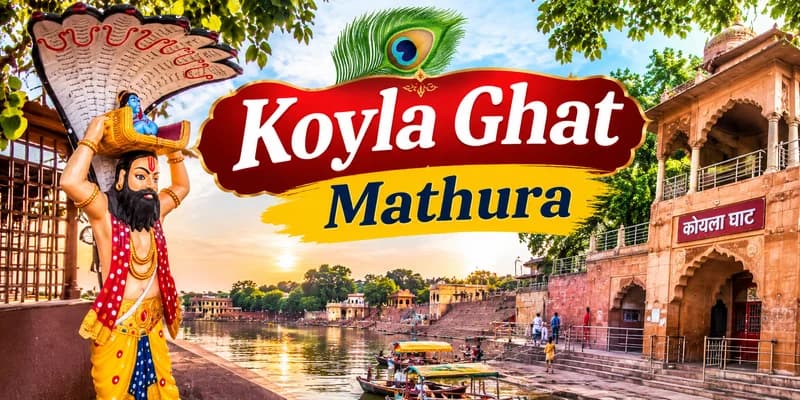
Koyla Ghat Mathura
By Gurudutt, Experience My India·4 November 2026
Quick Answer
Quick Enquiry
Koyla Ghat is one of those quiet corners of Mathura that I love taking the right kind of guest to. It is not loud or crowded like the big temples; it is a calm, restored stone ghat on the Yamuna and by our tradition it is the very place where Vasudeva ji crossed the river that stormy night, carrying the baby Krishna to safety in Gokul. Sit here at sunrise or sunset and the whole story feels close. My simple advice: come early morning or evening for the light and the peace, mind your step on the river stones and let the place be the quiet, reflective part of your Mathura day, a lovely contrast to the busy darshans. See our Mathura Vrindavan tour Packages or message WhatsApp +91 7302265809.
What Koyla Ghat is
Koyla Ghat is one of Mathura’s ancient ghats, the stone-step embankments that line the sacred Yamuna and it carries both deep devotional meaning and a quiet, scenic beauty. Mathura has a whole series of such ghats along the river, each with its own history and Koyla Ghat holds a special place among them for its association with the very night of Krishna’s escape to safety.
What sets it apart is its character. Where the main temple complexes of Mathura are grand and bustling, Koyla Ghat is relatively peaceful, a beautifully restored stone-step ghat that is widely considered one of the finest viewpoints to take in the serene Yamuna landscape in Braj. So it serves two kinds of visitor: the devotee who comes to stand at a site woven into the Krishna story and the traveller who simply wants a calm, beautiful stretch of the holy river away from the crowds. The sections below cover its history, its scenic character, its timings and best times, the key festival dates and how to fit it into a Mathura visit.
The history: Vasudeva’s divine crossing
The heart of Koyla Ghat’s significance is the story of the divine crossing. By local Braj tradition, Koyla Ghat marks the exact spot where Vasudeva, Krishna’s father, crossed the Yamuna while carrying the newborn Lord Krishna. On the stormy night of Janmashtami, the night Krishna was born in the prison of the tyrant Kansa, Vasudeva is said to have carried the baby out of the krishna janmabhoomi prison cells and across the swollen, rain-lashed Yamuna to the safety of Gokul, where the child would be raised in secret.
It is one of the most beloved episodes in the whole Krishna story, the night the divine child was carried through the storm to safety, the river parting or calming to let them pass in the telling and Koyla Ghat is cherished as the place where that crossing happened. Standing at the ghat, looking across the water, devotees feel the nearness of that night. These are devotional traditions and sacred lore held dear by the faithful, recounted here in that spirit and they are what give this otherwise quiet ghat its profound place in the sacred geography of Mathura. The ghat thus connects directly to the Janmabhoomi, the birthplace and to Gokul, the refuge, as the river-crossing between the two.
Scenic heritage: the quiet Yamuna viewpoint
Beyond its sacred history, Koyla Ghat is simply a beautiful and restful place. Unlike the grand, crowded temple complexes nearby, it remains a relatively quiet, beautifully restored stone-step ghat and it is widely regarded as one of the finest viewpoints to experience the serene landscape of the Yamuna in the Braj region.
The appeal is the calm. The restored stone steps lead down to the water, the river stretches wide and quiet and in the soft light of early morning or evening the scene is genuinely lovely, a contrast to the intensity of the temple lanes. It is the kind of spot to sit a while, watch the river and the birds, take in the gentle devotional atmosphere and simply breathe, which many visitors find a welcome balance to a day of busy darshans. For those who enjoy the river, Koyla Ghat pairs naturally with Mathura’s principal ghat, vishram ghat and the wider network of yamuna ghats and leela sites along the river. It is a photographer’s and a contemplative’s ghat as much as a pilgrim’s.
Timings and the best time to visit
As an open riverbank ghat, Koyla Ghat itself has no strict locking gates and is accessible throughout the day. That said, it follows the general rhythm of Mathura and Vrindavan:
Standard hours: visitors generally frequent the ghat between about 5:00 AM and 9:00 PM.
Mid-day break: like most local shrines, any accompanying priests or small shrines at the ghat observe a resting period (bhog) roughly between 12:00 PM and 4:00 PM, so the ghat is quietest and least “active” then.
Best time to visit: early morning for sunrise, or late evening around sunset, are highly recommended, both for the scenic vistas and for the peaceful, uncrowded atmosphere.
Please treat these as general guidance rather than fixed gate hours, since it is an open ghat and any shrine timings are set locally and can change; confirm on the day if you are coming for a specific shrine or aarti. The sunrise and sunset windows are genuinely the best, the light on the Yamuna is beautiful then, the heat is gentler and the ghat is at its most serene. Midday, especially in the hot months, is the least rewarding time. For the wider temple schedule of the region, see our mathura vrindavan temple timings guide.
Important 2027 festival dates
The ghat experiences its highest spiritual energy and footfall during key festivals, so if you want either the full devotional intensity or, conversely, to avoid the biggest crowds, keep these 2027 dates in mind.
Krishna Janmashtami 2027: expected around 25 August 2027. This is the great one for Koyla Ghat, as it is the anniversary of the very night of the legendary crossing, so the ghat and all of Mathura are at their most charged. Expect large crowds and a powerful atmosphere.
Yamuna Chhath 2027: expected in April 2027. Also known as Yamuna Jayanti, the major festival dedicated to the Goddess Yamuna, when the river ghats across Braj are especially busy and devotional.
Because both festivals follow the Hindu lunar calendar, these dates are expected and set by the panchang and can vary slightly between calendars, so treat them as approximate and reconfirm nearer the time. If you come for Janmashtami, plan for Mathura’s biggest crowds of the year; if you want Koyla Ghat at its serene best, a quiet morning or evening outside the festival peaks is ideal.
Best season to visit and planning
The ideal window to explore Mathura and to enjoy an open river ghat like Koyla Ghat, is from October to March. During these winter months the temperature ranges comfortably between about 15°C and 30°C, making outdoor sightseeing along the open river steps pleasant, especially at sunrise and sunset. The summer (April to June) is very hot, which makes a midday ghat visit uncomfortable, though early mornings remain pleasant; and the monsoon brings the river up and the greenery in, but also heat, humidity and rain.
A few practical notes for a visit:
Come at sunrise or sunset for the best light, the gentlest temperature and the most peaceful atmosphere.
Mind the river and the steps. As at any ghat, the stone steps can be uneven or slippery near the water, so step carefully, keep children close and do not venture into deep or fast-moving water; enjoy the river from the steps.
It is a quiet spot, which is its charm, but as with any quieter place, solo visitors (especially in the early dark or late evening) should stay aware of their surroundings and keep valuables secure.
Dress modestly, as it is a sacred site and carry water and sun protection for later in the day.
For reaching Mathura see how to reach vrindavan, for a base see where to stay in vrindavan and for the wider town, places to visit in mathura.
Combining Koyla Ghat with your Mathura visit
Koyla Ghat works beautifully as the calm, reflective part of a Mathura day rather than a destination on its own. A natural pairing is to visit the Krishna Janmabhoomi, the birthplace where the night of the crossing began and then come to Koyla Ghat to stand at the river where Vasudeva carried the baby across, which brings the story full circle. You can also pair it with Vishram Ghat and Mathura’s other riverside sites for a gentle ghat-and-temple morning or evening. Devotees tracing the Krishna story often continue on to Gokul, the refuge across the river, completing the arc of that night. A ready-made plan helps you fit the quieter sites like Koyla Ghat around the main darshans; see our mathura vrindavan tour plan.
Let a Brajwasi plan your visit
Quiet heritage spots like Koyla Ghat are exactly what a local guide knows to weave into your day, at the right hour and in the right order. As Brajwasis running Experience My India, we can fit Koyla Ghat into your Mathura visit at sunrise or sunset for the best light and calm, tell you its story at the river where it happened, pair it with the Krishna Janmabhoomi, Vishram Ghat and Gokul for the full arc of the crossing and arrange private transport and a local guide so the day flows without the crowds and touts. A shared Mathura and Vrindavan darshan starts from around 1,499 rupees per person; see our mathura vrindavan tour, or we design a private visit. Message us on WhatsApp at +91-7302265809 with your plans.
Related guides
Book Your Mathura - Vrindavan Trip Today
📞 +91-7302265809
💬 WhatsApp: +91-7302265809
We Reply in 30 Minutes
Packages start from ₹1,999/ person | Rated 4.5★ / 204+ Reviews
Explore all: Mathura Vrindavan Tour Packages
Jai Shri Krishna
Meet Gurudutt — Your Mathura Vrindavan Guide
Not just a tour operator — Gurudutt was born and raised in Braj Bhoomi. He has spent over a decade personally guiding pilgrims through the sacred lanes of Mathura & Vrindavan.

Founder – Experience My India
Gurudutt
Founder · Experience My India