Travel Guide · Travel Guides · Updated October 2026
Akrur Ghat: Where Akrur Saw Krishna’s Divine Form, Temple and How to Reach
By Gurudutt, Experience My India·23 October 2026
Quick Answer
Quick Enquiry
The pastime: where Akrura saw Krishna’s divine form
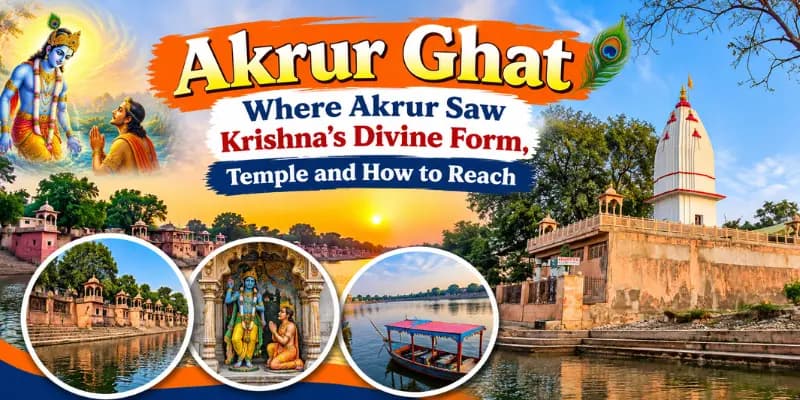
The ghat takes its name from Akrura, an uncle and ardent devotee of Lord Krishna. In the Srimad Bhagavatam, King Kamsa sends Akrura to bring Krishna and Balarama from Vrindavan to Mathura for a wrestling match, secretly intending to have them killed. Akrura, though he serves in Kamsa’s court, is a hidden devotee and the tradition describes his journey to Vrindavan as the happiest of his life, because he is at last to set eyes on the Lord he has longed for.
On the chariot journey to Mathura, the group stops on the bank of the Yamuna so the brothers can perform their morning rituals. While Krishna and Balarama rest under a tree, Akrura steps into the river to take his bath and chant his mantras, and by tradition, receives a profound vision beneath the water.
Balarama as Adishesha. Akrura is said to have seen Balarama in his form as Ananta Shesha, the many-headed cosmic serpent.
Krishna as Maha-Vishnu. He saw Krishna as Narayana, reclining upon Adishesha, surrounded by demigods, devas and the Saptarishis.
The two forms. Perplexed, Akrura lifted his head and saw the ordinary human forms of the two boys on the chariot; submerging again, the glorious four-armed (Chaturbhuji) form reappeared. The tradition holds that this revealed to Akrura that the young brothers were the Supreme pervading all creation.
The Adi Varaha Purana is said to celebrate Akrur Ghat as the “king of all holy places” and it is also remembered as the spot where the people of Braj were blessed to glimpse the Vaikuntha realm reflected in the Yamuna. Centuries later, by tradition, Sri Chaitanya Mahaprabhu made this ghat a base during his time in Vrindavan, bathing here and remaining absorbed in deep devotion. See our Mathura Vrindavan tour Packages or message WhatsApp +91 7302265809.
The meaning of Akrura’s vision
For many pilgrims the story is not just a miracle but a teaching and it is worth pausing on why Braj devotees hold this ghat so dear. Akrura spends the whole journey wrestling with a kind of doubt, is the boy on the chariot really the Supreme or only a beloved cousin? The vision in the water answers him directly: the same Krishna who laughs and talks on the chariot is, at once, the Narayana of all the worlds. Nothing about the human form is diminished and nothing about the cosmic form is added; the two are shown to be one.
This is why the tradition treasures the detail that the vision appeared only when Akrura submerged and vanished when he raised his head. It is read as a gentle lesson that the Lord’s full glory is revealed to the heart that dives in with faith, not to the eye that stays on the surface. Akrura’s name itself is often explained as “one who is not cruel”, the devotee whose tenderness lets him see what Kamsa, with all his power, never could. Standing at the ghat with this in mind changes the visit from sightseeing into something quieter and more personal, which is exactly the spirit in which Braj pilgrims come here.
The Gopi Nath temple complex and what to see
The site keeps a modest, deeply peaceful, rural feel rather than grand, paved architecture. The main site is the Gopi Nath temple complex, where visitors generally find the following.
Feature | What it is |
The main altar | Deities of Lord Krishna (left), Akrura standing in the middle and Lord Balarama (right), with a deity of the sacred Surabhi cow facing the altar |
Sri Chaitanya’s footprints | The lotus footprints of Sri Chaitanya Mahaprabhu, preserved beside the altar |
The ancient banyan tree | The old banyan where, by tradition, Chaitanya Mahaprabhu rested, still standing on the premises |
Pancha-mukhi Hanuman shrine | A separate shrine to the five-faced form of Lord Hanuman within the vicinity |
The arrangement of the altar is itself unusual and worth noticing: at most Braj temples the devotee stands before Radha and Krishna, but here Akrura himself is given the central place between the two brothers, a quiet honouring of the devotee whose faith the ghat celebrates. The Surabhi cow facing the altar ties the spot to Braj’s cowherd world, the setting Krishna is about to leave as he rides for Mathura.
The atmosphere here is the main draw. This is a place to sit quietly, not to rush. The banyan is old enough that its hanging roots have become part of the ground and it is easy to see why generations of devotees have chosen its shade for chanting and rest. If you enjoy the Yamuna ghats of Braj, pair a visit with keshi ghat in Vrindavan and vishram ghat in Mathura, the two best-known ghats at either end of the old road.
The Yamuna, the sacred dip and Kartik
Taking a holy dip at Akrur Ghat has long been part of its pilgrimage and the tradition holds a bath here to be especially purifying on a full moon (Purnima) and through the sacred month of Kartik, roughly October to November, when much of Braj turns to the river and to lamp offerings. Devotees who come in Kartik often combine the dip with an evening deepdaan, floating or lighting small lamps, in keeping with the mood of the month across the Braj ghats.
There is an honest practical point to make, though. Over the years the main flow of the Yamuna has shifted and the river now runs about a kilometre from the original temple site, so the ghat today sits among quiet fields rather than hard against the water. The classic riverside bath is therefore not always possible in the way it once was and the level and cleanliness of the water vary a great deal with the season. If taking a dip matters to you, check the current conditions on the spot and treat the darshan, the story and the atmosphere as the heart of the visit rather than the bathing itself. Many pilgrims now come chiefly to sit, hear the pastime and offer their respects at the altar.
How to reach Akrur Ghat
Akrur Ghat sits roughly midway on the old road connecting Mathura and Vrindavan, amid calm agricultural fields. Over time the main flow of the Yamuna has shifted and the river now runs about a kilometre from the original temple site, so do not expect the water to be right at the ghat. Distances and road conditions change, so confirm the approach locally before you set out. See our mathura to vrindavan distance guide for the full stretch this ghat sits on.
By road (local directions). Travelling on the main road from Vrindavan toward Mathura, watch for Vatsalya Gram on your right. Directly opposite Vatsalya Gram, turn left onto a narrow asphalted road, drive a few hundred metres past a small village and the Akrur Ghat temple complex appears on your right.
By train. The nearest major railheads are Mathura Junction and Vrindavan station. From either, an auto-rickshaw or taxi can take you directly to the ghat. See how to reach vrindavan for arrival options into the region.
By air. The closest airport is Indira Gandhi International Airport (DEL) in Delhi, roughly 150 km away; from there most pilgrims take a cab or bus down the Yamuna Expressway into the Mathura-Vrindavan region.
Visitor info. The open-air areas are generally accessible from dawn to dusk, with no entry fee, but confirm timings locally as they can vary. Because the complex is tucked off the main road among fields, it is genuinely easy to miss; a local driver who knows the Vatsalya Gram landmark saves a lot of circling and signage is minimal.
Best time to visit
Akrur Ghat can be visited year round, but the experience changes with the season and a little timing makes the quiet even sweeter. The cool months from October to March are the most comfortable for sitting by the banyan without the heat and this window also covers Kartik, the ghat’s most meaningful season, when the river and the lamps are central to Braj worship. A Purnima (full moon) visit in these months carries special significance for those who wish to bathe or offer lamps.
Within the day, early morning and the hour before dusk are the most beautiful, with soft light over the fields and the calm that the ghat is loved for. The summer months of April to June are hot and better avoided for a lingering visit and the monsoon can leave the approach roads and low ground muddy, so a dry-season, early-or-late-in-the-day visit is ideal. As with all smaller Braj sites, festival days bring more local pilgrims, so if you want the deep solitude the ghat is known for, an ordinary weekday morning is perfect. For the wider seasonal picture across the region, see best time to visit vrindavan.
Planning your visit and what to combine
Because Akrur Ghat sits between the two towns, the natural way to see it is as a short, meaningful stop while moving between Mathura and Vrindavan, rather than a separate trip. Give it twenty minutes to half an hour, enough to sit by the banyan, hear the Akrura story and take in the quiet. It pairs well with Vrindavan’s main temples, banke bihari temple, radha raman temple and the iskcon temple and with a Mathura darshan, so most visitors fold it into a day of mathura vrindavan local sightseeing.
A few simple things make the stop smoother. Wear shoes you can slip off easily for the temple, carry a little water as there is not much by way of shops, dress modestly as at any Braj temple and keep your phone and bag close, as at any quiet rural site. There is no formal queue or ticketing, so the pace is entirely your own. If you are building a fuller itinerary, see places to visit in vrindavan and our hub of the best temples and ghats for the surrounding Braj options.
Let a Brajwasi show you the quiet corners
Akrur Ghat is exactly the kind of place a local plan does justice. As Brajwasis, we can add it to a comfortable Mathura-Vrindavan day, tell the Akrura and Chaitanya history in the place it happened and cover the main temples without the rush. A shared Mathura-Vrindavan darshan starts from around 1499 rupees per person or we design a private day; see our vrindavan mathura tour package. Message us on WhatsApp at +91-7302265809 with your dates.
Related guides
Book Your Mathura - Vrindavan Trip Today
📞 +91-7302265809
💬 WhatsApp: +91-7302265809
We Reply in 30 Minutes
Packages start from ₹1,999/ person | Rated 4.5★ / 204+ Reviews
Explore all: Mathura Vrindavan Tour Packages
Jai Shri Krishna
Meet Gurudutt — Your Mathura Vrindavan Guide
Not just a tour operator — Gurudutt was born and raised in Braj Bhoomi. He has spent over a decade personally guiding pilgrims through the sacred lanes of Mathura & Vrindavan.
Founder – Experience My India
Gurudutt
Founder · Experience My India