Travel Guide · Festivals & Events · Updated November 2026
Tula Daan Seva in Vrindavan: Where, How to Book, Timings and Significance
By Gurudutt, Experience My India·14 November 2026
Quick Answer
Quick Enquiry
Tula Daan is one of the most beautiful charities in our tradition, you are weighed against grain, fodder or jaggery and that exact weight is given away to feed the hungry, the sadhus or our cows. By the Puranas, even Krishna was once weighed and only Rukmini’s single Tulsi leaf of pure love could balance him; that is the spirit, it is really an offering of your whole self. The cost is simply the market price of the goods equal to your weight, so it is not a fixed fee. People do it on birthdays, anniversaries and festivals and families sometimes do it as a heartfelt prayer when a loved one is unwell, which is a loving tradition, though it is a prayer and a daan, never a replacement for a doctor. We can arrange the whole seva, venue, pandit, the commodities and the weighing. Radhe Radhe. See our Mathura Vrindavan tour Packages or message WhatsApp +91 7302265809.
What Tula Daan Seva is
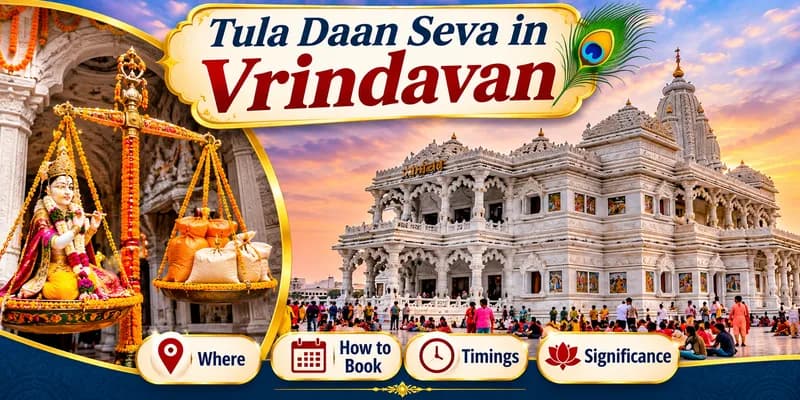
Tula Daan Seva, also known as Tulabhara, is one of the most sacred and powerful Vedic rituals of charity. The practice is simple and striking: a person sits on one pan of a massive balance scale (tula) and the other pan is filled with physical commodities, food grains, jaggery (gud), green fodder, sugar, ghee or oil, until it equals the person’s body weight. Those commodities are then immediately donated, to feed the needy, saintly sadhus or the sacred cows (Gau Mata).
In Sanatan Dharma, Tula Daan is categorised as a Mahadan, a supreme donation, because the giver offers charity equal to their own physical body, which is a profound act. It is “transactional” in the literal sense, your weight is measured and matched with real goods that you pay for and give away, but its spirit is devotional: weighing your body against charity symbolises that your entire physical being belongs to the Divine. So Tula Daan is at once a concrete act of feeding the hungry and the cows and a deep spiritual gesture of surrender. The sections below cover where to do it in Vrindavan, how the booking and payment work, the best days and its meaning, including an honest note on the health and astrological beliefs attached to it.
The legend behind Tula Daan
The roots of Tula Daan are tied, by tradition, to the Dwapar Yuga and to Lord Krishna himself, through one of the most beloved stories in the Puranas.
The pride of Satyabhama. By the Puranas, Queen Satyabhama wished to secure an exclusive, karmic hold over Lord Krishna and playfully “donated” him to the sage Narada. To get Krishna back, Narada told her she must weigh him against an equivalent weight of gold and jewels. Satyabhama piled her entire treasury onto the scale, but Krishna’s side would not move. Finally, Queen Rukmini placed a single Tulsi leaf, with pure devotion, atop the gold and the scale instantly balanced. The lesson is the heart of Tula Daan: no amount of wealth equals the Lord, only pure, loving devotion does.
The Pandavas’ redemption. In the Mahabharata tradition, the Pandavas are said to have performed Tula Daan at holy sites to cleanse themselves of the heavy karmic burden of the Kurukshetra War.
These are cherished scriptural and devotional traditions, recounted here in that spirit, not as literal history. Knowing them turns the act of being weighed against grain into something far richer, an echo of Krishna on the scale, balanced only by love.
Significance and the beliefs attached to it (an honest note)
In Sanatan Dharma, Tula Daan is a Mahadan and devotees perform it for several reasons. Some are straightforwardly devotional and charitable; others are matters of traditional belief that deserve an honest, careful framing.
Surrender of the ego. Weighing your physical body against charity symbolises that your entire physical being belongs to the Divine, an act that humbles personal ego. This is the core spiritual meaning and it is beautiful and uncomplicated.
Charity itself. The goods go straight to feeding the needy, sadhus or cows, so Tula Daan is a real, immediate act of seva, valuable in its own right whatever else one believes.
Karmic and planetary balance (traditional belief). In Vedic astrology, Tula Daan is regarded as a remedy to help neutralise severe planetary doshas (such as Rahu, Ketu, Shani or Guru afflictions). This is a traditional belief; devotees who hold it find meaning and comfort in the practice and even for those who do not, the charity remains genuinely worthwhile.
Performed as a prayer in illness (an important caveat). Traditionally, when a family member suffers a severe illness, some families perform Tula Daan as a heartfelt prayer, understood as a symbolic offering and surrender. Please understand this clearly and responsibly: Tula Daan is a devotional and charitable practice, not a medical treatment. It should be undertaken as a prayer and an act of charity alongside and never instead of, proper medical care. It makes no medical cure and no one should delay or replace a doctor’s treatment on account of it.
Held in this honest light, surrender, charity and tradition-based belief approached sensibly, Tula Daan is a meaningful and genuinely good act, whatever a devotee’s reason for performing it.
The three main types of Tula Daan
Tula Daan is categorised by the commodity you are weighed against and each type suits a different intention. Choose the one that fits your purpose.
Tula Daan category | Typical items used | Traditionally chosen for |
Anna Tula Daan | Rice, wheat, the seven grains (Sapta Dhanya), sugar | Overall health, prosperity and general charity |
Gau-Seva Tula Daan | Jaggery (gud), green fodder, mustard (oil) cakes | Charity to cows; sought for absolving sins and planetary relief (traditional belief) |
Dravya Tula Daan | Ghee, oil, clothes (historically gold or silver) | Charity for serious concerns and ancestral karmic debts (traditional belief) |
A few notes. Anna Tula Daan (grains and sugar) is the most common and goes to feeding people, so it is the easiest, most universally beneficial choice. Gau-Seva Tula Daan (fodder, jaggery, oil cakes) goes to the cows and is lovely to do at a gaushala. Dravya Tula Daan (ghee, oil, cloth) is chosen for larger ceremonies. The traditional “best suited for” reasons, particularly the planetary-relief and karmic-debt associations, are matters of belief, so choose primarily by the charity you wish to give (feeding people, feeding cows or providing ghee, oil and clothes), which is good and real regardless of belief. A pandit at the venue can advise which items suit your intention and the occasion.
Where to perform Tula Daan in Vrindavan
While you can technically arrange a Tula Daan through local pandits at the Yamuna ghats, the most prominent, organised and properly equipped places to perform a complete Tula Daan Seva in Vrindavan are these.
ISKCON Vrindavan (Sri Sri Krishna Balaram temple). Known for a highly transparent, streamlined and structured Anna Daan (food-donation) process, with official desk counters where you pay transactionally based on your weight and the equivalent food is routed directly into the temple’s massive daily prasadam distribution. See our iskcon krishna balaram mandir guide. This is the easiest, most transparent option for most families.
Prominent local gaushalas. Large cow sanctuaries (such as Shree Krishna Dham Gaushala or Sri Raghav Gaudham) commonly host this seva: your weight is counter-balanced with green fodder (hara chara), jaggery (gud) or oil cakes, fed straight to the cows. Ideal if you want your Tula Daan to be gau seva.
Specialised ashrams and shrines. Some ashrams (such as Gayatri Dham) and dedicated shrines near Govardhan and Vrindavan offer a deeper Vedic ritual, including a Sankalpa (vow) and a mini-havan before the weighing. Best if you want the full ceremonial experience.
The Yamuna ghats. You can also set up a Tula Daan with a local pandit at the ghats; see our braj yamuna ghats and leela sites guide.
For the Govardhan-area ashrams, see our places to visit in govardhan guide and for the short hop from Mathura Junction, our mathura to vrindavan distance guide. Choose by your intention: ISKCON for transparent food donation, a gaushala for gau seva or an ashram for a full Vedic ceremony. A coordinator can advise and arrange the venue that best fits your purpose and occasion.
Timings and the best days
Tula Daan is performed in daylight. Most ashrams, gaushalas and the ISKCON counters conduct it in two windows: roughly 7:00 AM to 12:00 PM in the morning and about 4:00 PM to 6:30 PM in the evening. Confirm the exact hours with your chosen venue, as they vary.
On auspicious days: for specific astrological or health-prayer purposes, Saturdays and Wednesdays are often recommended and performing it during the Shukla Paksha (the waxing-moon phase) on a Sunday is also preferred by many traditional priests. (These day preferences are matters of tradition and belief; any day you perform charity sincerely is worthwhile.) Beyond astrology, Tula Daan is overwhelmingly popular on personal and festive occasions, birthdays, wedding anniversaries and major festivals such as Diwali, Govardhan Puja and Navratri, when weighing yourself and giving away your weight in charity is a wonderful way to mark the day. For Govardhan Puja in particular, see our govardhan puja guide. If you want a specific auspicious day, especially a festival or a weekend, book ahead, as the venues get busy.
The transactional process: how to book and pay
Tula Daan is genuinely transactional, so here is exactly how the booking and payment work. The cost is not a fixed fee: you pay the current market price of the commodities (grain, fodder, jaggery, ghee and so on) equal to your body weight, so the amount depends on your weight and the item chosen and on current commodity rates. Confirm the rate at the venue.
In-person walk-ins. At ISKCON Vrindavan or the prominent gaushalas, you can simply step up to the donation desk. They register your name, weigh you on the scale, calculate the exact market price of the material matching your weight and you pay by cash, UPI or card. The goods are then donated immediately. This is quick and transparent, ideal for a simple Anna or Gau-Seva Tula Daan.
Prior registration. For large family groups or for a highly customised Vedic procedure (a personal pandit, specific clothes, a customised list of the seven grains, a Sankalpa and mini-havan), it is highly recommended to call or register with an ashram at least 24 to 48 hours in advance, so everything is arranged for your chosen day and muhurat.
A few sensible points: confirm the commodity rate and what the price covers before you are weighed; keep a receipt; prefer a transparent, well-known venue (like the ISKCON counter) if you want a simple, accountable process; and if you want a specific festival or weekend day, register early. For an elaborate ceremony with a pandit and a havan, prior registration is the way to go.
Let a Brajwasi plan your visit
Tula Daan is a moving seva and we can arrange it start to finish so you simply arrive and take part. As Brajwasis running Experience My India, we can set up your Tula Daan at the venue that suits your intention, the ISKCON Vrindavan counter for transparent food donation, a gaushala for gau seva or an ashram for a full Vedic ceremony with a pandit, Sankalpa and havan, arrange the commodities (grain, fodder, jaggery, ghee as you choose), coordinate the weighing and the donation, and, if you wish, fix an auspicious day. We also arrange your transport and a family stay and can add Braj darshan around the seva, the famous banke bihari temple and the other sites in our places to visit in vrindavan guide, ideally in the cool season (see our best time to visit guide). To be clear on money: the commodity cost (the market price of goods equal to your weight) is paid to the venue and goes directly into the charity and we charge only for our travel and coordination services, never adding a markup to your daan. A shared Mathura and Vrindavan darshan starts from around 1,499 rupees per person; see our mathura vrindavan tour. Message us on WhatsApp at +91-7302265809 and we will plan your Tula Daan Seva. Radhe Radhe.
Related guides
Book Your Mathura - Vrindavan Trip Today
📞 +91-7302265809
💬 WhatsApp: +91-7302265809
We Reply in 30 Minutes
Packages start from ₹1,999/ person | Rated 4.5★ / 204+ Reviews
Explore all: Mathura Vrindavan Tour Packages
Jai Shri Krishna
Meet Gurudutt — Your Mathura Vrindavan Guide
Not just a tour operator — Gurudutt was born and raised in Braj Bhoomi. He has spent over a decade personally guiding pilgrims through the sacred lanes of Mathura & Vrindavan.
Founder – Experience My India
Gurudutt
Founder · Experience My India