Travel Guide · Sacred Places & Nature · Updated November 2026
Kumudvan Mathura: The Forest of Water Lilies
By Gurudutt, Experience My India·5 November 2026
Quick Answer
Quick Enquiry
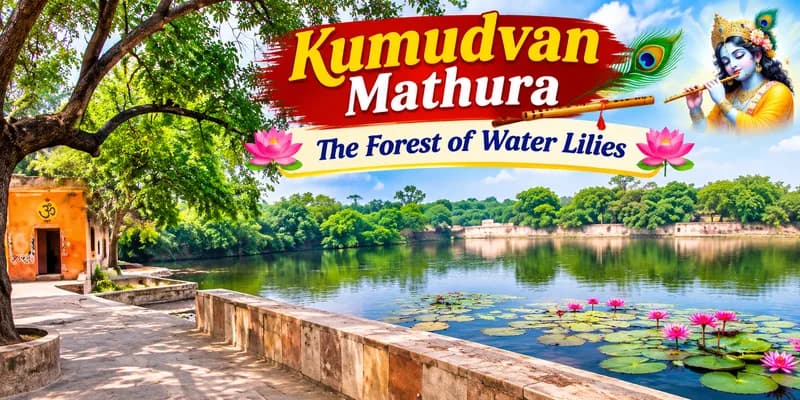
Kumudvan is a little jewel, the smallest of our twelve forests and many people have never heard of it. Its name means the forest of water-lilies, kumud, because it was once full of lily ponds where Krishna and his friends made garlands and played. This is a special place for the Chhak Leela, the divine picnic, where Radha Rani is said to have brought lunch and Krishna shared it with his cowherd friends while grazing the cows. There is a tiny, very old Kapila Muni temple by the Padma Kund too. The whole parikrama takes barely half an hour, so it is an easy, peaceful stop, mostly for pilgrims on the Chaurasi Kos Yatra. Come in the cool morning and let me tell you its gentle stories. See our Mathura Vrindavan tour Packages or message WhatsApp +91 7302265809.
What Kumudvan is
Kumudvan, also written Kumudavana and known today by the village name Kudaravan (or Kudarban, a local corruption of the old name), is one of the twelve principal sacred forests of Braj, the Dwadash Vana, each tied to particular pastimes of Krishna and his companions. Among the twelve, Kumudvan is distinctive as the smallest and one of the most serene, an intimate, rural, open-air site rather than a grand temple complex.
It lies west of Mathura, near the village of Usfar (Uspar) and is visited primarily as an essential stop on the holy Braj Chaurasi Kos Yatra, the great 84-kos pilgrimage circuit of Braj. For pilgrims walking that circuit and for anyone exploring the sacred geography and the quieter pastimes of Braj beyond the main temples, Kumudvan offers an intimate glimpse into the divine childhood of Krishna, the lily ponds, the cow-grazing, the picnic with his friends. Though small, it is rich in meaning, with its lily-pastime story, its Chhak Leela association, its ancient Kapila temple and its revered Padma Kund. The sections below cover the name and the pastimes, Sage Kapila and the kund, the key shrines, the timings and the 2027 yatra planning.
The name and the lily pastimes (Chhak Leela)
The name Kumud means the water-lily, specifically a bright red or white lily or lotus and the forest is named for the lush ponds where these flowers once grew in abundance. In the tradition, this was a forest of lily-filled waters and it is the setting for some of the gentlest and most charming of Krishna’s childhood pastimes.
By the scriptural tradition (texts such as the Padma Purana and Varaha Purana), Krishna, Balarama and their cowherd friends (sakhas) would come here to graze their cows and would play water-sports among the lilies, weaving beautiful lily garlands for one another. Krishna would call out to the cows with sweet words to bring them to drink at the pond. Above all, Kumudvan is celebrated as a site of the Chhak Leela, the divine picnic: the beloved pastime in which Radha Rani is said to have brought lunch (a pot of curd and makhan, butter) and Krishna sat with his cowherd friends amid the lilies to share a picnic together. It is a tender, joyful image, the divine child picnicking with his friends in a forest of water-lilies and it is the heart of Kumudvan’s charm. These are cherished devotional and scriptural traditions, held dear by the faithful.
Sage Kapila and the Padma Kund
Kumudvan’s sanctity reaches back even before Krishna’s pastimes, in the tradition. On the banks of its sacred pond, the Padma Kund (also known as the Kumud Kund, Kumudini Kund, Vihar Kund or Ganga Sagar Kund), stands a tiny, ancient temple, only about 8 by 8 feet, dedicated to Lord Kapila. By tradition, the great sage Kapila, revered as an incarnation of Vishnu and the author of the Sankhya philosophy, performed deep and rigorous penance (austerities) at this very spot, in an age long before Krishna (the tradition places it in an earlier yuga). So the site carries the sanctity of a great sage’s tapasya as well as Krishna’s pastimes.
The Padma Kund itself is highly revered. By local belief and scriptures such as the Adi-Varaha Purana, taking a holy dip in the Padma Kund at Kumudvan is believed to grant deep spiritual knowledge, the knowledge of the Vedic literature and great spiritual merit. This belief in the kund as a bestower of sacred knowledge is central to Kumudvan’s draw for pilgrims. It is a devotional belief, held dear by the faithful and recounted here in that spirit. As at any kund, if you go down to the water, step carefully and stay in shallow, safe water.
Key shrines to see
For a small forest, Kumudvan holds a few precious shrines, each worth pausing at.
The Kapila Muni temple. A very small, historic shrine (about 8 by 8 feet) housing the deity of Kapila Muni, right on the bank of the Padma Kund, marking where the sage is said to have performed his penance.
The Mahaprabhuji Baithak. A sacred sitting-place (baithak) dedicated to Shri Vallabhacharya, the great saint of the Pushtimarg tradition, counted among his baithaks (this is one of his seats). It marks where he is honoured to have sat and taught.
The footprints of Chaitanya Mahaprabhu. A small shrine preserving the charana-chinha, the sacred footprints, said to have been left by Chaitanya Mahaprabhu during his 16th-century pilgrimage through Braj, when he traced and revived many of its sacred sites.
Together these shrines link Kumudvan to three great streams of devotion, the ancient sage Kapila, the Pushtimarg of Vallabhacharya and the Gaudiya tradition of Chaitanya Mahaprabhu, which is remarkable for so small a site and they reward the pilgrim who knows to look for them. A local guide can point out each one, since they are modest and easy to pass by.
Timings, parikrama and best time to visit
Kumudvan is a small, rural, largely open-air site, so visiting it is simple and quick.
Opening hours: the outdoor shrines, kund and village pathways are generally open through the day (broadly sunrise to sunset, often cited as about 6:00 AM to 7:00 PM). The individual small temples in the village keep flexible hours and typically close for a midday break, roughly 12:00 PM to 3:00 PM.
Duration: it is a small site, so you need only about 20 to 30 minutes to complete the short parikrama (about 1 to 1.5 km) and visit the core shrines.
Best time: early mornings, roughly 6:00 to 11:00 AM, are the most serene and peaceful, with the shrines open and the rural surroundings calm; and the cool months of October to March offer the pleasantest weather.
Please treat all timings as indicative, since this is a modest village site rather than a large managed complex and local and temple hours can vary, so confirm on the day and avoid the midday temple break if you want the shrines open. The early cool-season morning genuinely suits Kumudvan’s quiet, intimate character best. For the wider season, see our best time to visit guide.
The Chaurasi Kos Yatra and 2027 planning
Kumudvan is a major milestone along the Braj Chaurasi Kos Yatra, the 84-kos pilgrimage circuit and that is how most pilgrims visit it; see our braj chaurasi kos yatra guide for the full circuit.
Devotees visit Kumudvan year-round, but the mass pilgrimage footfalls peak during the traditional yatra seasons: broadly the Bhadrapada-Ashwin and Ashwin-Kartik months (around September to November 2027), and in years when the lunar calendar includes it, the auspicious Purushottam Maas (Adhik Maas). During these periods thousands of devotees undertake the Chaurasi Kos Parikrama and the forests along the route, including Kumudvan, are at their busiest and most devotional. Because these depend on the Hindu lunar calendar (and the Adhik Maas only occurs in some years), treat the timing as approximate and confirm the 2027 yatra dates nearer the time.
One modern note for travellers looking ahead: it has been reported that the Vrindavan Chandrodaya Mandir complex by ISKCON (see our chandrodaya temple guide) is developing a large recreation of the classic Braj forests, said to include a modern thematic version of Kumudvan with landscaped lakes and greenery, with timelines mentioned around late 2027 and beyond. This is a planned, developing project, so treat it as such and confirm its status and opening if it interests you; it would be a modern, recreated garden rather than the ancient Kumudvan itself, which remains the original sacred site near Usfar.
How to reach and combining with Braj
Kumudvan is in the village of Kudaravan, Post Usfar (Uspar), in Mathura district, about 15 to 20 km west of Mathura city and roughly 3.2 km west of Talvan (another of the twelve forests). Taxis and autos are available from Mathura; see our how to reach vrindavan guide for reaching the region and where to stay in vrindavan for a base.
Because it is small and off the usual tourist route, Kumudvan is best combined with a wider Braj plan rather than visited alone. The most natural pairing is with nearby Talvan (the palm forest of Balarama, just a couple of kilometres east), so the two small western forests can be seen together and more broadly it fits into the Braj Chaurasi Kos Yatra alongside the other eleven forests. You can also add it to a Mathura-area day; see our places to visit near mathura guide. A ready-made plan helps you fit a quieter forest like Kumudvan into your trip; see our mathura vrindavan tour plan.
Let a Brajwasi plan your visit
Tiny, off-route forests like Kumudvan are exactly where a local guide makes the difference, both to find them and to bring their quiet stories alive. As Brajwasis running Experience My India, we can include Kumudvan in your Braj plan, guide you to the Padma Kund and the little Kapila temple near Usfar, tell you the Chhak Leela and lily-pastime stories on the spot, point out the easy-to-miss Vallabhacharya baithak and Chaitanya footprints, pair it with nearby Talvan or fit it into the Chaurasi Kos Yatra and arrange private transport and a local guide so the smallest gems are not missed. A shared Mathura and Vrindavan darshan starts from around 1,499 rupees per person; see our mathura vrindavan tour, or we design a private Braj-forests visit. Message us on WhatsApp at +91-7302265809 with your plans.
Related guides
Book Your Mathura - Vrindavan Trip Today
📞 +91-7302265809
💬 WhatsApp: +91-7302265809
We Reply in 30 Minutes
Packages start from ₹1,999/ person | Rated 4.5★ / 204+ Reviews
Explore all: Mathura Vrindavan Tour Packages
Jai Shri Krishna
Start with these
Meet Gurudutt — Your Mathura Vrindavan Guide
Not just a tour operator — Gurudutt was born and raised in Braj Bhoomi. He has spent over a decade personally guiding pilgrims through the sacred lanes of Mathura & Vrindavan.

Founder – Experience My India
Gurudutt
Founder · Experience My India