Why Chandrodaya matters in my Braj
I have watched this one rise from the Vrindavan plain with my own eyes. Vrindavan Chandrodaya Mandir is unlike anything Braj has built before - a temple planned to soar some 700 feet, set to be the tallest in the world, raised by the devotees of ISKCON Bangalore in service of Krishna. It is bold, modern and still a work in progress and I tell every pilgrim the truth: it is not yet finished. But it is a remarkable thing to witness even now - and around it, the twelve forests of old Braj are being recreated. Come knowing it is rising, not risen and confirm what is open before you travel. Radhe Radhe.
The world's tallest temple - a vision rising
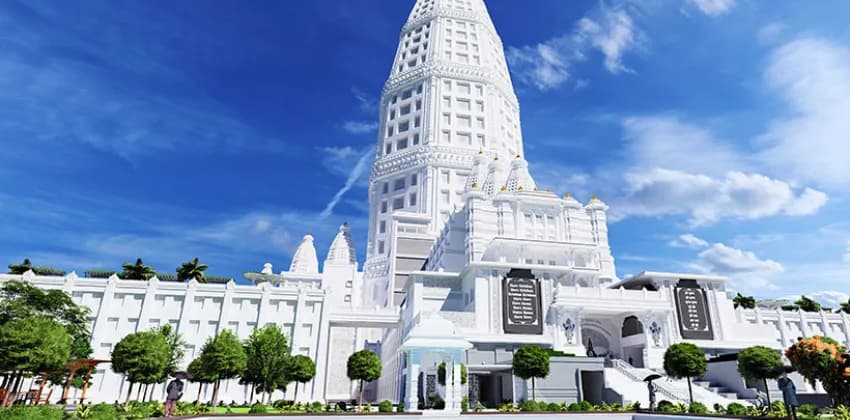
On completion, Vrindavan Chandrodaya Mandir is intended to be the tallest temple - indeed the tallest religious monument - in the world. The plan is for the central tower to rise about 210 metres (roughly 700 feet), on the order of 70 floors - figures that have been stated a little differently in different reports, so I give them as planned and approximate.
It is conceived in the Nagara style of temple architecture given a modern, engineered form - built to withstand high winds and seismic forces at such a height. A planned capsule elevator is to carry visitors toward the top for a panoramic view across Braj Mandal. It is, by any measure, one of the most ambitious temple projects ever undertaken in India.
Prabhupada's vision & ISKCON Bangalore
The temple grows from a vision of Srila Prabhupada, the founder of ISKCON. In 1972, standing in Vrindavan, he spoke of yukta-vairagya - engaging even the modern impulse to build skyscrapers in the service of Krishna, raising "a big temple like a skyscraper for Krishna." Inspired by that, the devotees of ISKCON Bangalore conceived Chandrodaya Mandir.
Its foundation stone was laid on 16 March 2014, the day of Holi, by the then President of India. The project carries ISKCON's mission - to spread Krishna consciousness and to present the Bhagavad Gita and Srimad Bhagavatam in a modern idiom. Four temples are planned within it, honouring Krishna-Balaram, Radha-Krishna, Srila Prabhupada and Chaitanya Mahaprabhu.
The twelve forests of Braj, recreated
To me, the loveliest part of the project is not the height but the forests. Around the temple, on its grounds, the twelve forests (Dwadash Van) of Braj are being recreated - Mahavana, Vrindavana, Talavana and the rest - planted with the trees, flowers and springs described from Krishna's own time.
A biodiversity park with themed zones, nature trails, lakes and fountains is planned, recreating the green Braj of the leela in one place. In an age when Braj's old groves have thinned, there is something moving about a temple that plants the forests back. It is the leela's landscape, raised anew at the foot of the tower.
The name Chandrodaya - the rising moon
The name carries a beauty worth pausing on. Chandrodaya means "the rising of the moon." Krishna is the Vrindavan-chandra - the moon of Vrindavan - whose cooling, beautiful light gladdens the heart. So Chandrodaya Mandir is the temple of the rising of Krishna's moon-like glory.
How fitting, then, for a temple that itself rises - taller than any before it - to be named for the rising of the moon of Braj. The name and the form speak together: Krishna's glory, ascending over Vrindavan.
Status & what to expect - an honest note
Here I must be plainly honest, as a good guide must. Vrindavan Chandrodaya Mandir is still under construction. Its completion has been announced and extended several times and the temple is opening in phases rather than all at once. As of now, what a visitor can see and access depends on the current stage of construction - and that changes.
So before you travel: confirm the current construction status and exactly what is open to visitors. Do not arrive expecting a finished wonder with the elevator running to the top - verify first. A guide who pretends it is complete does you no favours. Come to witness a remarkable thing rising, with clear expectations and you will not be disappointed.
Festivals & the temple's mission
As an ISKCON project, Chandrodaya Mandir will keep the great Gaudiya-Vaishnava festivals - Janmashtami (Krishna's birth), Radhashtami, Gaura Purnima (Chaitanya's appearance) and the holy month of Kartik - with kirtan and devotion, as the construction phases allow.
Central to ISKCON's culture is Annadanam - the free distribution of sanctified food; the temple plans a large hall to serve sattvic meals to pilgrims, sadhus and the needy. Festival observances will grow as the temple opens; verify what is being held on the day before you plan around a particular festival here.
How to reach Chandrodaya Mandir
Chandrodaya Mandir is in Vrindavan, on Bhaktivedanta Swami Marg, near the highway side of town.
From Mathura Junction: 13-14 km, by cab or auto.
From Vrindavan town: a short ride to the temple grounds.
From Delhi: Yamuna Expressway to Mathura (3 hrs), then Vrindavan.
For local routing, see the Vrindavan commute guide.
Experience My India is the most trusted and professional travel partner to book your Mathura Vrindavan Tour Package - and for an evolving site like this, a local operator can tell you what is actually open right now and fold it sensibly into a Vrindavan darshan.
Best time to visit + crowd, safety & accessibility
Cool-season months (roughly October to March) are the most comfortable for the grounds. Because the temple is under construction, the visitor experience, crowds and accessible areas all depend on the current phase - another reason to verify before you go.
As a modern, planned complex, the finished portions are designed to be relatively accessible, with broad spaces and (in time) elevators - but active construction zones are not, so elderly or less mobile pilgrims especially should confirm what is open and walkable. The usual Braj care applies: heat and hydration, sealed water, sun protection and giving any generosity through official temple channels.
Temples to combine nearby
Chandrodaya pairs naturally with Vrindavan's other modern temples and the ISKCON family:
ISKCON Krishna-Balaram Mandir - the established ISKCON temple, Prabhupada's samadhi; the sibling of this project
Prem Mandir - the marble masterpiece, spectacular at night
Banke Bihari & the old-lane temples - Vrindavan's beloved heart
Radha Damodar - where Prabhupada did his bhajan, near Rupa Goswami's seat
Browse all at the Famous Temples of Mathura Vrindavan hub.
Food & prasad nearby
In time, the temple's Annadanam hall will serve sanctified sattvic prasad. Around Vrindavan you'll find the usual Braj fare - peda, makhan-mishri, kachori-jalebi, lassi - and ISKCON's own clean prasad nearby. Favour busy, freshly-cooking stalls and drink sealed bottled water.
Author's tips from Gurudutt - what only a local knows
Confirm what's open before you go - it's under construction and opens in phases; never assume the finished temple awaits.
See it with the established ISKCON temple - the Krishna-Balaram Mandir, with Prabhupada's samadhi, is the heart from which this grew.
Don't miss the forests - the recreated Dwadash Van, the green Braj of the leela, is the project's loveliest idea.
Read the name - Chandrodaya, the rising moon; Krishna's glory ascending over Vrindavan.
Manage expectations - come to witness something rising, not a completed marvel and you'll find it remarkable.
They are raising the moon of Vrindavan higher than any temple before it - and planting the twelve forests back at its feet. It is not finished and I will not pretend it is. But to watch Krishna's tower climb the Braj sky is to watch devotion dream big. Come, but come knowing it still rises. - Gurudutt