Travel Guide · Travel Guides · Updated July 2026
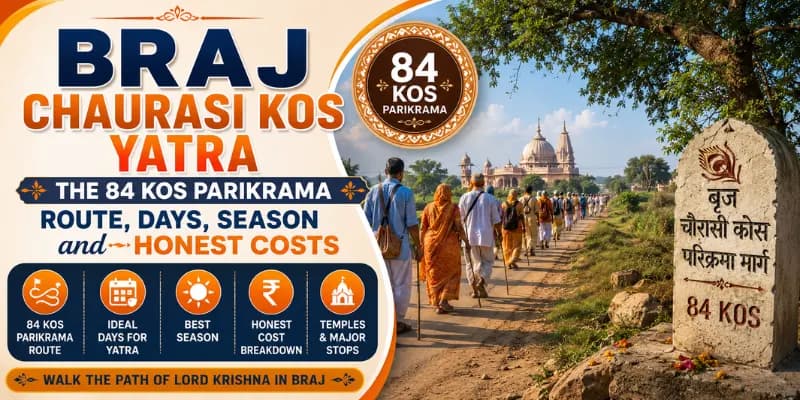
Braj Chaurasi Kos Yatra: The 84 Kos Parikrama Route, Days, Season and Honest Costs
By Gurudutt, Experience My India·23 July 2026
Quick Answer
Quick Enquiry
Key facts at a glance
Distance | About 84 kos, roughly 252 kilometres. One kos is about three kilometres |
Shape | A circular route, starting and ending at the same place, usually Mathura or Vrindavan |
Duration on foot | Traditionally around forty to forty five days as a padyatra |
Duration by vehicle | Commonly seven to twelve days, depending on pace |
Best season | October to March. Avoid the extreme heat of May and June |
Cost | The parikrama is free. You pay only for travel, stay and food |
What the Braj Chaurasi Kos Yatra actually is
The Braj Chaurasi Kos Yatra, also called the Braj 84 Kos Parikrama, is the great circular pilgrimage around the whole of Braj Bhoomi, the land of Krishna. Chaurasi means eighty four and kos is an old unit of distance of roughly three kilometres, so the circuit comes to about 252 kilometres. It is not a walk around one hill or one town. It is a circumambulation of the entire region.
The route takes in the twelve forests, the van, along with gardens, kunds and dozens of villages and it returns you to where you began. Devotees have walked it for centuries and the saints of the Bhakti movement are held in tradition to have performed it and encouraged others to do the same.
It is important to be clear about what this is not, because the names get muddled. It is not the govardhan parikrama guide, which is the twenty one kilometre circuit of Govardhan hill, nor the vrindavan parikrama route, which is the ten kilometre circuit of Vrindavan town. Both of those sit inside the Braj region and are often done as part of this larger yatra, but they are far shorter undertakings.
From the ground (Gurudutt): If someone offers you an eighty four kos yatra that finishes in two days, they are selling you a temple tour with a grand name on it. The real thing is a long circuit and it is measured in weeks on foot or in a good number of days by vehicle. Know which one you are buying. See our Mathura vrindavan tour or message WhatsApp +91 7302265809.
The yatra at a glance: distance, days, season and cost
Here is the practical shape of it in one place. Treat the durations and costs as honest ranges rather than fixed figures, because they move with your pace, your group, the season and how you travel.
Detail | Braj Chaurasi Kos Yatra |
Total distance | About 84 kos, roughly 252 kilometres |
Route shape | Circular, starting and ending at the same point |
Usual start and end | Mathura or Vrindavan |
On foot | Traditionally around forty to forty five days |
By vehicle | Commonly seven to twelve days; some stretch to fifteen for a slower pace |
Best season | October to March, for cool, pleasant weather |
Avoid | May and June, when the Braj heat is genuinely dangerous for a long walk |
Cost of the parikrama | Free. There is no fee to walk it or to enter the sacred places on it |
What you actually pay for | Transport, stay, food and any organised yatra arrangements |
Terrain | Flat throughout. The difficulty is distance and heat, not climbing |
One honest note on distance: Different traditions and route maps give slightly different sequences and totals and printed route maps are sold in Mathura and Vrindavan. The 252 kilometre figure is the widely accepted sacred measure. Do not expect every operator's route to match every other one exactly.
The route and the places it covers
The circuit is traditionally taken from Mathura or Vrindavan and moves around the region before returning to the starting point. The broad sequence most routes follow, with local variation, takes in these places.
Mathura, Krishna's birthplace, with Vishram Ghat and the old city temples.
Vrindavan and the temples and ghats of the town.
Gokul and Mahavan, the sites of Krishna's infancy and Baldeo, the temple of Balarama.
Nandgaon and Barsana, the villages of Nanda Baba and of Radha Rani.
Govardhan, with its own parikrama and Radha Kund and Shyam Kund nearby.
Kamyavan, Deeg and the outer forests and kunds of the Braj mandal.
Along the way are the twelve van, the sacred forests and a great many kunds and small shrines that most visitors never see on an ordinary trip. If you want a taste of this without the full circuit, the gokul barsana nandgaon day trip covers three of the key villages in a single day and the radha kund snan guide covers that sacred pair of ponds.
How many days it takes, on foot and by vehicle
This is the question that decides whether you can realistically do it, so let me be plain. Walked as a traditional padyatra, the full circuit takes around forty to forty five days. That is the authentic form and it is a serious undertaking of time, stamina and simple living.
Done by vehicle, with walking only at the sacred stops and for the shorter parikramas within it, most people complete the circuit in seven to twelve days. Some stretch it to fifteen to move gently and spend longer at the places that matter to them. Seven days is brisk and means long days and little lingering.
There is also a middle path that many devotees take: doing the yatra in stages across several visits, walking the sections that matter most and covering the rest by road. Nobody will tell you this is wrong and for people with jobs and families it is often the only realistic way to complete it at all.
From the ground (Gurudutt): Be honest with yourself about pace before you commit. A seven day vehicle yatra sounds efficient until day four, when you have been in and out of a vehicle since dawn every day. If you can spare ten days, take ten. The point of a parikrama is not to finish it quickly.
When to go and when not to
The best window is October to March, when Braj is cool and clear and long days outdoors are a pleasure rather than an ordeal. Kartik, in October and November, is the most devotional season of all and a beautiful time to be walking in Braj.
Avoid May and June. The Braj summer is severe and a long daily walk in that heat is not merely uncomfortable, it is genuinely risky, particularly for older pilgrims. The monsoon brings its own difficulties with mud and waterlogged village stretches.
There are also traditional windows when organised group yatras run, commonly in the spring around Chaitra and some groups set out after Vijaya Dashami in October. Festival periods such as Holi, Janmashtami and Radhashtami add enormous devotional atmosphere and equally enormous crowds. For the dates, which follow the lunar calendar, see our braj festival calendar.
What it costs, honestly
The parikrama itself is free. There is no ticket to walk it, no fee to enter the sacred places along it and nobody has the authority to charge you for the yatra as such. What costs money is the practical side: getting there, sleeping, eating and, if you choose one, the organised arrangements.
Walking it independently is the cheapest way, staying in dharamshalas and ashrams along the route.
An organised group yatra bundles vehicle, stay, meals and coordination into a per person price.
A private vehicle yatra for a family costs more and is quoted per vehicle rather than per head.
Prices rise sharply in the parikrama season and around Kartik and the festivals.
Quoted prices for organised multi day yatras vary widely by operator, vehicle, room standard and number of days, so treat any single figure you see online as one operator's offer rather than a market rate. Always confirm exactly what is included, meals, stay standard, vehicle type and the number of days, before you pay an advance.
On advances: Multi day yatra operators commonly ask for a booking advance. Get the inclusions in writing first and be wary of any arrangement that will not put the route, the number of days and the stay standard in plain terms.
An honest word: what is sold as an 84 kos yatra and what it really is
This is the part I most want you to read, because it is where pilgrims are most often misled. A great deal of what is marketed as a Braj Chaurasi Kos Yatra is, in truth, a multi day Braj temple tour by vehicle that visits many of the same towns without completing the full circuit in the traditional sense.
There is nothing wrong with such a tour. It can be a wonderful, well planned way to see Braj and for many families it is the right choice. But it should be described honestly and you should know which of the two you are buying. If completing the actual circuit matters to you devotionally, ask the operator directly whether the route closes the full parikrama and returns to the starting point.
We will always tell you plainly which one we are arranging for you. If you want a Braj highlights trip, we will call it that. If you want the full circuit, we will plan it as the multi day undertaking it genuinely is.
How to prepare and what to carry
The terrain is flat throughout, so the challenge is not climbing, it is distance, sun and the simplicity of the village stretches. Prepare accordingly.
Broken in walking shoes and spare socks. Some walk barefoot by tradition, but footwear is entirely acceptable.
Water and more than you think. Refill often and do not rely on finding it in the quieter stretches.
Sun protection, a cap or cloth and a light layer for cold winter mornings.
Basic medicines, blister care and any regular prescriptions in sufficient quantity.
Small denomination cash. Card payment is unreliable in the villages on the route.
Modest clothing suitable for temples throughout, since you will be entering many.
On the stretches away from the main towns, facilities are basic, food is simple and pure vegetarian and accommodation is dharamshala or ashram standard rather than hotel standard. If you are basing in the towns between legs instead, our where to stay in vrindavan guide covers the areas and types of stay.
From the ground (Gurudutt): Get a medical check before you commit to a long padyatra if you are older or have any ongoing condition. I say this to people every season. The devotion is admirable; collapsing from heat exhaustion twenty kilometres from a hospital is not the outcome anybody wants.
Doing it with elders, or in stages
Many of those who most wish to perform this yatra are older and the full walked circuit is beyond them. That is not a barrier to the pilgrimage, only to one form of it. A vehicle supported yatra, walking only at the sacred stops, makes the whole route accessible and doing it in stages across several visits is a long accepted approach.
Build in rest days, keep the daily distances modest and do not let anyone shame an older pilgrim for travelling by road. For wider guidance on making a Braj trip gentle and comfortable, see our guide to visiting with mathura vrindavan with elderly parents.
How we can help you plan it
We are local, we know these roads and villages and we will be straight with you about what a given plan actually covers. We can arrange a vehicle supported multi day yatra, help with a staged approach across visits, or simply advise you honestly if what you want is a shorter Braj trip instead.
For a shorter taste of Braj, a shared day tour starts from around ₹1,499 per person and a full multi day yatra is a separate undertaking quoted on its route, days and vehicle. You can see the shorter options on our mathura vrindavan tour packages and our how to plan a mathura vrindavan trip guide covers the general trip planning. Message me on WhatsApp at +91-7302265809 with your dates, your group and how many days you have and I will tell you honestly what is achievable.
Related guides:
Meet Gurudutt — Your Mathura Vrindavan Guide
Not just a tour operator — Gurudutt was born and raised in Braj Bhoomi. He has spent over a decade personally guiding pilgrims through the sacred lanes of Mathura & Vrindavan.
Founder – Experience My India
Gurudutt
Founder · Experience My India