Travel Guide · Travel Guides · Updated November 2026
Premanand Maharaj Daily Routine and Schedule
By Gurudutt, Experience My India·9 November 2026
Quick Answer
Quick Enquiry
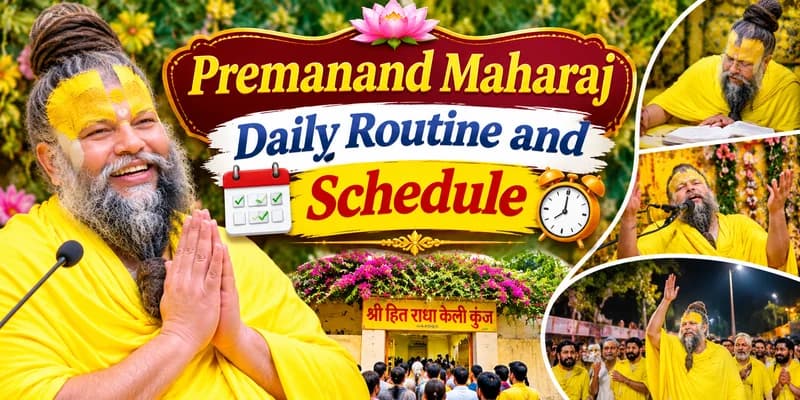
What amazes devotees most about Maharaj Ji is his routine. A man on regular dialysis still keeps a clockwork day that starts in the midnight hours, the 2 AM walk, the 4 AM satsang, the aartis, the scripture paths, given freely, every single day. That discipline is itself a teaching. For a visitor, the shape is simple: the morning is the public window, the afternoon is his rest and treatment and the evening is lighter and often paused. One lovely detail: the morning scripture path changes by the day of the week, Hit Chaurasi on most days, Radha Sudhanidhi on Tuesday and Friday. Everything is free, so never pay for “passes”. And because his health rules the day, check the official channel before you travel or simply watch the live broadcast from home. Radhe Radhe. See our Mathura Vrindavan tour Packages or message WhatsApp +91 7302265809.
His routine and what it teaches
Before the hour-by-hour table, it is worth understanding the spirit of Maharaj Ji’s routine, because the discipline is itself part of why he is so revered. He is a saint of the Radha Vallabh Sampradaya, devoted to Radha and Krishna and his life runs on a strict, intensely disciplined spiritual schedule that begins in the midnight hours and is centred on Naam Jap (constant chanting), public discourses (Satsang) and private theological guidance (Ekantik Vartalap).
What moves people is that he keeps this rigorous routine despite severe health challenges, kidney failure requiring ongoing dialysis. To rise before 2:00 AM, walk to the ashram, give a full discourse, lead the aartis and the scripture recitations and do it daily while gravely ill, is an extraordinary example of devotion and discipline. For a devotee, then, the routine is not just a timetable to plan around; it is an inspiration. It also sets the right expectation for a visit: the morning is the public heart of his day, the late morning and afternoon are reserved for his rest and medical care (rightly protected) and the evening is lighter and often curtailed. Reading his day this way, the public window, the rest, the health-driven limits, helps a visitor plan sensibly and, above all, with respect for what the routine costs him.
The daily schedule, hour by hour
Maharaj Ji’s baseline daily schedule is as follows. Treat every time as approximate and health-dependent (see the note below) and verify the current day on the official channel before relying on it.
Time window | Activity | Devotee access |
2:00 AM to 3:30 AM | Padyatra (morning walk) | He walks from his residence to the ashram; devotees line the Parikrama Marg for a brief glimpse (darshan) |
4:10 AM to 5:30 AM | Morning Satsang | The primary daily discourse, on bhakti, brahmacharya and devotional practice |
5:30 AM to 6:30 AM | Mangala Aarti and Van Vihar | Morning prayers and devotional worship at the ashram |
6:30 AM to 8:15 AM | Holy-text recitations (Path) | Weekly rotation: Shri Hit Chaurasi Path (Mon, Wed, Thu, Sat, Sun); Shri Radha Sudhanidhi Path (Tue, Fri) |
9:30 AM onwards | Rest and token distribution | Maharaj Ji rests and undergoes medical care; tokens for future personal interactions are given around this time |
4:00 PM to 5:00 PM | Dhup Aarti and evening session | Evening prayers; evening interactions and the personal Ekantik Vartalap are frequently limited or paused depending on his health |
The morning block (roughly 2:00 AM to 8:15 AM) is the public heart of the day. Note the long rest-and-treatment period from about 9:30 AM and that the evening session is lighter and often curtailed. For the attendance and token mechanics in detail (how to get a hall token, the Padyatra, the Ekantik Vartalap process), see our separate first-timer and appointment guides; this page focuses on the shape of his routine.
The weekly scripture-path rotation
One distinctive feature of Maharaj Ji’s routine is that the morning holy-text recitation (Path), held roughly 6:30 AM to 8:15 AM after the Satsang and Mangala Aarti, changes by the day of the week. This is a lovely detail for devotees who want to know what they will hear on a given morning.
Monday, Wednesday, Thursday, Saturday and Sunday: the Shri Hit Chaurasi Path, the recitation of the Shri Hit Chaurasi, the eighty-four verses composed by Shri Hit Harivansh Mahaprabhu, the founder of the Radha Vallabh Sampradaya.
Tuesday and Friday: the Shri Radha Sudhanidhi Path, the recitation of the Radha Sudhanidhi, a revered devotional text in praise of Radha Rani.
Both texts are central to the Radha Vallabh tradition and its focus on devotion to Radha and Krishna. So if a particular text is dear to you, you can time your morning accordingly, Hit Chaurasi on most days, Radha Sudhanidhi on Tuesday or Friday. As with everything in the routine, this is the usual pattern when sessions are running and it is subject to the same health-driven changes, so confirm the current day’s programme on the official channel. Knowing the rotation adds meaning to a morning in the ashram and it reflects the scriptural depth beneath Maharaj Ji’s simple, practical teaching.
Location and venues
Maharaj Ji’s routine plays out mainly at his primary ashram, with some functions nearby.
Primary ashram: Shri Hit Radha Keli Kunj, near Varaha Ghat on the Parikrama Marg, Vrindavan, Mathura district, Uttar Pradesh. This is where the Satsang, the aartis and the scripture paths take place and it is the end point of the morning Padyatra.
Secondary venue: some functions take place nearby at Shri Hit Radha Kripa Dham, on Radhakund Road.
How to reach: the closest international airport is New Delhi; the nearest railhead is Mathura Junction (about 15 to 20 km away), from where local auto-rickshaws and e-rickshaws easily reach Varaha Ghat; and by road it is a straightforward drive via the Yamuna Expressway. See our how to reach vrindavan guide for the full picture, our delhi to vrindavan distance guide for the drive from Delhi and our mathura to vrindavan distance guide for the short hop from Mathura Junction. The ashram sits on the vrindavan parikrama route and because the routine is pre-dawn, staying close by is essential; see our where to stay in vrindavan guide.
Rest, treatment and health-dependent changes
The single most important caveat about the routine is that it bends around Maharaj Ji’s health. Because he undergoes regular medical treatments (dialysis for kidney failure), his daily darshan windows are subject to sudden changes or cancellations without notice. The late-morning-to-afternoon block (from about 9:30 AM) is specifically set aside for his rest and medical care and the evening session and the personal Ekantik Vartalap are the parts most frequently limited or paused.
So the routine on this page is a baseline, the shape of a normal day, not a guarantee of what is running on any given date. What this means for a devotee is simple and kind: do not travel on the assumption that a particular window will be open; verify the current day’s status on the official channel first. And there is a wonderful alternative the ashram itself offers, devotees can watch the daily live broadcasts on the official YouTube channel or via Vrindavan Ras Mahima, following the Satsang and the routine from anywhere in the world. In a sense, his routine is more accessible than ever: even when in-person darshan is limited for his health, the teaching reaches you live at home. Treat any in-person darshan as a hoped-for blessing, keep your expectations gentle and lean on the live broadcast when the day’s windows are closed.
Who he is and his teachings
Understanding the man behind the routine deepens its meaning. Maharaj Ji was born Aniruddh Kumar Pandey in Kanpur, Uttar Pradesh. He left home at a very young age to seek spiritual liberation, living first as a sanyasi in Varanasi, practising rigorous asceticism, before a mystical pull drew him to Vrindavan. There he was initiated into the Radha Vallabh Sampradaya, the Vaishnava tradition founded by Shri Hith Harivansh Mahaprabhu, which focuses on Sahchari Bhav, meditating on the eternal, loving pastimes of Radha and Krishna (Nitya Vihar Ras).
His teachings are loved for three things. Universal accessibility: he breaks complex Vedic concepts into simple, practical advice for everyday modern life. The power of chanting: his core philosophy revolves around Naam Jap, the unceasing repetition of the divine name, as the ultimate tool to calm the mind and attain inner peace, which is why Naam Jap anchors his whole routine. And selfless service: through the Shri Hit Radha Keli Kunj Trust, his organisation provides extensive free food, clothes and medical care to shelterless people and visiting saints across the Braj region. This seva is the routine’s outward face, devotion expressed as care for others and it, along with the free-of-cost nature of everything, is why there can be no paid tokens or VIP tiers. The routine, the teaching and the service are all one piece.
Critical guide for visitors
If you plan to visit the ashram in person to witness the routine, keep these operational rules in mind.
Absolutely free. There is no ticket, no VIP pass and no online paid booking system. Anyone claiming to sell early-entry passes or guaranteed darshan is running a scam, never pay for access.
Arrive very early. For morning seating inside the satsang hall, devotees often begin lining up between about 2:00 AM and 4:00 AM, so plan a very early start and a nearby stay.
Strict etiquette. Photography, video recording and mobile phones are strictly prohibited inside the main hall. Wear modest, clean clothing and maintain complete silence.
Health-dependent changes. Because of his regular medical treatments, the daily darshan windows can change or be cancelled without notice, so verify the current status first. Alternatively, watch the daily live broadcasts on the official YouTube channel or via Vrindavan Ras Mahima.
Follow these willingly, they protect the sanctity of the ashram and a seriously ill saint and they keep you safe from the scams that cluster around popular sants. Build your trip so it is rewarding regardless of which windows are open: the cool months are easiest for the early starts (see our best time to visit guide) and the ashram pairs naturally with the iskcon temple, the beautiful prem mandir, an evening of aartis and the town’s famous food. Treat witnessing any part of Maharaj Ji’s routine as a blessing. For the full first-timer walkthrough and the token process, see our companion guides.
Let a Brajwasi plan your visit
Witnessing Maharaj Ji’s routine, the 2 AM walk, the dawn satsang, is a profound experience, but it needs an early start and a flexible plan given his health. As Brajwasis running Experience My India, we can arrange your transport and an e-rickshaw for the narrow lanes, suggest a stay close by so the pre-dawn windows are reachable, help you read the current official status and the day’s scripture-path programme, brief you on the rules and pair the visit with Banke Bihari, ISKCON, the parikrama and the other Vrindavan temples so your trip is rewarding regardless. To be completely clear, in the spirit of the ashram’s own rules: we only ever charge for travel services such as transport, stay and guiding and we never sell or guarantee any token, darshan or meeting with Maharaj Ji, which are free, in person and subject to his health. A shared Mathura and Vrindavan darshan starts from around 1,499 rupees per person; see our mathura vrindavan tour. Message us on WhatsApp at +91-7302265809 and do keep praying for Maharaj Ji’s health.
Related guides
Book Your Mathura - Vrindavan Trip Today
📞 +91-7302265809
💬 WhatsApp: +91-7302265809
We Reply in 30 Minutes
Packages start from ₹1,999/ person | Rated 4.5★ / 204+ Reviews
Explore all: Mathura Vrindavan Tour Packages
Jai Shri Krishna
Start with these
Meet Gurudutt — Your Mathura Vrindavan Guide
Not just a tour operator — Gurudutt was born and raised in Braj Bhoomi. He has spent over a decade personally guiding pilgrims through the sacred lanes of Mathura & Vrindavan.

Founder – Experience My India
Gurudutt
Founder · Experience My India