Travel Guide · Temple Guides · Updated August 2026
Banshi Vat Temple, the Maha Raas Sthali of Vrindavan: A Complete Guide
By Gurudutt, Experience My India·3 August 2026
Quick Answer
Quick Enquiry
Key facts at a glance
What it is | The Maha Raas Sthali, the site of the great raas |
The name | Bansi, flute and Vat, banyan tree |
Where | In the heart of Vrindavan, near the Yamuna and parikrama marg |
Revered for | Krishna's flute and the Maha Raas with the gopis |
Holds | The sacred Charan, footprints and a Radha Krishna temple |
Cherished by | The Nimbark, Gaudiya and Pushtimarg traditions |
Banshi Vat Maha Raas Sthali: an overview
Banshi Vat, the Maha Raas Sthali, is one of the most sacred sites of Vrindavan, revered as the very place where, by the tradition, Krishna played his flute, his bansi, beneath an ancient banyan tree, the vat, and, calling the gopis to him by its sweet sound, danced with them the Maha Raas, the great dance of divine love. Its name joins the two: bansi, the flute and vat, the banyan. In the heart of Vrindavan, near the Yamuna and the parikrama marg, it is held to be the original sthali, the place, of the raas as told in the scriptures.
Today Banshi Vat is a temple complex, holding the sacred footprints, the Charan, of Radha and Krishna and a temple of Radha Krishna and it is cherished deeply across the Nimbark, Gaudiya and Pushtimarg traditions, each of which honours it. This guide covers the site and its story, the Maha Raas, the temple and its treasures, the sampradayas that revere it, the festivals and how to reach and visit it. It stands near other great sites of Vrindavan; see our keshi ghat yamuna aarti and nidhivan guides for its neighbours on the sacred river and in the raas-leela heart of Vrindavan.
From the ground (Gurudutt): Banshi Vat rewards the pilgrim who comes knowing its story, for its treasures are not grand architecture but sacred presence: the footprints of Radha and Krishna, the memory of the ancient banyan, the pichwai painting of the Maha Raas and the sense of standing where the great dance is held to have taken place. Come quietly and reverently, take darshan of the Charan and the deities and let the meaning of the place, the flute, the banyan and the raas, settle on you. A local guide who knows its layered history across the sampradayas deepens the visit greatly. See our Mathura Vrindavan tour or message WhatsApp +91 7302265809.
The temple at a glance
Here are the essentials of Banshi Vat in one place.
Detail | Information |
What it is | The Maha Raas Sthali, site of the great raas |
The name | Bansi, flute and Vat, banyan tree |
Where | Heart of Vrindavan, near the Yamuna and parikrama marg |
Revered for | Krishna's flute and the Maha Raas with the gopis |
Holds | The sacred Charan, footprints and a Radha Krishna temple |
The deity that appeared | Radha Gopinath, now at Jaipur |
Cherished by | The Nimbark, Gaudiya and Pushtimarg traditions |
Key festival | Sharad Purnima, the night of the Maha Raas |
In one line: Banshi Vat, the Maha Raas Sthali, is the Vrindavan site revered as the place of Krishna's flute and the great raas with the gopis, holding the sacred footprints of Radha and Krishna, near the Yamuna and the parikrama marg.
What is Banshi Vat?
Banshi Vat, also written Bansi Vat or Vamshi Vat, takes its name from two things: bansi, or vamshi, the flute of Krishna and vat, the banyan tree. So the name means the banyan of the flute and it marks the spot where, by the tradition, Krishna stood beneath an ancient banyan and played his flute, whose sweet, irresistible sound drew the gopis of Braj to him through the night for the great dance. It is revered as the original Maha Raas Sthali, the place of the great raas, as told in the scriptures of Krishna's leelas.
So Banshi Vat is not merely a temple but a sacred place, a sthali, hallowed by one of the most beloved and profound of all the leelas of Krishna, the Maha Raas. In the heart of Vrindavan, near the Yamuna, whose bank it once stood upon before the river receded and on the parikrama marg, it is among the holiest sites of the town, cherished by devotees of the raas and the love of Radha and Krishna. We present its sanctity and its story as the belief and tradition of Braj, held with deep faith and recounted with reverence.
The Maha Raas leela
The Maha Raas, the great raas, is the profound and beloved leela for which Banshi Vat is revered. By the tradition, on the full-moon night of the autumn, Krishna played his flute beneath the banyan and its sound so filled the hearts of the gopis with divine love that they left all and came to him through the forest; and there, in the moonlight, Krishna danced with them the raas, the circle dance of divine love, in which, in the belief, he multiplied himself so that each gopi had Krishna beside her and all were fulfilled.
In the tradition, the Maha Raas is understood not as an earthly romance but as the highest expression of the soul's love for the divine and the divine's answering love, the union of the devotee and the Lord, the deepest of spiritual truths clothed in the sweetness of the leela. So the raas is revered as sacred and profound, approached with devotion and reverence, not as mere story. Banshi Vat, as the place of this great dance, is therefore one of the most spiritually charged of all the sites of Vrindavan. We recount the Maha Raas, as we do all such leelas, as the cherished belief and tradition of the sampradayas of Braj, held with faith and reverence, never sensationalized.
The temple and the sacred footprints
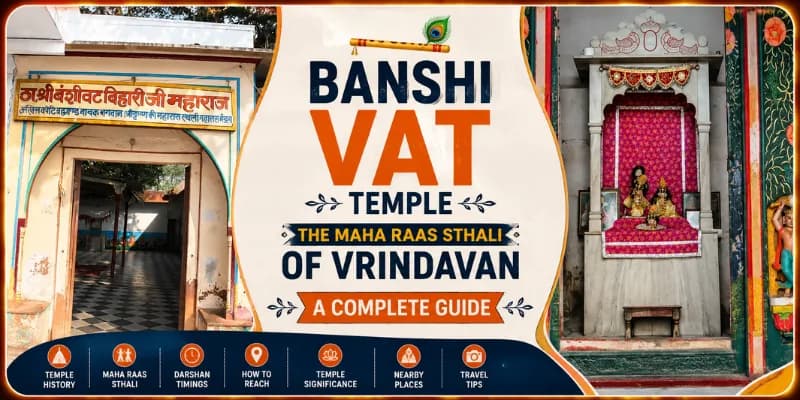
Today Banshi Vat is a temple complex of some size in the heart of Vrindavan, holding, by the tradition, sacred treasures. At its centre is a small shrine of the Charan, the sacred footprints of Radha and Krishna, revered as given, in the tradition, to a great devotee sage in the early nineteenth century and served by the temple's hereditary custodians ever since. Behind the Charan hangs a pichwai, a devotional painting, depicting the Maha Raas leela, said to have been painted by a revered saint of the site.
A larger temple in the same complex holds the deities of Radha Krishna, worshipped daily, built, in the tradition, by a royal patron in a later century. So a visit to Banshi Vat brings darshan of the sacred footprints of Radha and Krishna, the pichwai of the Maha Raas and the deities of the larger temple, in the very place of the great dance. These, rather than grand architecture, are the treasures of Banshi Vat, cherished by its devotees. We present the story of the Charan and the deities as the tradition of the site holds it.
The ancient banyan and Radha Gopinath
At the heart of Banshi Vat's story is the ancient banyan tree, the vat, from which, by the tradition, the beloved deity Radha Gopinath appeared. The tradition tells that when a great Gaudiya saint was serving and sweeping the place, he found a flute at the root of the tree, and, digging deeper, the self-manifested deity of Radha Gopinath emerged from the spot, a wondrous appearance that made Banshi Vat one of the most sacred of Vrindavan's sites.
The Radha Gopinath deity that appeared here was later, in the tradition, moved to Jaipur for safekeeping during a time of danger to the temples of Braj and is worshipped there to this day, as with several of Vrindavan's great deities. So the original deity is now at Jaipur, while Banshi Vat remains the sacred place of its appearance and of the Maha Raas. We present the appearance of the deity, as we do the self-manifestation of the deities of Braj, as the cherished belief and tradition of the sampradaya, held with faith and recounted with reverence.
Banshi Vat and the sampradayas
Banshi Vat is remarkable for being cherished across several of the great devotional traditions of Braj, each of which honours it.
The Gaudiya tradition: by the tradition, when the great saint Chaitanya Mahaprabhu visited Vrindavan, he first came to Banshi Vat, served the place and entrusted it to his disciples; the deity Radha Gopinath appeared here to a Gaudiya Goswami and the site is mentioned in the Chaitanya Charitamrita.
The Nimbark tradition: Banshi Vat is deeply revered in the Nimbark sampradaya, founded and served here by its acharyas and mentioned in its books; a revered saint of the tradition painted the pichwai of the Maha Raas and composed devotional works here.
The Pushtimarg tradition: by the tradition, Shri Vallabhacharya, founder of the Pushtimarg, came to Vrindavan seeking a pure place for the Bhagavata katha and chose Banshi Vat and it is linked in the tradition with an early darshan of Shrinathji.
The raas leela stage tradition: by the tradition, the staged raas leela performances, now beloved across Braj, were first performed here at Banshi Vat, as the original place of the raas.
So Banshi Vat is honoured by the Gaudiya, Nimbark and Pushtimarg traditions alike, a rare meeting-point of the sampradayas, each drawn by the sanctity of the Maha Raas Sthali. This layered devotion, of saints and acharyas across the centuries, gives Banshi Vat a rich living heritage. We present the significance of the site to each tradition as that sampradaya holds it, with respect, honouring the faith of all who cherish it.
Sharad Purnima and the raas leela
The great festival of Banshi Vat is Sharad Purnima, the full-moon night of the autumn, revered as the very night of the Maha Raas, when, by the tradition, Krishna danced the great raas with the gopis in the moonlight. On this night, Banshi Vat and all Vrindavan celebrate the raas with special fervour, worship and joy and it is a supremely fitting and beautiful time to be at the Maha Raas Sthali, though also crowded.
Through the year and especially in the festival seasons, the raas leela is also performed on stage in Vrindavan, the devotional dramatisation of Krishna's pastimes that, by the tradition, was first performed here at Banshi Vat. So the site is bound up with both the original raas and its living re-enactment. Our braj festival calendar guide covers Sharad Purnima and the festivals of Braj. For the raas and its dates, come in the autumn, around Sharad Purnima, for the most fitting darshan of the Maha Raas Sthali.
Timings, darshan and how to visit
Banshi Vat keeps morning and evening darshan hours, like the temples of Vrindavan, closing for a few hours in the middle of the day. So plan a morning or an evening visit and avoid the midday closure. The exact hours vary by season and by the temple's discretion, so it is worth confirming locally, but the morning-and-evening pattern holds.
Darshan is free, as throughout Braj. Dress modestly, be ready to remove your footwear and move quietly and reverently through this sacred place, taking darshan of the Charan, the pichwai and the deities. Allow an unhurried half hour or more for the visit, more if you combine it with the neighbouring sites and the parikrama marg. Being a little off the main tourist track, in the old town near the river, Banshi Vat is often calmer than the most famous temples, a peaceful place for devotion. Beware anyone pressing for large donations; keep offerings voluntary.
How to reach Banshi Vat
Banshi Vat is in the heart of old Vrindavan, near the Yamuna and the parikrama marg and there are two main ways to reach it.
By the Chhatikara-Vrindavan road and the ISKCON and parikrama marg, reaching the site from the parikrama marg side, a good route now that the marg is renovated, suited to a larger vehicle.
By the Mathura-Vrindavan road, past the Rangji temple and through Gopinath Bazar, by the small old-town lanes, suited to a small car or a rickshaw.
Vrindavan is about 13 km from Mathura and 150 km from Delhi; reach Vrindavan first, then the site within the old town.
Within the old town, the final approach is on foot or by rickshaw through the lanes to the temple.
Because it lies in the old-town lanes near the river, the final approach to Banshi Vat is best made on foot or by cycle-rickshaw, as in much of old Vrindavan. A local guide or a planned tour makes finding it easy. Our how to reach vrindavan guide covers arriving in Vrindavan, our how to commute in vrindavan guide getting around the old town and our vrindavan parikrama route guide the parikrama marg on which Banshi Vat stands.
Combining with the sites of Vrindavan
Banshi Vat is easily combined with the great sites of Vrindavan around it.
With Keshi Ghat and the Yamuna: the sacred ghat and the evening aarti, near Banshi Vat on the river.
With Nidhivan and Seva Kunj: the sacred groves of the raas leela, in the same devotional heart of Vrindavan.
With Banke Bihari and the Goswami temples: the beloved temples of the old town nearby.
On the parikrama marg: Banshi Vat stands on the Vrindavan parikrama route, so it is naturally taken in on the circuit.
So a visit to Banshi Vat fits naturally into a fuller Vrindavan pilgrimage, the temples, the groves and the ghats of the old town and the parikrama. We arrange Vrindavan visits taking in Banshi Vat and the town's great sites, with the transport, the routing through the lanes, the timing and a knowledgeable local guide to tell the stories of the Maha Raas and the sampradayas. A shared day tour starts from around ₹1,499 per person, with darshan free throughout and our one-day vrindavan tour package and two-day mathura vrindavan tour cover the twin cities. Our best time to visit vrindavan mathura guide helps you plan. Message me on WhatsApp at +91-7302265809 to arrange your visit to the Maha Raas Sthali.
Related guides
Meet Gurudutt — Your Mathura Vrindavan Guide
Not just a tour operator — Gurudutt was born and raised in Braj Bhoomi. He has spent over a decade personally guiding pilgrims through the sacred lanes of Mathura & Vrindavan.

Founder – Experience My India
Gurudutt
Founder · Experience My India