The temple of grace
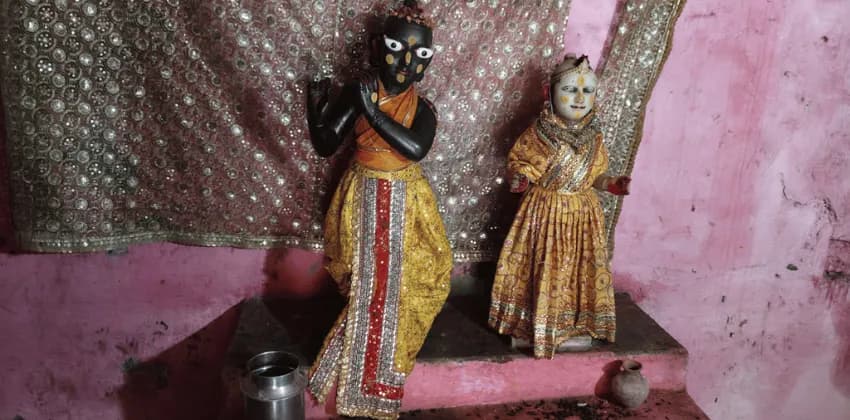
In the busy old lanes of Mathura, near Holi Gate, stands a small, easily-missed temple that holds one of the most moving stories in all of Krishna's life - the Krishna Kubja Temple. Most visitors hurry past it to the great sites - the Janmabhoomi, Dwarkadhish, Vishram Ghat. But this modest shrine, said to be about 500 years old, is unlike any other in Braj: it is the one temple where Krishna stands not with Radha, but with Kubja - the hunchbacked servant-girl he lifted up with a single touch.
It is, in a word, the temple of grace - of the truth that no one is too lowly, too broken or too overlooked for Krishna's love. For the pilgrim who seeks not spectacle but mercy, it is a quiet jewel. Radhe Radhe.
Who was Kubja (Trivakra)?
The story comes from the Bhagavata Purana. When Krishna and Balarama first entered Mathura to confront the tyrant Kamsa, they passed through the streets and met a young woman carrying a tray of sandalwood paste (chandan) for the king. She was hunchbacked - bent in three places - and so was called Trivakra ("three bends") or Kubja ("the hunched one"); she was a maidservant in Kamsa's service.
Seeing Krishna, her heart overflowed with love and she offered him the precious sandalwood, anointing him and Balarama with it. Moved by her pure, selfless devotion, Krishna pressed his foot gently upon her toes, placed his fingers beneath her chin and lifted - and her bent body straightened, her three bends gone, transforming her into a woman of radiant beauty. She who had been pitied and overlooked was, in an instant, made whole and lovely by the Lord's touch.
The unique idol - Krishna with Kubja
What makes this temple one of a kind is its central image. Across Braj - across the whole world of Krishna-worship - Krishna is shown with Radha, his eternal beloved or with his cowherd-friends or as the child of Yashoda. But here and (by tradition) here alone, Krishna stands beside Kubja - depicted in the moment after her transformation, the straightened, beautiful woman beside the Lord who lifted her.
It is a deliberate, theological choice: this temple does not celebrate the romance of Radha or the play of the gopis, but a different kind of love entirely - the Lord's compassion for the lowliest of his devotees. To stand before this rare image is to be reminded that Krishna's grace is not reserved for the beautiful or the great.
The meaning - grace to the overlooked
The Kubja leela carries one of the most tender messages in all of bhakti: that Krishna sees the heart, not the body or the station. Kubja was deformed, low-born, a servant of his enemy - the kind of person the world ignores. Yet she offered what little she had, sandalwood meant for a tyrant, with pure love - and that single sincere offering drew the Lord's full grace.
The teaching is plain and beautiful: no soul is too broken, too humble or too overlooked to be healed and uplifted by Krishna. One does not need wealth, beauty, ritual or status - only a sincere heart. For every pilgrim who has felt unseen or unworthy, Kubja's temple says quietly: Krishna sees you. It is, in this, a deeply comforting and dignifying shrine.
The healing tradition - an honest word
The temple carries a strong popular tradition of healing, especially of skin ailments - devotees come to pray and offer sandalwood paste (echoing Kubja's own gift), tulsi and sweets, believing in the same transforming touch that made Kubja whole. Many share heartfelt stories of relief and comfort.
Here I must be honest, as a guide who cares for you. This is a matter of faith and devotional tradition - not medical fact. A temple is a place of prayer, peace and grace; it is not a substitute for a doctor or proper medical care. If you or a loved one has a health condition, please see a qualified physician - and visit the temple, if you wish, for the comfort, hope and devotion it offers, not as a cure. The true gift of Kubja's temple is spiritual: the assurance of grace, the easing of the heart. Come for that, with faith and never let anyone exploit your hope or fear.
Kubja Kupa - the well of the meeting
Nearby tradition also points to Kubja Kupa - the well where, in the telling, Kubja first met Krishna and Balarama as she carried her sandalwood toward Kamsa's palace. Such leela-sites dot old Mathura, each marking a moment of Krishna's brief, world-changing entry into the city. If you visit the temple, you can ask locally about the Kupa; like much of old Mathura, it is tucked into the lanes and best found with someone who knows the way.
The deeper Puranic story
For those who love the scriptures, the Kubja leela has deeper, varying layers. In some traditions (the Brahma Vaivarta Purana), Kubja is held to be the reincarnation of Surpanakha - Ravana's sister, who had desired Rama in the previous age - her devotion at last finding fulfilment in Krishna; other folk tellings link her instead to Shabri, the devotee who served Rama her berries. These are sampradaya and oral traditions that vary and a good Brajwasi shares them as the rich, differing lore they are, rather than fixing one as certain. What they share is the theme of devotion rewarded across lifetimes - the long arc of grace.
Is the temple open? An honest note
A practical honesty, because I would not have you walk to a locked door: the Krishna Kubja Temple has been reported closed for restoration, its old structure worn by pollution and time, with preservation work underway. Things change - it may since have reopened or work may continue. So before you set out, verify its current status - ask locally or let a Braj-based guide confirm it is open and accessible on the day. The story and the site endure regardless; but for a darshan, check first.
How to visit
A few honest pointers:
Location - Krishna Puri Colony, Antapara, near Holi Gate and Tank Choraha, about a 10-15 minute walk from Vishram Ghat; easily paired with the Vishram Ghat aarti and the old-city temples.
Verify it is open - given the reported restoration, confirm before you go.
The lanes are narrow - old-Mathura galis; wheelchair access is difficult and a local guide helps you find this easily-missed shrine.
Timings - small old-city temples keep informal hours; verify on the temple timings guide and locally.
Offerings - sandalwood paste, tulsi and sweets are traditional; give donations only of your own free will.
Festivals
The Kubja leela belongs to Krishna's entry into Mathura, so the temple resonates with Mathura's great Krishna festivals:
Janmashtami - Krishna's birth, the supreme Mathura festival, fills the whole old city.
Holi - Mathura's Holi (Holi Gate is right beside the temple) is famous and fervent.
Festival dates are tithi-based and move yearly, so verify the current year's dates. If the temple is under restoration, confirm whether it observes them.
Temples to combine nearby
The Kubja Temple sits in the heart of old Mathura, easily combined with:
Vishram Ghat & the Yamuna leela-sites - a 10-15 min walk away
Shri Dwarkadhish Temple - Mathura's most-thronged temple, nearby
Shri Krishna Janmabhoomi - the birthplace
Mathura's Guardian Mahadevs & Devis - the old city's Shiva and Devi shrines
Browse all at the Famous Temples of Mathura Vrindavan hub.
Author's tips from Gurudutt - what only a local knows
Verify it is open first - the reported restoration means a guide or a local call saves you a wasted walk.
Come for grace, not a cure - the temple's gift is the comfort and dignity of Kubja's story; for health, see a doctor.
Pair it with Vishram Ghat - it is a short walk; do the ghat aarti and this quiet shrine together.
Bring sandalwood - offering chandan, as Kubja did, is the fitting gesture here.
Take a guide for the lanes - it is easily missed in the old-city galis; a local finds it in a moment.
Everyone wants the temple of Radha and Krishna, the romance, the beauty. But let me take you to a little door near Holi Gate, to the one temple where Krishna stands with Kubja - a hunchbacked servant-girl nobody looked at twice. He looked. He touched her and she stood up straight and lovely. That is the Krishna I want you to meet: the one who sees the person everyone else walks past. If you have ever felt unseen, this is your temple. - Gurudutt