Travel Guide · Temple Guides · Updated July 2026
Rangji Temple, Vrindavan: The Dravidian Temple, Brahmotsav and a Visitor's Guide
By Gurudutt, Experience My India·23 July 2026
Quick Answer
Quick Enquiry
Key facts at a glance
What | One of Vrindavan's largest temples, the only major Dravidian style one |
Built | In 1851 by Seth Govind Das and Seth Radha Krishna |
Deity | Lord Ranganatha, a reclining form of Vishnu, with Goddess Andal |
Highlights | A tall seven storey gopuram and a 50 foot gold plated pillar |
Festival | Brahmotsav, the ten day Rath ka Mela chariot festival, in spring |
Entry | Free. Midday closure. Inner sanctum has a traditional entry custom |
What is Rangji Temple and why it stands apart
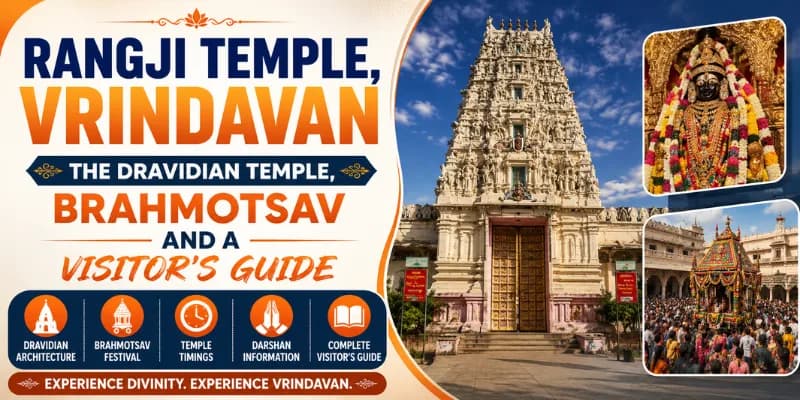
Rangji Temple, properly Sri Ranganath Ji Temple, is one of the largest temples in Vrindavan and quite unlike anything else in the town. While Braj's temples are overwhelmingly in the North Indian idiom, Rangji is built in the grand South Indian Dravidian style, inspired by the great Ranganathaswamy temple of Srirangam in Tamil Nadu. Walking into its vast, colonnaded enclosures feels like stepping into the deep south, transplanted to the land of Krishna.
Built in 1851, it is dedicated to Lord Ranganatha, a reclining form of Vishnu and to Goddess Andal. Its towering gopuram, gold plated pillar, temple tank and gardens make it a genuine change of scene from the intimate old lane temples. Our how to plan a mathura vrindavan trip guide shows where it fits in a Vrindavan day; this page is the full visitor's guide.
From the ground (Gurudutt): I send visitors to Rangji when they want space and grandeur rather than the crush of the old temples. It is vast and calm, with room to wander the enclosures and sit by the tank. Give it unhurried time; it is as much a serene garden temple to walk as a darshan to take. See our mathura vrindavan tour or message WhatsApp +91 7302265809.
The story: Lord Ranganatha and Goddess Andal
The temple is dedicated to Lord Ranganatha, worshipped as Rangamannar, a form of Vishnu who reclines on the coils of the sacred serpent Sesha and to Goddess Andal, also called Goda. Andal was a revered eighth century Tamil Vaishnava saint who composed the beloved devotional hymns of the Thiruppavai and by tradition longed for and was united with the Lord as her bridegroom.
The temple thus carries the deep devotion of the South Indian Sri Vaishnava tradition into the heart of Braj, its rituals conducted by South Indian priests in the Vedic manner of that lineage. Within the complex are also shrines to other forms of the Lord, including Narasimha, Rama and Venugopala and to the great teacher Ramanujacharya.
On the tradition: We describe the temple's South Indian Sri Vaishnava tradition and the story of Andal as they are held and practised here, respectfully, without adjudicating the finer points different traditions hold in their own ways.
The Dravidian architecture: gopuram, gold pillar and tank
The architecture is the great draw, a fusion of Dravidian, Rajput and Mughal styles, unique in Vrindavan. The temple is entered through a towering seven storey Rajagopuram, the South Indian gateway tower, guarded by the divine gatekeepers Jaya and Vijaya, leading through concentric rectangular enclosures toward the sanctum.
The seven storey Rajagopuram, a soaring South Indian gateway tower.
A striking 50 foot Dhwaja Stambha, a pillar believed to be gold plated.
The temple tank, the Pushkarni, with steps to sit by and a garden view.
Vast colonnaded enclosures and stone gates carved in Rajasthani style.
It is spread over a large expanse, so it is as much a place to walk and sit as to take darshan. The steps by the tank, with the garden beyond, are a lovely spot to rest, a rare quiet openness among Vrindavan's dense temple lanes.
Entry: who can go where
There is one practical point worth knowing before you visit and I state it plainly and neutrally, as it is simply the temple's long standing custom. In keeping with its South Indian tradition, the innermost sanctum where the deity resides is entered by Hindus, while other visitors are welcome through the courtyard and enclosures and there are further gateway limits for non Indian visitors. This mirrors the custom of the great southern temples it is modelled on.
No visitor should feel unwelcome: the vast enclosures, the gopuram, the tank and the atmosphere are open to be enjoyed and the temple draws people of every background. It is simply worth knowing the custom in advance so no one is surprised at a gateway. If you are travelling from abroad, our vrindavan guide for foreigners covers this and the wider trip.
Timings and darshan
Rangji opens for darshan in the morning and again in the evening, with a midday closure, as at Braj temples generally. Being large and less crowded than the famous old temples, it is an easy, unhurried darshan. Because exact hours shift by season, we do not print fixed clock times here.
Morning darshan, calm and uncrowded compared with the old temples.
A midday closure, as across Braj.
Evening darshan, lovely with the aarti and the lit enclosures.
Timings shift by season and festival, so confirm the day's schedule.
For how Vrindavan timings move through the year, keep our mathura vrindavan temple timings page handy. The evening aarti and the Brahmotsav festival are the two most rewarding times to visit.
Brahmotsav and the festivals
Rangji's great festival is the Brahmotsav, a grand ten day celebration held in spring, in the month of Chaitra and known locally as the Rath ka Mela, the chariot fair. During it the deities are taken out through the town on a huge, beautifully decorated chariot, the rath, drawn by crowds of devotees to a garden pavilion, in the South Indian manner. It draws enormous, joyful crowds and is the temple at its most spectacular.
Brahmotsav, the ten day Rath ka Mela chariot festival in spring, the great highlight.
Vaikuntha Ekadashi, when the Vaikuntha Dwar, the gate of heaven, is opened for devotees to pass through.
Holi, uniquely celebrated here in the temple's own South Indian style.
Jal Vihar and other Sri Vaishnava observances through the year.
For the exact festival dates, which follow the lunar calendar, see our braj festival calendar and confirm locally. The Brahmotsav especially is worth timing a visit around if you can.
What to see and do at Rangji
Beyond the darshan, Rangji rewards an unhurried wander. Take in the towering gopuram and the gold plated pillar, walk the vast enclosures and sit a while on the steps by the temple tank with the garden beyond. Near the entrance there is a small museum and a moving diorama or puppet show, a modest, charming extra for a token fee.
It is one of the few Vrindavan temples where you can simply be still in open space, which makes it a restful contrast to the intensity elsewhere. For other calm corners of the town, see our vrindavan temples less crowded peaceful darshan guide.
How to reach Rangji Temple
Rangji sits on Rangji Mandir Road in Vrindavan, close to Banke Bihari and the other central temples, a modest distance from Mathura. Being a large complex, it is easier to reach and approach than the tightest old lane temples, though as ever you may walk or take an e-rickshaw the final stretch.
Reach Vrindavan first, then it is a short local ride. It pairs naturally with banke bihari temple and the central temples in the same part of town, offering a complete change of architectural scene within the same morning.
Fitting Rangji into a Vrindavan visit
Rangji makes a wonderful, spacious contrast within a Vrindavan day: pair it with the intimate old temples for the sheer variety and time it for the evening aarti or, if you can, for the Brahmotsav chariot festival. Its calm and grandeur balance the crush of the famous shrines beautifully.
We fold Rangji into our Vrindavan visits, timed for a calm darshan or the aarti and around the Brahmotsav for those who want the spectacle. A shared tour starts from around ₹1,499 per person on our 1 day vrindavan darshan package, with darshan free throughout. Message me on WhatsApp at +91-7302265809 and I will place Rangji in your day at the right moment.
Meet Gurudutt — Your Mathura Vrindavan Guide
Not just a tour operator — Gurudutt was born and raised in Braj Bhoomi. He has spent over a decade personally guiding pilgrims through the sacred lanes of Mathura & Vrindavan.
Founder – Experience My India
Gurudutt
Founder · Experience My India