Travel Guide · Temple Guides · Updated July 2026
Radha Raman Temple, Vrindavan: The Self-Manifested Deity, Timings and a Visitor's Guide
By Gurudutt, Experience My India·23 July 2026
Quick Answer
Quick Enquiry
Key facts at a glance
What | A principal Gaudiya temple in the old lanes of Vrindavan, near Keshi Ghat |
Established | In 1542 by Gopala Bhatta Goswami, a disciple of Chaitanya Mahaprabhu |
The deity | By tradition self-manifested from a shaligram shila, worshipped unbroken since |
No Radha idol | A crown beside Krishna represents Radha's presence |
Also here | The appearance place, Gopala Bhatta's samadhi and Chaitanya relics |
Entry | Free. Midday closure. Photography restricted inside |
What is Radha Raman Temple and why it matters
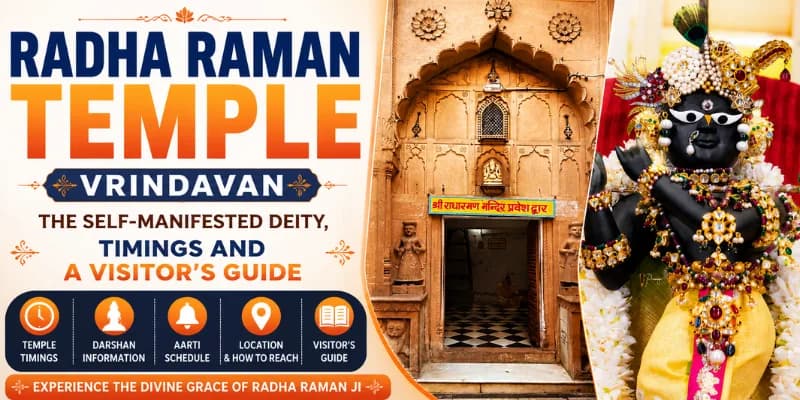
Radha Raman Temple is one of the most revered and atmospheric temples of Vrindavan, tucked in the old lanes near Keshi Ghat and one of the seven principal Thakur temples of the town. Its name means the one who gives pleasure to Radha. For followers of Gaudiya Vaishnavism especially, it is deeply sacred, for its deity is held, by tradition, to be self-manifested and the same original deity has been worshipped here unbroken for centuries.
It is a quieter, deeper darshan than the great crowd temples, a place of high standards of worship and genuine devotional atmosphere. Our how to plan a mathura vrindavan trip guide shows where it fits in a Vrindavan day; this page is the full visitor's guide to the temple and its remarkable story.
From the ground (Gurudutt): Radha Raman is where I take devotees who want depth rather than spectacle. It does not have the crush of Banke Bihari or the scale of Prem Mandir, but the quality of worship and the atmosphere are among the finest in Vrindavan. Come unhurried and let it work on you. See our mathura vrindavan tour or message WhatsApp +91 7302265809.
The story: Gopala Bhatta Goswami and the shaligram
The temple was established in 1542 by Gopala Bhatta Goswami, one of the Six Goswamis of Vrindavan and a close disciple of the great saint Chaitanya Mahaprabhu, who had sent him to Vrindavan to serve. By the beloved tradition, Gopala Bhatta worshipped shaligram shilas, sacred stones, which he had gathered from the Kali Gandaki river in Nepal.
Longing to serve the Lord in a form with a face and limbs he could adorn and dress, rather than a round stone, Gopala Bhatta prayed with deep devotion. By tradition, one of the shaligrams then manifested of its own accord into the enchanting form of Krishna playing the flute, with a mystic smile. This self-manifested deity became known as Radha Raman. We share this as cherished tradition, held with reverence.
On the tellings: We recount the appearance of Radha Raman as living Gaudiya tradition, deeply held, rather than asserting it as verified fact. Braj holds such stories as devotion and we honour them in that spirit.
The self-manifested deity and why there is no idol of Radha
What makes Radha Raman so special to devotees is that the deity is, by tradition, swayambhu, self-manifested, not carved by any human hand and it is the same original deity worshipped since 1542, never replaced. That unbroken continuity, over more than five centuries, is rare and precious.
There is another distinctive feature that surprises first time visitors. Although the temple is named for and dedicated to Radha, there is no separate idol of Radha Rani. Instead, a crown is placed beside Krishna to signify her presence. In the Gaudiya understanding, Radha is present with Krishna in essence and the crown lovingly marks that. It is one of the tender details that makes Radha Raman unlike any other temple.
The eternal flame and the highest standards of worship
Radha Raman is known among Vrindavan's temples for the exacting, loving standard of its daily worship, conducted by the Goswami sevayats in the Gaudiya tradition of Gopala Bhatta. Everything, the bathing, dressing, offering and kirtan, is done with great care and devotion.
By cherished tradition, the sacred flame used for the temple's rituals is said to have burned continuously for centuries, never allowed to go out, each day's fire kindled from that same living flame rather than struck anew. Devotees hold this as a moving sign of unbroken devotion. We share it, as with the appearance story, as tradition held with reverence rather than a claim we assert as proven.
Timings and darshan
Radha Raman opens for darshan in the morning and again in the evening, with a midday closure, following the daily rhythm of its seva. The worship is rich with kirtan and the deity is revealed through the day's offerings. Because exact hours shift by season, we do not print fixed clock times here.
Morning darshan, with the day's early seva and offerings.
A midday closure, as at Braj temples generally.
Evening darshan, with kirtan and the evening seva.
Timings shift by season and festival, so confirm the day's schedule.
For how Vrindavan timings move through the year and to plan around the midday closures at Radha Raman and elsewhere, keep our mathura vrindavan temple timings page handy. An early morning darshan is the calmest and most peaceful.
What to see: the appearance place, samadhi and relics
Radha Raman offers more than the darshan of the deity and it rewards an unhurried visit.
The self-manifested deity of Radha Raman, with the crown beside him for Radha.
The appearance place, where by tradition the deity manifested to Gopala Bhatta.
The samadhi of Gopala Bhatta Goswami, within the complex beside the appearance place.
Preserved relics, including, by tradition, the seat of Chaitanya Mahaprabhu and belongings of Gopala Bhatta.
These make Radha Raman not just a temple but a living link to Chaitanya Mahaprabhu and the Six Goswamis who shaped Vrindavan's devotion. For other calm, deep darshans away from the crowds, see our vrindavan temples less crowded peaceful darshan guide.
Festivals at Radha Raman
The most special day here is the appearance day of Radha Raman, celebrated on Vaishakha Purnima, the full moon of the month of Vaishakha, in April or May, when the deity is bathed with milk and other offerings in a beautiful abhishek. It is the temple's own anniversary and its most cherished festival.
The temple also observes the wider Gaudiya calendar with devotion and the Braj festivals of Jhulan in the monsoon, Janmashtami and Holi bring their own beauty and larger crowds. For the dates, which follow the lunar calendar, see our braj festival calendar and confirm locally before you travel.
Entry, photography and how to reach
Entry to Radha Raman is free, with no ticket for darshan. As at many temples, photography inside is restricted to preserve the sanctity, so follow the sevayats' guidance and appreciate the deity and the atmosphere with your own eyes. Dress modestly and remove footwear, as at any temple.
The temple is in the old lanes of Vrindavan near Keshi Ghat, so vehicles cannot reach it directly; you alight nearby and walk the last stretch through the lanes. It sits close to Banke Bihari, Nidhivan and Keshi Ghat, so it pairs naturally with them. Our how to reach vrindavan guide covers getting into Braj, from where the old city temples sit close together.
Fitting Radha Raman into a Vrindavan visit
Radha Raman belongs in a calm early morning circuit of old Vrindavan, alongside Banke Bihari, Nidhivan and Keshi Ghat, all a short walk apart, before the midday closures. It is the deep, quiet darshan that balances the busier temples and a place devotees often return to again and again.
We fold Radha Raman into our Vrindavan mornings, sequenced with the nearby temples and timed for a calm darshan. A shared tour starts from around ₹1,499 per person on our 1 day vrindavan darshan package, with darshan free throughout. Message me on WhatsApp at +91-7302265809 and I will place Radha Raman in your morning at the right moment.
Meet Gurudutt — Your Mathura Vrindavan Guide
Not just a tour operator — Gurudutt was born and raised in Braj Bhoomi. He has spent over a decade personally guiding pilgrims through the sacred lanes of Mathura & Vrindavan.
Founder – Experience My India
Gurudutt
Founder · Experience My India