Travel Guide · Travel Guides · Updated October 2026
Seva Kunj vs Nidhivan: What Is the Difference
By Gurudutt, Experience My India·23 October 2026
Quick Answer
Quick Enquiry
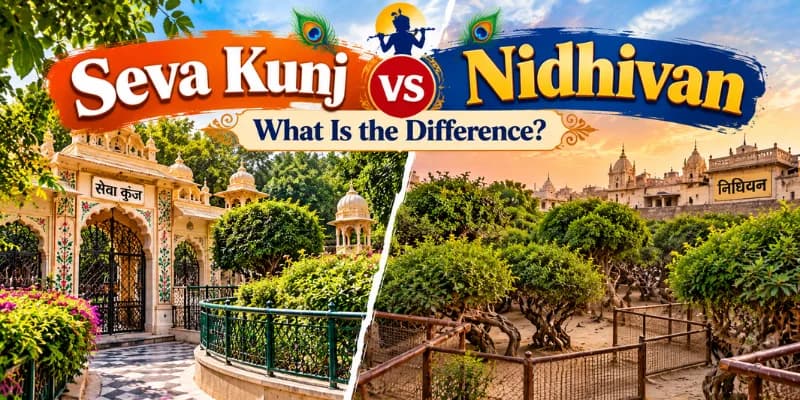
Seva Kunj and Nidhivan are both ancient, walled groves in the heart of old Vrindavan, within a short walk of each other and both are among the most atmospheric and revered spots in the town. Yet despite their closeness, they commemorate different pastimes of Radha and Krishna and feel quite distinct. One is a tender grove of loving service; the other a mysterious forest of divine dance and manifestation. Visiting both, which is easy given their proximity, lets you experience two complementary facets of Braj devotion in a single, short walk. See our Mathura Vrindavan tour Packages or message WhatsApp +91 7302265809.
Spiritual significance and legends
The heart of the difference is in the pastime each grove commemorates.
Seva Kunj: the grove of service
seva kunj focuses on the tender, selfless devotion of Krishna himself. It is believed to be the place where Krishna personally served Radha Rani, massaging her feet, arranging her hair and decorating her with flowers after they danced together. Its very name, the Grove of Service (seva), captures this mood of loving, selfless care, the Lord serving his devotee, which makes it one of the sweetest and most intimate sites in Vrindavan.
Nidhivan: the mystical forest
nidhivan is celebrated as the stage of the Maha Raas Leela, where Krishna dances with Radha and the gopis. It is also famously the Prakatya Sthal, the place where the deity of banke bihari first manifested before the great saint and musician Swami Haridas. So Nidhivan carries a double significance, the divine dance and a living manifestation, which gives the grove its uniquely charged, mysterious atmosphere.
Physical layout and what is inside
The two groves look and feel completely different on the ground.
Seva Kunj
Seva Kunj is a smaller, relatively calm marble temple complex surrounded by ancient trees. Its devotee pathways are secured with iron mesh or grills, which keeps visitors protected from the local monkeys, a real comfort. The temple interiors feature beautiful wall and ceiling murals depicting scenes of the Raas Leela and Holi. Inside you will find the central temple shrine, the Lalita Kund (a holy pond) and a version of the Rang Mahal where the divine couple is said to rest.
Nidhivan
Nidhivan is a much larger, sprawling forest grove, densely packed with small, uniquely twisted Tulsi (holy basil) trees whose branches bend downward toward the earth or entwine in pairs. It is completely open-air and un-netted, so monkeys roam freely throughout, keep your glasses, phone and snacks secured. At its heart is the main Rang Mahal shrine, where priests are said to leave out daily items such as a toothbrush, water and sweets that are found used the next morning, alongside the Samadhi (tomb) of Swami Haridas.
Core comparison
A simple side-by-side of the two groves.
Feature | Seva Kunj | Nidhivan |
Core theme | Krishna’s loving service (seva) to Radha | The divine dance (Raas Leela) and the manifestation of Banke Bihari |
Monkey protection | High; walkways fully covered in protective iron mesh | None; a fully open grove with highly active monkeys |
Key historical figure | Tied to the broader theology of Braj devotion | Strongly tied to the saint Swami Haridas |
Landscape | Small grove, marble temple structures, extensive wall murals | Large natural grove filled with pairs of twisted Tulsi trees |
The shared rule: gates close before sunset
For all their differences, Seva Kunj and Nidhivan share one striking rule: both strictly lock their gates before sunset. Local lore firmly holds that no humans, animals or birds are allowed to remain inside overnight, because Radha and Krishna return every single evening to perform their mystical pastimes. This belief is taken very seriously in Vrindavan and the sealed Rang Mahal of Nidhivan, with its daily-used offerings, is cited as part of the mystery. Whether you take it as devotional faith or simply as one of Braj’s most beautiful legends, plan to visit both groves well before sunset, as they will close.
Best time to visit: season and time of day
When you go shapes which grove feels strongest and the shared sunset rule sets a firm outer limit.
Both groves are open through the year, but the mood of each shifts with the season and even more, with the hour of the day. The single rule you must plan around is the one both share: the gates are locked before sunset, so there is never any question of an evening visit inside either grove. Treat the day and ideally the morning, as your window and confirm the current opening and closing times locally, because they move with the season and with temple arrangements.
Time of day matters most. Early to mid morning is the calmest and the loveliest, with soft light on the murals of Seva Kunj and on the low, twisted Tulsi of Nidhivan and the smallest crowds. Mid day is bright and busier. By late afternoon you are racing the closing, so do not leave either grove for the end of a long itinerary. If photography or a quiet, unhurried darshan matters to you, arrive soon after the groves open and take Nidhivan first, while the forest is still cool and the light is gentle.
Season changes the frame around the visit. Braj is very hot from about April to June, so an early start is essential then; the monsoon from roughly July to September greens the groves and the Tulsi but can bring mud underfoot; and the cool, pleasant window of about October to March is the most comfortable, which is also when crowds are heaviest around Kartik, Diwali and above all, Holi and Janmashtami. On the big festival days the old lanes around both groves are packed, the atmosphere is electric and darshan is slower, so weigh a quieter weekday against a festival if crowds trouble you. All of these are seasonal patterns rather than fixed rules, so confirm locally before you plan around them.
Nearby sites and weaving the two groves into a Braj day
Because both groves sit in the heart of old Vrindavan, they slot naturally into a wider darshan.
Seva Kunj and Nidhivan are in the congested old quarter, a short walk from the town’s most important temples, which is exactly why they are so easy to combine. The most natural pairing is with Banke Bihari darshan, since Nidhivan is, by tradition, the very grove where that deity first manifested to Swami Haridas, so the story and the shrine sit minutes apart and make far more sense seen together. From there the Radha Raman temple, Prem Mandir on the edge of town and the Yamuna ghats are all within an easy Vrindavan circuit.
A simple, workable order for a half day is to take an early Banke Bihari darshan, walk to Seva Kunj and Nidhivan next while the morning is still fresh and well before the sunset closing and keep the open-air sites such as the ghats or Prem Mandir for later in the day when the groves have shut. This keeps the two time-bound groves safely in daylight and lets the rest of the trip flow around them. If you have longer, the same day can reach out to Govardhan or Barsana for a fuller Braj pilgrimage, though that turns a relaxed morning into a full and tiring day, so plan transport and timing carefully and confirm distances and road conditions locally.
Visiting both
Because they are only minutes apart, Seva Kunj and Nidhivan are easy to see together and seeing both is the best way to appreciate the contrast. A few practical tips: go in the morning or well before the gates close at sunset; at Nidhivan especially, secure your glasses, phone and snacks against the monkeys; dress modestly as for any Braj temple; and move respectfully and quietly in both groves. They sit in the old quarter near the main temples, so you can easily combine them with Banke Bihari darshan. For planning the wider trip, see our mathura vrindavan tour itinerary and best time to visit vrindavan guides and how to reach vrindavan for getting here.
Let us show you the hidden stories of Vrindavan
Groves like Seva Kunj and Nidhivan come alive when someone who grew up with their stories walks them with you. As a Brajwasi, I can take you through both at the right time of day, tell you the pastimes and the mysteries behind each one, steer you safely past the monkeys and weave them into a wider Vrindavan darshan, Banke Bihari, Prem Mandir, the ghats and out to Govardhan and Barsana. A shared day tour starts from around 1,499 rupees per person or we design a private vrindavan tour package at your pace. Darshan is free. Message us on WhatsApp at +91-7302265809 with your dates.
Related guides
Book Your Mathura - Vrindavan Trip Today
📞 +91-7302265809
💬 WhatsApp: +91-7302265809
We Reply in 30 Minutes
Packages start from ₹1,999/ person | Rated 4.5★ / 204+ Reviews
Explore all: Mathura Vrindavan Tour Packages
Jai Shri Krishna
Start with these
Related guides
Meet Gurudutt — Your Mathura Vrindavan Guide
Not just a tour operator — Gurudutt was born and raised in Braj Bhoomi. He has spent over a decade personally guiding pilgrims through the sacred lanes of Mathura & Vrindavan.

Founder – Experience My India
Gurudutt
Founder · Experience My India