Travel Guide · Travel Guides · Updated November 2026
Agra Fort Visiting Guide: Timings, Tickets and Time Needed
By Gurudutt, Experience My India·5 November 2026
Quick Answer
Quick Enquiry
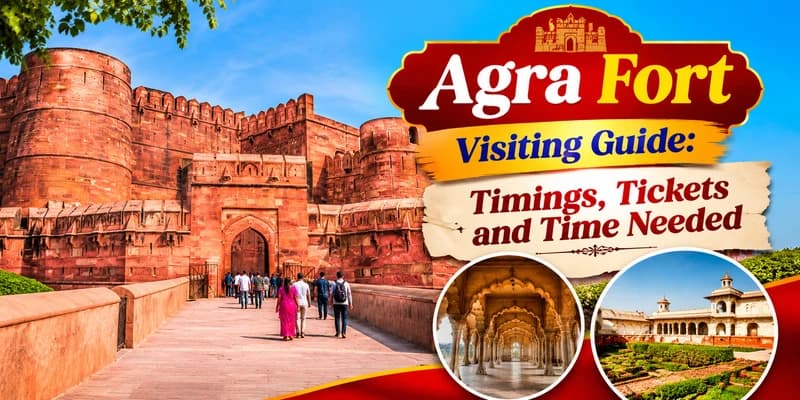
Agra Fort is the one most people rush and it deserves better. It is a huge red-sandstone Mughal fort right by the Yamuna and the big practical point is that, unlike the Taj, it is open every day including Friday, so it is the perfect thing to do on a Taj-closed Friday, which is exactly why it gets busy then. Give it two to three hours, not twenty minutes. Stand in the Musamman Burj, the marble tower where Shah Jahan was kept prisoner by his own son and look across the river at the Taj he built, that view, with that story, is the heart of a visit. Buy the e-ticket, enter at the Amar Singh Gate and all the numbers here are indicative, so check the official ASI portal near your date. See our Mathura Vrindavan tour Packages or message WhatsApp +91 7302265809.
Agra Fort timings: open every day, including Friday
Agra Fort is open daily from sunrise to sunset, approximately 6:00 AM to 6:00 PM, every single day of the week. The ticket counters close about an hour before the fort, around 5:00 PM, so arrive in good time if you are buying at the gate.
The single most useful thing to know about Agra Fort timings is that, unlike the Taj Mahal, Agra Fort is open on Fridays. The Taj Mahal is closed every Friday for general sightseeing, so Agra Fort is open seven days a week and is the natural thing to see on a Friday in Agra. The flip side is that this makes Agra Fort noticeably more crowded on Fridays, as Taj-bound visitors redirect here, so if you are visiting on a Friday, arrive right at opening, around 6:00 AM, to explore in relative peace before the crowds build. On any day, the early morning is the best time: cooler, quieter and better light on the red sandstone. Please treat the hours as indicative, tied to the actual sunrise and sunset and confirm the current timings on the official ASI portal before you travel.
Ticket prices and online booking
Agra Fort tickets are priced by visitor category and you can buy them at the gate in cash or, better, online in advance for a cashless discount. The indicative prices are as follows.
Category | Offline cash | Online / digital | Special Friday rate |
Indian citizens | about 50 rupees | about 35 rupees | about 40 rupees |
SAARC and BIMSTEC | about 90 rupees | about 50 rupees | n/a |
Foreign tourists | about 650 rupees | about 550 rupees | about 600 rupees |
Children under 15 | free | free | free |
Please treat these prices as indicative, since fees are set by the authorities and can change, so confirm the current prices on the official ASI portal before you travel. Buying online through the official ASI portal gives the lower digital price and lets you skip the cash line, so for most visitors the advance e-ticket is the smart choice. Children under 15 enter free in every category. One useful combined-ticket point for foreign visitors: if you buy the 500-rupee Agra Development Authority (ADA) toll ticket at the Taj Mahal, you do not need to pay that additional toll segment again at Agra Fort, provided you visit both on the exact same day. So pairing the Taj and the Fort on one day can save the foreign-tourist toll portion.
The entry gate and how long to spend
Two practical points make a visit smooth. First, the entry point: general public and tourist entry is strictly through the Amar Singh Gate only. The fort has other historic gates, but they are not the public entrance, so head for the Amar Singh Gate on the south side.
Second, the time needed: plan to spend about 2 to 3 hours to comfortably explore the major palaces and courtyards. Agra Fort is often underestimated as a quick stop, but it is a vast complex with grand audience halls, marble pavilions and the famous river-facing tower and it rewards unhurried time. Two to three hours lets you take in the main structures without rushing; a flying visit of twenty minutes does it no justice. If you are combining it with the Taj Mahal on the same day, build the Fort in as a proper half-day rather than an afterthought. A licensed guide genuinely adds to the Fort, because so much of its meaning is in the history, which stones alone do not tell.
History and significance
Agra Fort carries monumental historical weight. The site began as an 11th-century brick fort known as Badalgarh, but its great form came when Emperor Akbar the Great ordered a massive rebuild in fine-grained red sandstone between 1565 and 1573. It then served as the primary imperial city and royal residence of the Mughal Dynasty until the capital shifted to Delhi in 1638.
Architecturally, the fort is a blend of Islamic, Persian and Hindu mastery. Akbar built it primarily as an impenetrable military stronghold, but his grandson Shah Jahan, the builder of the Taj Mahal, later converted parts of it into a luxurious white-marble palace complex, softening the fortress into a royal residence. The site holds one of history’s most poignant stories: Shah Jahan spent his final years imprisoned inside the fort’s Musamman Burj by his own son, Aurangzeb, who had seized the throne and legend has it he passed his days gazing across the river at the Taj Mahal, the tomb of his beloved wife, which he had built but could no longer visit. Agra Fort has been a UNESCO World Heritage Site since 1983. Knowing this history, the military fort, the marble palace, the imprisoned emperor and that river view, transforms a walk through the courtyards into something far more moving.
Key structures to see inside
Agra Fort is a complex of palaces, halls and towers. The main structures to see are:
Jahangiri Mahal. The sprawling red-sandstone palace built by Akbar for his son Jahangir, one of the fort’s most striking and best-preserved buildings, blending Hindu and Central Asian design.
Diwan-i-Aam and Diwan-i-Khas. The magnificent halls of public audience (Diwan-i-Aam) and private audience (Diwan-i-Khas), where the emperor met his subjects and his nobles respectively.
Khas Mahal and Sheesh Mahal. Royal marble pavilions; the Sheesh Mahal, the palace of mirrors, is famous for its glass-mosaic mirror work.
Musamman Burj. The octagonal white-marble tower with panoramic, unobstructed views of the Taj Mahal across the river and the room where Shah Jahan was held prisoner in his final years. For many visitors this is the emotional high point of the Fort.
Together these give a full picture of Mughal court life, from the grand public hall to the private marble chambers to the river-facing tower. A local guide can walk you through them in a sensible order and tell you the story of each, which is what brings the Fort alive.
2027 pro-tips and ground rules
A few practical rules and tips make for a smooth visit.
Plan around the Friday effect. Because the Taj Mahal is closed every Friday, Agra Fort becomes heavily crowded on Fridays as Taj-bound visitors come here instead. If you are visiting on a Friday, arrive at 6:00 AM right when the gates open to explore in peace before the crowds build.
Prohibited items. Do not bring large backpacks, electronic tripods, drones, snacks or cigarettes. Only small bags, wallets, phones and water bottles are permitted inside. Travel light to clear security quickly.
Hire licensed guides. To avoid aggressive local vendors and touts, arrange a guide through an official travel agency or hire only verified, licensed personnel at the ticketing gates. Do not engage touts outside the gate.
These are the general ground rules; specific security rules and prohibited-item lists can change, so follow the signage and staff instructions on the day and confirm anything important on the official ASI portal in advance. Beyond these, the usual advice applies: go early, wear comfortable shoes for a lot of walking on stone, carry water and sun protection and give yourself the full two to three hours.
Planning your Agra Fort visit with the Taj and Braj
Agra Fort and the Taj Mahal sit about 2.5 km apart, so they are almost always done together and both pair naturally with the Mathura and Vrindavan side of Braj. The classic plan is the Taj Mahal and Agra Fort on one Agra day (remembering the Taj’s Friday closure, see our separate Taj Mahal timings guide for that) and the Braj temples on another, over a two or three-day trip. Doing the Taj and the Fort on the same day also lets foreign visitors use the shared ADA toll ticket.
For the rest of Agra and the Braj side, see our places to visit in agra and places to visit in mathura guides; for getting there and basing yourself, our how to reach vrindavan and where to stay in vrindavan guides. A ready-made plan makes it easy to fit Agra and Braj together around the Taj’s Friday closure; see our mathura vrindavan tour plan. The simplest way to combine them is a two-day Agra and Braj trip; see our agra mathura vrindavan tour.
Let a Brajwasi plan your visit
We are a Braj team, so Mathura and Vrindavan is our home ground and Agra and its monuments are right next door, which makes the Taj-and-Fort-plus-Braj combination our most popular trip. As Brajwasis running Experience My India, we can plan your Agra day around both monuments and the Taj’s Friday closure, arrange your e-tickets and a licensed Agra guide so you skip the touts, time your Fort visit for the quiet early hours, give the Fort the proper two to three hours it deserves, pair it with the Mathura and Vrindavan temples over a two or three-day trip and handle private transport throughout. See our agra mathura vrindavan tour for the combined trip, or, for the Braj side on its own, a shared Mathura and Vrindavan darshan starts from around 1,499 rupees per person on our mathura vrindavan tour. Message us on WhatsApp at +91-7302265809 with your dates.
Related guides
Book Your Mathura - Vrindavan Trip Today
📞 +91-7302265809
💬 WhatsApp: +91-7302265809
We Reply in 30 Minutes
Packages start from ₹1,999/ person | Rated 4.5★ / 204+ Reviews
Explore all: Mathura Vrindavan Tour Packages
Jai Shri Krishna
Start with these
Meet Gurudutt — Your Mathura Vrindavan Guide
Not just a tour operator — Gurudutt was born and raised in Braj Bhoomi. He has spent over a decade personally guiding pilgrims through the sacred lanes of Mathura & Vrindavan.

Founder – Experience My India
Gurudutt
Founder · Experience My India