
A tower of white marble
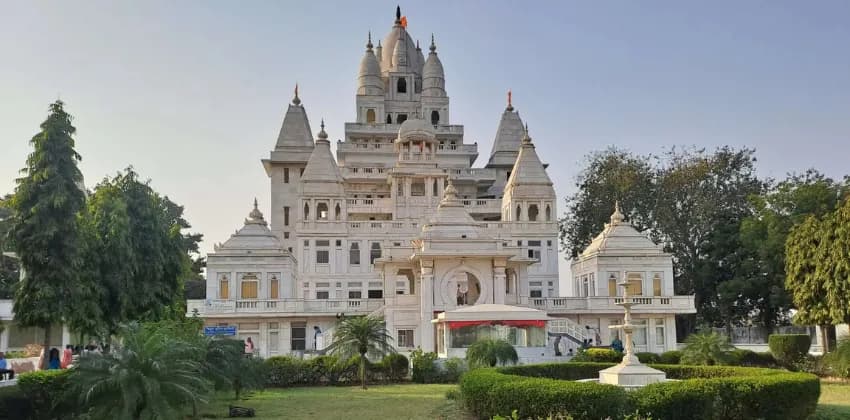
Arriving in Vrindavan from the Mathura side, you cannot miss it: a soaring white-marble temple, rising tier upon tier above the road, gleaming against the sky. This is the Pagal Baba Temple, also called Liladham - one of Vrindavan's most striking modern landmarks, standing around 221 feet over about nine storeys of carved marble, in the Nagara style.
It is a temple of a different kind from the ancient Goswami shrines of the old town. Built in the twentieth century to draw the world's eyes to Krishna's land, it is part landmark, part gallery of the Lord's leela - and, for all its scale, one of the calmer, less-crowded temples you can visit. Many find it a welcome place of quiet after the press of the famous shrines. (It belongs among Vrindavan's modern temples and attractions.)
Pagal Baba - the "mad" devotee
The temple takes its name from its founder, a saint lovingly called "Pagal Baba" - pagal meaning "mad," but here a madness of pure devotion, an ecstatic love of Krishna so complete that the world thought him mad. By the much-loved tradition, he wandered the lanes in tattered robes, hair flowing, lost in chanting and dancing before his Lord - and the people, watching, named him the Mad Saint.
An honest word on his name: it is given variously in the accounts - most often as Srimad Leelanand Thakur (Lilanand Thakur), but elsewhere as Sheela Nand Ji Maharaj (said to have been a judge of the Calcutta High Court who renounced his post) and in some tellings by other names. A born-Brajwasi gives you this plainly rather than pretending to a single certain version. What all agree on is the heart of him: a man who gave up everything for love of Krishna.
The story behind the temple
Behind the temple is one of Vrindavan's most beloved oral tales. There was a poor Brahmin, a devotee of Banke Bihari, who borrowed money from a moneylender and repaid it faithfully, installment by installment. But the moneylender, falsely, took him to court, claiming the whole sum was still owed. Standing before the judge with no proof, the Brahmin declared simply: "Lord Banke Bihari himself is my witness."
And - the story tells - a mysterious stranger appeared in the court, gave testimony and proved the Brahmin innocent, then vanished. The judge, shaken to his soul by what he had witnessed, renounced his position, left his home and wandered to Vrindavan in search of that Thakur - Banke Bihari, who had come in person for his devotee. He became Pagal Baba and with his devotees built this temple to the Lord who keeps faith with those who trust him. (Told as oral tradition; the versions vary, but the heart of it is dear to Braj.)
Nine storeys of dhams
The temple's design is itself a pilgrimage: each floor is a different "dham," a shrine to a different form of the Lord, so that climbing the tower is like walking through the whole sweep of devotion. The arrangement is given a little differently by different accounts, but broadly you ascend through:
a ground floor of Shiva, Durga and Kali with Bhairav, Pagal Baba's own samadhi-dham and the ever-burning Akhand Jyoti;
floors of Radha-Krishna and Ganesh, Krishna-Balaram, Nand-Yashoda with the baby Krishna, the Ram Darbar, the Vaman avatar, Lakshmi-Narayan;
and at the top, an "Om" dham and a panoramic view over all of Vrindavan.
An honest note: the number of storeys is given variously - most often nine, but some accounts say seven, ten or eleven. It is said to have been the first temple of its kind on such a scale; whatever the exact count, the climb through its dhams, ending in that wide view, is the experience pilgrims remember.
The famous puppet show
For families - and for the child in everyone - the temple's best-loved feature is on the lower floors: the animated puppet show and electronic jhankis, where scenes from the Ramayana, the Mahabharata and the leelas of Krishna (and of Pagal Baba himself) are enacted by moving figures. Children especially are enchanted and it has made the temple a favourite stop on family pilgrimages.
There is, too, a circular window on the first floor shaped like Vishnu's Sudarshan chakra, gardens with a fountain and pond and - in the spirit of its founder's selfless service - a free khichdi meal offered to visitors and the poor.
What you'll see today
Today the temple is calm, clean and well-kept, watched over by a managing committee and notably less crowded than the famous shrines - which is much of its charm. Pilgrims come from across India and especially, by long affection, from Assam, Bengal and Odisha. Many come believing it a manokamana temple, where a sincere prayer is answered; devotees leave their wishes written on the walls. (A Brajwasi shares this gently, as the faith of those who come, without making promises - come for darshan and the peace of the place and let your heart do the rest.)
Pagal Baba also built Leela Kunj, near Gopeshwar Mahadev in the old Bhutgali quarter - a quieter second site of his devotion.
An honest note
A born-Brajwasi keeps it straight:
The founder's name is given variously (Leelanand Thakur most often; also Sheela Nand and others) - I name them rather than fix one as certain.
The number of storeys is reported differently (nine most commonly; sometimes seven, ten or eleven).
The origin story is cherished oral tradition, told in varying versions - revere it as the beautiful tale it is.
The temple is a modern landmark (built 1969; deities installed around 1981; Pagal Baba's mahasamadhi in 1980), not an ancient leela-site - wonderful to visit, but a different thing from the Goswami temples.
Timings and any entry fee vary - verify them locally and on our timings page before you go; cameras are often restricted inside.
Author's tips from Gurudutt - what only a local knows
Climb to the top - the floor-by-floor dhams and the panoramic view over Vrindavan are the whole point; don't stop at the ground floor.
Bring the children to the puppet show - the animated Ramayana and Mahabharata jhankis are a delight.
Come for the calm - it's far quieter than Banke Bihari or ISKCON; a lovely place to slow down.
Leave the camera - photography is often not allowed inside; check at the gate.
It's a modern temple - visit it as the beautiful landmark it is, not expecting an ancient shrine; pair it with Prem Mandir for the two great modern temples.
People smile at the name - "Pagal Baba," the mad saint. But let me tell you, in Braj we do not think madness for Krishna is a small thing. A judge who saw the Lord come to a courtroom for a poor Brahmin and gave up his robes and his home to wander our lanes searching for that Thakur - is he mad or is he the only sane one among us? This white tower he raised is not old like our Goswami temples and I tell my pilgrims so honestly. But climb it floor by floor, watch the children laugh at the puppet-leelas, stand at the top and see all of Vrindavan spread below - and you will feel the love that built it. That love was real, whatever name the books give the man. - Gurudutt