The great Devi seat of Braj
Braj is Krishna's land - but it has a Goddess at its heart and her great seat is the Katyayani Shakti Peeth in Vrindavan, also known as the Uma Shakti Peeth. Among the 51 Shakti Peeths that ring the subcontinent, this is Braj's own - the place where, in the tradition, the ringlets of Sati's hair fell to earth.
It is a temple where two great streams of devotion meet: the worship of the Mother Goddess in her fierce, protecting form and the Krishna-bhakti of Braj - for it was here, the Bhagavata tells, that the gopis worshipped Katyayani to win Krishna himself. For the pilgrim who would honour both the Devi and the Lord, this white-marble shrine on Bhuteshwar road is essential. Radhe Radhe.
What is a Shakti Peeth?
The Shakti Peeths come from one of the great myths of Shiva and Shakti. When Daksha held a grand yajna and pointedly did not invite his son-in-law Shiva, his daughter Sati, unable to bear the insult to her lord, gave up her body in the sacrificial fire. Shiva, mad with grief, took up her lifeless form and danced the tandava of destruction that threatened all creation.
To end it, Vishnu sent his Sudarshan Chakra, which cut Sati's body into pieces; wherever a part of her fell, that spot became a Shakti Peeth - a seat of the Goddess's power. Tradition counts 51 such seats (some say 108, of which 51 are known). At each, the Goddess is present in a named form, with Shiva as her guardian Bhairava. And the Braj Shakti Peeth - where her hair fell - is this one, the Katyayani / Uma Peeth in Vrindavan.
Why Uma, why Bhotesh
At this Peeth, the fallen relic is the hair (the ringlets) of Sati and so the Goddess is enshrined here as Uma (a name of Sati/Parvati) and worshipped above all in her fierce form as Katyayani. Her guardian Bhairava here is Bhotesh - and a born-Brajwasi will tell you at once that Bhotesh is none other than Bhuteshwar Mahadev, the great guardian Shiva of the dham. So the Devi's seat and the Shiva of Braj are bound together: Uma and Bhuteshwar, the Goddess and her Lord, guarding Krishna's land.
This is the well-attested Braj Shakti Peeth. (You may hear other Braj Devi shrines, like Chamunda Devi, also called Shakti Peeths in local tellings; a good Brajwasi notes that traditions vary, while honouring Katyayani / Uma as the principal one.)
The gopis' Katyayani Vrat - the Krishna connection
Here is the story that makes this temple uniquely beloved in Braj. In the Bhagavata Purana, the young gopis of Vrindavan, longing for Krishna as their husband, undertook the Katyayani Vrat - a month-long vow in the cold of early winter, rising before dawn to bathe in the Yamuna and worship an image of Goddess Katyayani they fashioned, praying with all their hearts: "O Katyayani, grant that the son of Nanda may become our husband."
The Goddess heard them and by her grace they were blessed with the Maharasa - the great circle-dance - with Krishna himself. (It was during this vrat that the famous cheer-haran leela took place at Chir Ghat, where Krishna taught the gopis a lesson in humility before the Goddess.) So Katyayani is, in Braj, the Goddess who unites the soul with Krishna - and her Peeth the place where that union was sought and granted.
The Katyayani Vrat today
Because the gopis won Krishna through Katyayani, the Katyayani Vrat lives on - and to this day, unmarried girls come to this Peeth to pray to the Goddess for a good husband and a happy marriage. It is one of the temple's most tender and popular traditions, especially observed in the month of Margashirsha and during Navratri.
Let me say this warmly and honestly, as a guide who cares: come to the Goddess with faith and an open heart and let the vrat be an offering of devotion and hope - not a transaction or a source of anxiety. The Mother blesses the sincere; she is not a vending machine and a true vrat brings peace and trust, whatever the outcome. Pray and leave the rest to her grace.
The temple & its deities
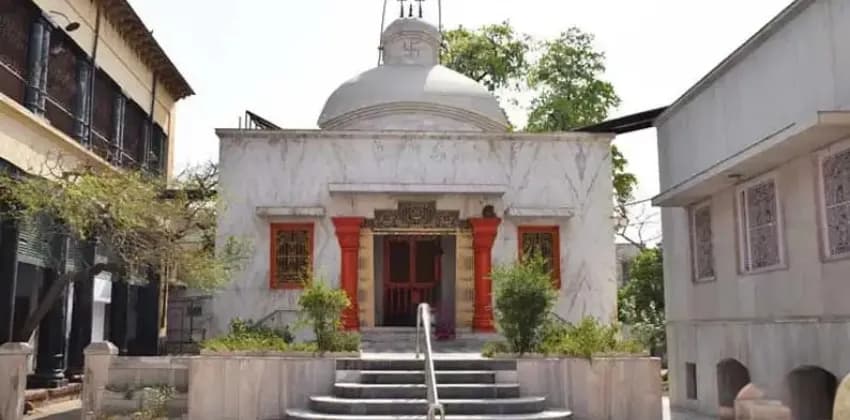
The present temple is a graceful white-marble building with black-stone pillars and, at its entrance, golden lion statues - the lion being Durga's vahana (mount). Within, the Goddess Katyayani is the principal deity; some accounts describe an ashtadhatu (eight-metal) idol brought from Bengal, others a black-stone image. The Devi's sword, Uchawal Chandrahaas, is also worshipped and an eternal flame (jyoti) burns.
A distinctive feature: the temple honours the five great sampradayas (sects) together -
Katyayani (Shakta - the Goddess)
Shiva / Bhotesh (Shaiva)
Lakshmi-Narayan (Vaishnava)
Ganesh (Ganapatya)
Surya (Saura)
- so that a worshipper of any tradition finds their deity here. The temple also keeps a gaushala (cowshed) and a Vedic school.
Katyayani as Yogamaya
There is a deeper Krishna-link still. In one tradition, Katyayani is Yogamaya - Vishnu's own divine power - who, in the Krishna birth-story, was born as the daughter of Nanda and Yashoda on the very night Krishna was born. When Kamsa seized that infant girl to dash her down, she slipped from his hands, rose into the sky as the eight-armed Goddess and warned him that his slayer was already born - then took her seats across the land as Durga, Vindhyavasini and Katyayani.
So Katyayani is woven into the very night of Krishna's birth - the Goddess who shielded him and foretold the tyrant's end. To honour her at this Peeth is to honour the divine feminine power that guarded the child Krishna.
An honest note - ancient seat, modern shrine
A born-Brajwasi owes you an honest distinction. The Shakti Peeth itself - the seat, the sthan - is ancient, named in the Puranas and revered across the ages; the great saint Chaitanya Mahaprabhu is credited with reviving its remembrance. But the present temple building is modern - constructed around 1923 (some sources say 1929) by Yogiraj Swami Keshvanand Brahmachari, who, by tradition, located and re-established the Peethsthan. So when you stand here, know that the holiness is ancient even though the marble is a century old. A guide who tells you the building is "thousands of years old" has misled you; the seat is timeless, the shrine is of our own era. Both truths stand together.
How to visit
A few honest pointers:
Location - Bhaktivedanta Swami Marg, Goda Vihar / Radha Bagh, near the Bhuteshwar road and Bhuteshwar Mahadev temple; about 1 km from the Vrindavan stand and station.
Timings - verify on the temple timings guide and locally; it keeps morning and evening darshan windows.
Photography - not allowed inside; respect this and ask before photographing.
Dress modestly - shoulders and knees covered; footwear removed.
Navratri is intense - expect great crowds and queues during the nine nights; come early and mind the elderly and children in the crush.
Festivals - Navratri above all
Festival | What's special | When (verify the year) |
Navratri (Chaitra & Ashvin) | The Goddess's supreme festival Durga Saptashati / Chandi Path, Shatchandi pujas | Spring & autumn |
Katyayani Vrat | Girls pray for a good husband; the gopis' vow | Margashirsha & Navratri |
Dussehra | The victory of the Goddess | Ashvin Shukla Dashami |
Krishna Janmashtami | Katyayani's link to Krishna's birth | Bhadrapada Krishna Ashtami |
Basant Panchami, Holi, Diwali | Kept with devotion | Tithi-based |
Festival dates are tithi-based and move yearly, so verify the current year's dates. Navratri is the great time to come - at the height of the Goddess's worship.
Temples to combine nearby
The Peeth pairs naturally with Vrindavan's nearby sites:
Bhuteshwar Mahadev - Bhotesh, the Peeth's own Bhairava
Banke Bihari - Vrindavan's most beloved Krishna
Chir Ghat & the Yamuna leela-sites - the cheer-haran of the Katyayani-Vrat gopis
Mathura's Guardian Mahadevs & Devis - the wider Shiva-and-Devi guardians of the dham
Browse all at the Famous Temples of Mathura Vrindavan hub.
Author's tips from Gurudutt - what only a local knows
Know it is Braj's Shakti Peeth - the one of the 51 where Sati's hair fell; the Devi seat of Krishna's land.
Bhotesh is Bhuteshwar - pair the Peeth with the Bhuteshwar Mahadev temple, its own Bhairava.
The gopis' Katyayani Vrat is the heart of it - this is where the gopis prayed for Krishna; tell the girls who pray here that story.
Come at Navratri for the fervour, an ordinary morning for the calm - the nine nights are intense and crowded.
The seat is ancient, the marble is modern - honour the timeless Peeth and don't be fooled into thinking the building is old.
People come to Vrindavan thinking only of Krishna and forget that Braj has a Mother too. Her seat is here, where Sati's hair fell - and here is the secret that binds her to the Lord: the gopis themselves prayed to Katyayani to win Krishna as their husband. So when a young girl bows here for a good marriage, she stands exactly where the gopis stood, asking the Mother for the same boon. That is not a small temple. That is the Goddess who gives you Krishna. - Gurudutt