The fierce Mother on the Vrindavan road
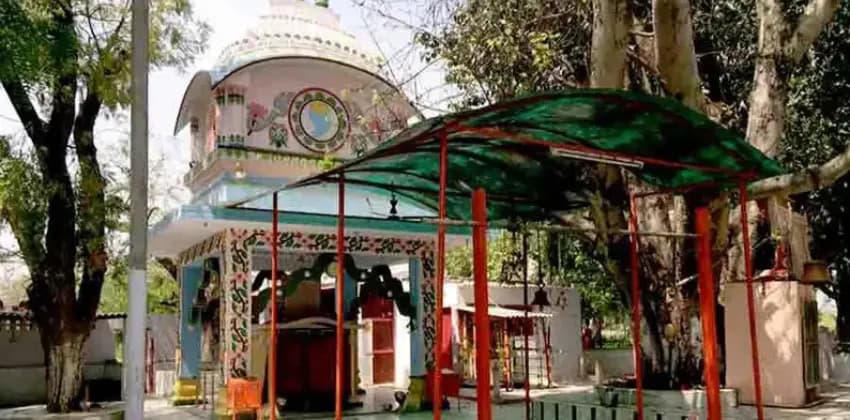
Braj is a land of tender love - but it also has its fierce, protecting Mother and one of her seats stands on the Mathura-Vrindavan road: the Chamunda Devi Temple. Here the Goddess is worshipped as Chamunda, the terrible, demon-slaying form of Durga - the warrior-mother who guards her children from every harm.
Two things make this shrine distinctive. First, the Goddess is worshipped not through a carved idol but through a sacred yantra - a geometric form embodying her power. And second, she is held to be the kuldevi, the clan-goddess, of Nand Baba himself - Krishna's own foster-father. For the devotee who would seek the Mother's protection in the very land of Krishna, it is a powerful and intimate place. Radhe Radhe.
Who is Chamunda?
Chamunda is one of the fiercest forms of the Goddess - a terrible aspect of Durga (and akin to Kali), born to destroy demons. Her very name records her greatest deed: in the Devi tradition, she slew the demon-generals Chanda and Munda (sent by the demons Shumbha and Nishumbha) and from their names she became Cha-munda.
She is counted among the Matrikas (the mother-goddesses), often depicted gaunt and fearsome, garlanded with skulls, haunting battlefields and cremation grounds - the Goddess in her most uncompromising, protective fury. Yet for her devotees, this fierceness is maternal: she is terrible only to evil and a shield to those who take refuge in her. To worship Chamunda is to seek the protection of the Mother who fears nothing.
Worship without an idol - the yantra
The most striking feature of this temple is that there is no physical idol of the Goddess. Instead, Chamunda is worshipped here through a sacred yantra - a geometric diagram that, in the tantric and Devi traditions, is understood to embody the deity's power and presence as fully as any image.
This is rare and meaningful. A yantra is the Goddess in her abstract, energetic form - pure power rather than depicted shape - and worshipping her thus is considered, in some traditions, especially potent. For the pilgrim used to murti-darshan, it is an unusual and thought-provoking shrine: here you bow not before a face, but before the living geometry of the Mother's force.
The kuldevi of Nand Baba - the Krishna link
Here is the connection that binds this fierce Goddess to the gentle world of Krishna. Tradition holds that Chamunda is the kuldevi - the clan-goddess - of Nand Baba, the cowherd-chief who was Krishna's foster-father. Every traditional family has its kuldevi, worshipped at life's great moments; and Nand's was Chamunda.
So it is said that after Krishna's mundan (the mundan sanskar, the ceremonial first head-shaving of a child), Nand Baba came to worship here, presenting the child to the family's protecting Goddess as custom required. This makes Chamunda, in a beautiful sense, the guardian-goddess of Krishna's own foster-family - the fierce Mother who watched over the household of Nand and Yashoda. To this day, families bring their children's mundan and life-rites to such kuldevi shrines, following the very custom Nand Baba kept.
Is it a Shakti Peeth? An honest word
You may hear the Chamunda Devi Temple described as "one of the 51 Shakti Peeths." Let me be honest and careful here, as a Brajwasi should be. Some local tellings do give it that status (by one account, where a strand of the Goddess's hair fell). But the well-attested principal Shakti Peeth of Braj is the Katyayani / Uma Shakti Peeth in Vrindavan - the seat of the 51 where Sati's hair fell, with Bhotesh (Bhuteshwar) as its Bhairava.
So the honest position is this: traditions vary. Chamunda Devi is a revered and powerful Goddess shrine, called a Shakti Peeth in some local accounts; but a good Brajwasi honours Katyayani / Uma as the principal Braj Shakti Peeth and presents Chamunda's designation as the local tradition it is, without adjudicating between them. Revere both; confuse neither.
What devotees seek
Because Chamunda is the fierce, demon-slaying Mother, devotees come to her for protection, strength, courage and fearlessness. They pray for the removal of enemies and obstacles, for shielding from harm and negativity and for the inner fortitude to face life's battles - drawing on the Goddess who fears nothing and guards her children fiercely.
There is comfort in her fierceness: the same terrible power that destroys demons is, for the devotee who takes refuge, a mother's protecting arms. Come to Chamunda not in fear but in trust and ask the warrior-mother to stand between you and all that would harm you.
How to visit
A few honest pointers:
Location - on the Mathura-Vrindavan road, opposite Maa Gayatri Tapobhumi, on the Chhatikara/Vrindavan side; easily reached between the two cities.
Getting there - by cab, auto or e-rickshaw; combine it with the Chhatikara-side temples (ISKCON, the modern temples).
Timings - verify on the temple timings guide and locally; it keeps morning and evening windows, extended in Navratri.
Yantra darshan - remember there is no idol; you take darshan of the sacred yantra, so approach with the right understanding.
Dress modestly and remove footwear before the sanctum.
Festivals - Navratri above all
Festival | What's special | When (verify the year) |
Navratri (Chaitra & Ashvin) | The Goddess's supreme festival - Durga puja, Chandi Path | Spring & autumn |
Dussehra | The victory of the Goddess over evil | Ashvin Shukla Dashami |
Krishna Janmashtami | Chamunda as Nand Baba's kuldevi | Bhadrapada Krishna Ashtami |
Mundan ceremonies | Families bring children's first-tonsure, as Nand Baba did | Year-round (auspicious days) |
Navratri is the great time at any Devi shrine and Chamunda's fierce worship reaches its height across the nine nights with Durga puja and the Chandi Path. Festival dates are tithi-based and move yearly, so verify the current year's dates.
Temples to combine nearby
The temple sits on the Mathura-Vrindavan road, easily combined with:
Katyayani / Uma Shakti Peeth - Braj's principal Shakti Peeth; the natural Devi pairing
ISKCON Krishna-Balaram Mandir & the modern temples - on the Chhatikara side
Shri Nand Mahal, Nandgaon - the home of Nand Baba, whose kuldevi she is
Mathura's Guardian Mahadevs & Devis - the dham's wider Devi and Shiva guardians
Browse all at the Famous Temples of Mathura Vrindavan hub.
Author's tips from Gurudutt - what only a local knows
There's no idol - bow to the yantra - come understanding that the Goddess is worshipped here in her yantra-form, her abstract power.
Know the Nand Baba link - this is the kuldevi of Krishna's own foster-family; that is its tender Braj heart.
Don't confuse it with the Katyayani Shakti Peeth - Katyayani/Uma is Braj's principal Peeth; Chamunda's Shakti-Peeth status is local tradition.
Come at Navratri for the power - the fierce Mother's worship blazes across the nine nights.
Seek protection, not in fear but in trust - her fierceness is a mother's shield for those who take refuge.
People are frightened of Chamunda - the skulls, the fierce face. But understand her rightly: she is terrible only to the demons. To you, her child, she is the mother who will tear apart anything that comes to harm you. And here is the sweet secret of this place - she is Nand Baba's own clan-goddess. When little Krishna's head was shaved, his father brought him here, to this fierce Mother, to be blessed and protected. If she guarded Krishna's household, will she not guard yours? Bow to her and walk out unafraid. - Gurudutt