Travel Guide · Stories & Experiences · Updated June 2026
Govardhan Hill: Significance, Story & Pilgrimage Guide
By Gurudutt, Experience My India·9 June 2026
Quick Answer
Quick Enquiry
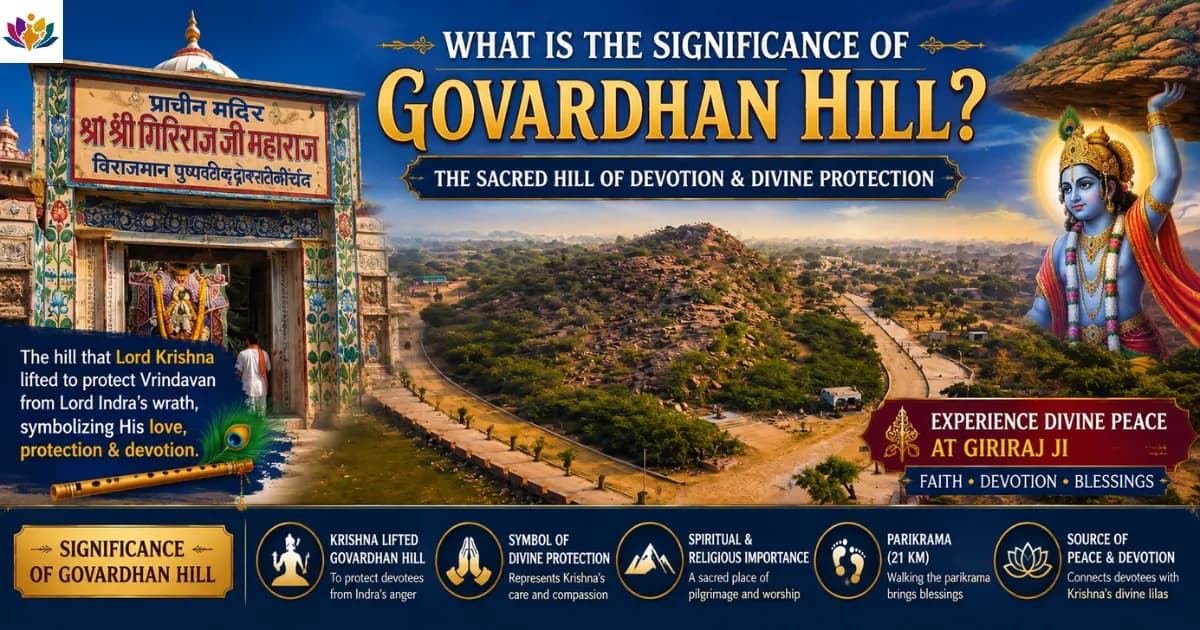
Govardhan Hill sits at the spiritual centre of Braj - and most pilgrims who visit Mathura and Vrindavan never reach it. The hill is 25 km from Mathura city, often treated as a secondary add-on to temple tours and yet within the Vaishnav tradition it is described in the Bhagavata Purana as the most sacred site in all of creation - surpassing even Vrindavan. Its significance is not architectural. It has no towering temple, no grand gateway. It is a hill - and that is precisely the point.
I am Gurudutt, born and raised in Braj Bhoomi and the founder of Experience My India. Since 2018, I have guided 50,000+ pilgrims through the Govardhan Parikrama, Radha Kund, Kusum Sarovar and the festival of Govardhan Puja. Every theological, historical and practical detail in this guide comes from that direct on-ground experience.
By the end of this guide you will understand the spiritual significance of Govardhan Hill in Hindu and Vaishnav theology, the complete story of Krishna lifting the hill, why the 21 km Govardhan Parikrama is performed, which sacred sites sit along the parikrama route and how to plan a Govardhan visit that does full justice to what this place actually is.
Book Mathura Vrindavan Tour Packages Now
Govardhan Hill - The Crown Jewel of Braj
Govardhan Hill - also called Govardhan Parvat or Giriraj - is a sandstone hillock located in Govardhan town, approximately 25 km from Mathura and 22 km from Vrindavan in Uttar Pradesh. It stretches approximately 8 km in length and rises to a maximum height of roughly 25 metres at its highest point - visually modest, spiritually immense.
In the Braj Mandal - the 84-kos sacred territory associated with Lord Krishna's life - Govardhan Hill holds the position of highest sanctity. The Vaishnav scriptures, particularly the Bhagavata Purana (10th Skandha) and the Garga Samhita, describe Govardhan as not simply a hill but as the greatest devotee of Krishna himself - a living personality who longs for Krishna's presence.
Govardhan is also known as Giriraj ("King of Mountains") - a title that reflects the Braj tradition of venerating the hill itself, not merely what occurred there. Pilgrims touch the stone of Govardhan, perform parikrama (circumambulation) and make offerings directly to the hill. Experience My India guides every pilgrim through the spiritual context of each act before they arrive. View our Govardhan Parikrama Package →
The Story of Krishna Lifting Govardhan Hill
The story of Krishna lifting Govardhan Hill is narrated in the Bhagavata Purana, Canto 10 and is one of the most celebrated episodes in the entire Krishna canon. It forms the scriptural foundation for the annual Govardhan Puja festival celebrated the day after Diwali across India.
The background: In Braj, the annual tradition was to perform a grand sacrifice (yajna) to Lord Indra, the god of rain, to secure his favour and ensure the rains fell reliably on the land. The young Krishna challenged this tradition by telling the residents of Braj - the Vrajavasis - that Govardhan Hill, not Indra, deserved their worship. The hill provided grass for their cows, forests for their shelter and clean water from its streams. It was the hill, Krishna argued, that truly sustained them.
Indra's response: Enraged at the withdrawal of tribute, Indra sent Samvartaka - the clouds of cosmic dissolution - to flood the Braj region. For seven days and seven nights, torrential rains and hailstorms fell on Govardhan. The rivers overflowed, the crops were submerged and the residents of Braj - men, women, cattle and all - faced destruction.
The lifting: The young Krishna, said to be seven years old at the time in some traditions, placed one finger under Govardhan Hill and lifted the entire mountain overhead as an umbrella. For seven days and nights, the people of Braj sheltered under the hill while Krishna held it aloft on his little finger. Indra, recognising Krishna's divine nature, withdrew the rains and descended to offer apologies. Krishna lowered the hill back to its place.
The title: For this act of protection, Krishna received the title Giridhari - "he who holds the mountain" - one of the most beloved names of Krishna in Braj devotion.
Book Same day Govardhan Barsana Tour Package
Why Govardhan Hill is Considered Sacred - Theological Significance
The significance of Govardhan Hill operates on several levels simultaneously - mythological, theological and experiential.
1. Govardhan as a devotee of Krishna: In Vaishnav theology, Govardhan is not simply a place where Krishna acted - it is an entity that participates in Krishna's lila. The Garga Samhita describes Govardhan as the most exalted of all sacred mountains because it serves Krishna directly - providing shade, food and shelter for the Vrajavasis, cows and birds who are all part of Krishna's own circle. This is why Vaishnav pilgrims touch Govardhan's stones reverently - they are touching a devotee, not merely a rock.
2. Above Vrindavan in spiritual hierarchy: The Padma Purana contains a passage where Radha herself tells a devotee that Govardhan is even more sacred than Vrindavan - because it is the place where Krishna revealed his divine protection of his devotees most directly. This theological position is unique to the Braj tradition and is one reason why serious Vaishnav pilgrims treat Govardhan as the culminating sacred stop of the Braj circuit.
3. Govardhan Puja: The Govardhan Puja festival - celebrated the day after Diwali as Annakut - re-enacts the original worship that Krishna instituted. Devotees offer 56 varieties of food (Chhappan Bhog) to the hill and to Krishna's deity form. The number 56 is derived from the 8 meals per day over 7 days that Krishna skipped while holding up the mountain - devotees offer all 56 meals at once.
4. The 84 kos of Braj: Govardhan sits within the sacred 84-kos Braj Mandal circuit - the total pilgrimage territory associated with Krishna's earthly life. Within this circuit, Govardhan occupies a place of singular importance because it is explicitly described as Giriraj in multiple Puranic texts.
The Govardhan Parikrama - What It Is and Why Pilgrims Perform It
The Govardhan Parikrama is the ritual circumambulation of Govardhan Hill - walking the complete circuit around its base as an act of devotion. It is the primary pilgrimage act performed at Govardhan and is practised by millions of devotees annually.
Detail | Information |
Total parikrama distance | ~21 km (some traditions say 21 km, others 25 km depending on the full outer circuit) |
Walking time | 5 to 7 hours at a devotional pace |
Pradakshina direction | Clockwise (keeping the hill to your right) |
Starting point | Jatipura or Govardhan town - both are common starting points |
Best day | Ekadashi - 11th lunar day - largest gathering of devotees |
E-rickshaw circuit (for elderly) | Full circuit available at ₹200–₹400 per vehicle |
Entry fee | No entry fee for the parikrama route |
Parikrama on Govardhan Puja | Largest single-day parikrama of the year |
Why pilgrims perform the parikrama: The Bhagavata Purana and the Garga Samhita both describe parikrama of Govardhan as equivalent to the merit of performing all pilgrimage to all sacred sites in Braj simultaneously. The parikrama is performed barefoot by many pilgrims as a sign of respect - the earth of Govardhan is considered sacred ground throughout the circuit.
Dandavat parikrama: Some highly devoted pilgrims perform the parikrama by prostrating themselves on the ground at every step - rising, taking one step, then prostrating again for the full 21 km. This form of parikrama can take several days.
Experience My India plans partial parikramas for elderly pilgrims - covering all key sacred stops by cab with short walks at each site. Nobody misses Govardhan on our tours.
For More details read - Govardhan Hill: History, Parikrama Timings, Distance, Route, Location and Complete Guide
Key Sacred Sites on the Govardhan Parikrama Route
The parikrama route passes through multiple sacred sites, each connected to specific events in the Braj literature. These are not simply stops on a walk - each carries its own theological significance and is worth spending 20 to 45 minutes at.
Sacred Site | Location on Route | Significance | Time Needed |
Mukharvind Temple (Jatipura) | Start/End point | Main deity temple - the "mouth" of Govardhan | 30–45 min |
Radha Kund | ~8 km from start | Most sacred lake in Braj - Radha bathed here after Krishna killed Arishtasura | 30–45 min |
Shyam Kund | Adjacent to Radha Kund | Krishna's sacred lake - directly opposite Radha Kund | 20–30 min |
Kusum Sarovar | ~10 km | Step-well and lake where Radha gathered flowers - 18th-century Bharatpur architecture | 20–30 min |
Manasi Ganga | Govardhan town | Sacred lake - believed to be created by Krishna's mind (manasa) | 20–30 min |
Dan Ghati | Midpoint | Where Krishna collected "tax" (dan) from Radha and her companions | 15–20 min |
Govind Kund | On route | Lake associated with the Govardhan Puja episode itself | 15–20 min |
Punchari ka Lota | Southern circuit | Ancient deity - one of the most important temples on the route | 15–20 min |
Radha Kund and Shyam Kund deserve special mention. The Bhagavata Purana places Radha Kund's spiritual importance at the very highest level - Chaitanya Mahaprabhu, the 16th-century Vaishnav saint, is said to have discovered this sacred lake and spent considerable time there. Bathing in Radha Kund on Ekadashi or on Radhashtami is considered an act of extraordinary spiritual merit in the Gaudiya Vaishnav tradition.
Experience My India includes Radha Kund and Kusum Sarovar in all Govardhan tour packages. WhatsApp +91-7302265809.
Govardhan Puja 2026 - Festival, Chhappan Bhog & Dates
Govardhan Puja is celebrated the day after Diwali - known as Annakut - and is the festival that re-enacts Krishna's original instruction to worship the hill. It is one of the most visually elaborate and devotionally intense festivals in all of Braj.
Event | 2026 Date | What Happens |
Diwali 2026 | October 20, 2026 | Night before Govardhan Puja |
Govardhan Puja / Annakut 2026 | October 21, 2026 | Chhappan Bhog offered at all major Govardhan temples; Govardhan Puja performed at all temples; largest parikrama gathering of the year |
Ekadashi (month of Kartik) | October–November 2026 | Heavy parikrama pilgrim gathering; multiple Kartik Ekadashis see special programmes |
Govardhan Parikrama (regular days) | Daily, year-round | Standard devotional parikrama; Ekadashi days busiest |
The Chhappan Bhog (56 varieties of food): On Annakut, temples at Govardhan prepare and display 56 varieties of food offered to the deity and to the hill. The number 56 represents the 8 meals per day that Krishna skipped across the 7 days he held the mountain - devotees offer all these meals simultaneously as a gesture of making up the fast.
At the Mukharvind Temple in Jatipura and at the Govardhan Hill itself, the Chhappan Bhog display on Annakut is a genuinely spectacular act of devotion - rows of sweets, savouries, fruits and cooked dishes arranged before the deity from dawn until the evening aarti.
Festival crowd reality: Govardhan Puja and the days around Diwali bring the largest crowds of the year to the parikrama route - lakhs of pilgrims converge on the 21 km circuit. Experience My India advises all clients to arrive a day early (October 20) and stay overnight in Govardhan town for Govardhan Puja. Festival packages fill by September. WhatsApp +91-7302265809 to check availability. View Govardhan Puja Tour →
Govardhan Hill - Practical Visitor Guide 2026
Detail | Information |
Location | Govardhan town, 25 km from Mathura, 22 km from Vrindavan |
Distance from Delhi | ~185 km via Yamuna Expressway - 3.5 to 4.5 hours |
Distance from Mathura | 25 km - 40 to 50 minutes by cab |
Distance from Vrindavan | 22 km - 35 to 45 minutes by cab |
Entry to parikrama route | Free - no tickets required |
Best visiting time | October to March (weather, Govardhan Puja, Kartik month) |
Parikrama on foot | 5 to 7 hours - start at sunrise for cooler temperatures |
Parikrama by e-rickshaw | ₹200–₹400 full circuit - available at Jatipura and Govardhan town |
Nearby accommodation | Govardhan town, Mathura city (25 km), Vrindavan (22 km) |
For senior citizens and differently-abled pilgrims: Experience My India plans the Govardhan parikrama as a cab-and-walk combination for elderly groups - the cab follows the route and parks at each major sacred site while the pilgrims walk 100 to 300 metres to the site entrance. Nobody who comes with us misses the Govardhan parikrama due to mobility limitations. WhatsApp +91-7302265809 with specific requirements before booking.
What to carry:
Comfortable non-slip footwear - the parikrama path is largely unpaved with sections of stone
Water - kiosks are available along the route but gaps exist on some sections
Small cash only - no large bags on the parikrama path
Dress modestly - traditional clothing recommended throughout
Ground Truth - What Nobody Tells You About Govardhan Hill
The hill is shrinking - and this is documented. Environmental degradation, illegal quarrying over the 19th and 20th centuries and weathering have significantly reduced Govardhan's height. The hill that appears in 18th-century documentation was noticeably taller. Today's 25-metre maximum height is substantially less than historical records suggest. The Supreme Court of India has issued orders protecting Govardhan from further quarrying - a sign of how serious the concern is.
The full 21 km parikrama cannot be done comfortably in afternoon summer heat. Most pilgrims who plan an afternoon departure from Mathura or Vrindavan and arrive at Govardhan at 2:00 PM to begin the parikrama find themselves walking in 40°C heat by 4:00 PM on the exposed sections. Experience My India always starts Govardhan parikramas at sunrise (5:30–6:00 AM) or plans the parikrama during October to March.
Radha Kund's Kartik bath is one of the most significant religious events in the Braj calendar - and almost unknown outside it. On the night of Kartik Ashtami (Radhashtami in some traditions), thousands of pilgrims enter Radha Kund at midnight for a holy bath - considered an act of extraordinary spiritual merit available once a year. Most Mathura/Vrindavan tours miss this entirely. Experience My India plans it as a specific optional addition in October–November packages.
There is no single "Govardhan Temple" at the hill. Several guides and websites describe visiting "Govardhan Temple" as though it is a single structure like Banke Bihari. In reality, Govardhan has multiple temples distributed along the parikrama route - Mukharvind (Jatipura), Manasi Ganga, Govind Kund temple and others. The hill itself is the object of veneration, not any single structure.
E-rickshaw drivers frequently quote inflated rates on festival days. Standard full-circuit e-rickshaw rate at Govardhan is ₹200–₹400. On Govardhan Puja day and Kartik Ekadashi, some operators quote ₹1,000–₹2,000. Experience My India pre-arranges transport for all tour groups - no negotiation required on arrival.
CONCLUSION
Govardhan Hill is not the most visually impressive site in Braj - it is the most spiritually complete. The story of Krishna lifting the hill is not simply a miracle narrative; it is a statement about the relationship between devotion and protection, between the natural world and the divine. Every stone on the parikrama path carries that meaning.
If you want to experience Govardhan with the full scriptural context, the right sequence of sacred sites and a guide born in this land who has walked the parikrama hundreds of times - Experience My India is ready to plan it for you, book Vrindavan Mathura Tour.
💬 WhatsApp +91-7302265809 - Book Now
Jai Shri Krishna 🙏
Meet Gurudutt — Your Mathura Vrindavan Guide
Not just a tour operator — Gurudutt was born and raised in Braj Bhoomi. He has spent over a decade personally guiding pilgrims through the sacred lanes of Mathura & Vrindavan.
Founder – Experience My India
Gurudutt
Founder · Experience My India
_converted.webp&w=1920&q=75)